







Question: Help please i'm consistently getting wrong, will thumbs up. Question 1: Production budget The firm's inventory policy is to have ending inventory equal to 10%
Help please i'm consistently getting wrong, will thumbs up.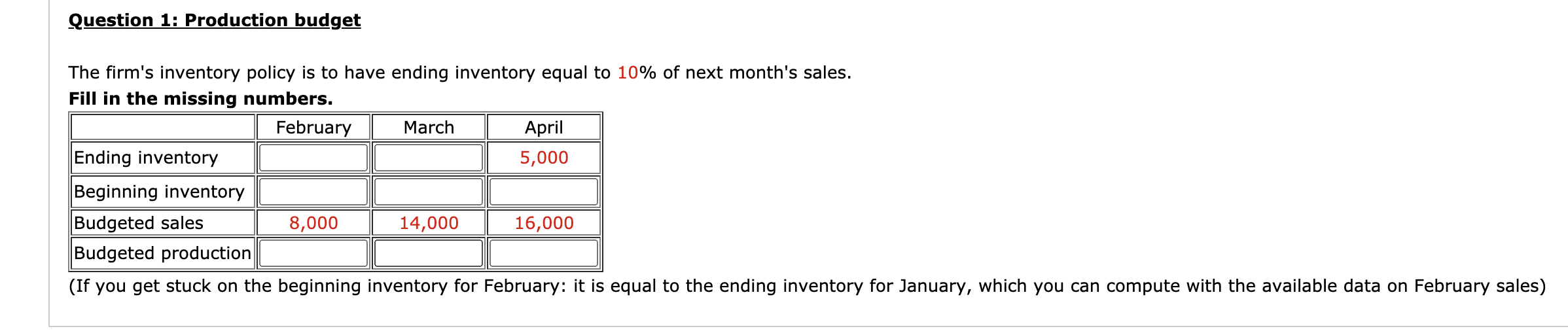
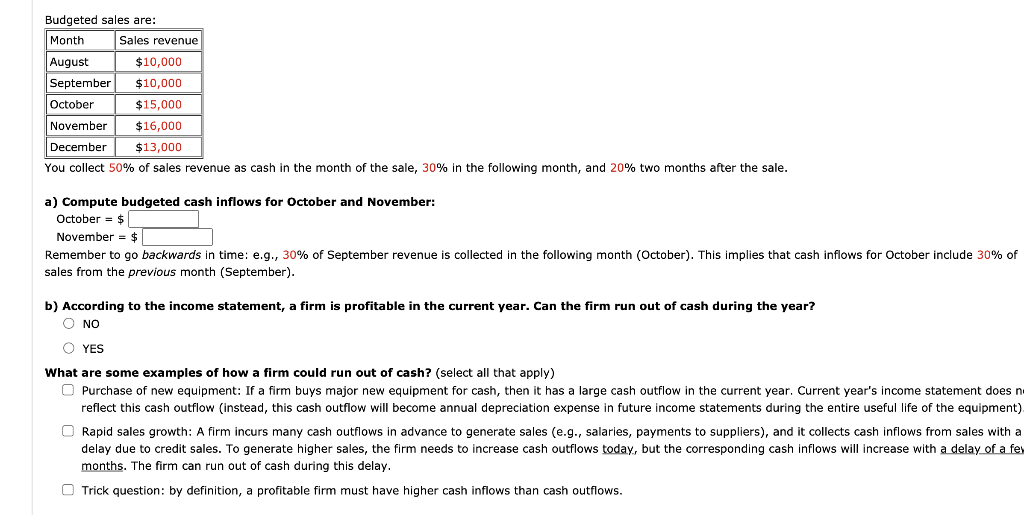
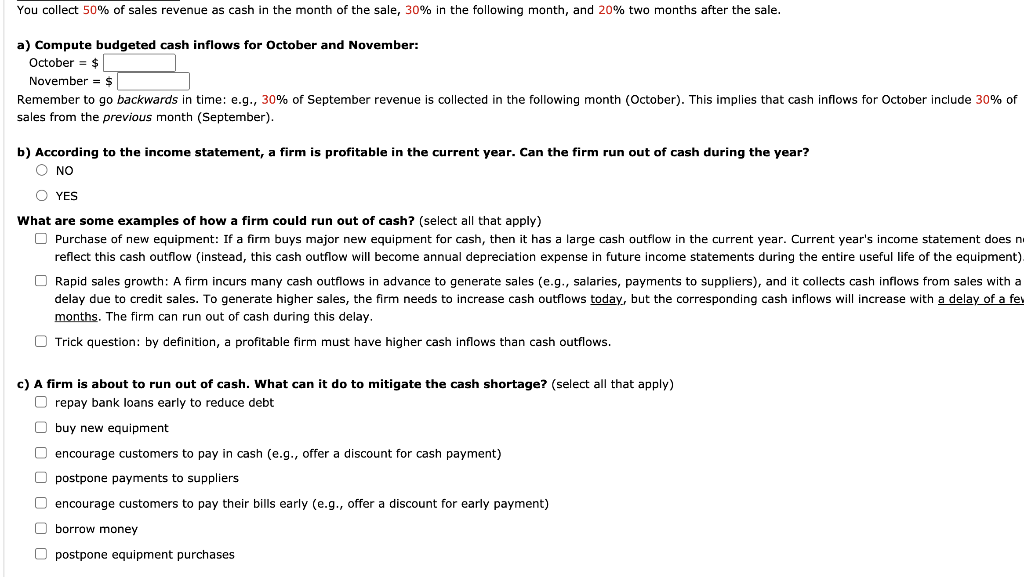
Question 1: Production budget The firm's inventory policy is to have ending inventory equal to 10% of next month's sales. Fill in the missing numbers. February March April Ending inventory 5,000 Beginning inventory Budgeted sales 8,000 14,000 16,000 Budgeted production (If you get stuck on the beginning inventory for February: it is equal to the ending inventory for January, which you can compute with the available data on February sales) Budgeted sales are: Month Sales revenue August $10,000 September $10,000 October $15,000 November $ 16,000 December $13,000 You collect 50% of sales revenue as cash in the month of the sale, 30% in the following month, and 20% two months after the sale. a) Compute budgeted cash inflows for October and November: October = $ November - $ Remember to go backwards in time: e.g., 30% of September revenue is collected in the following month (October). This implies that cash inflows for October include 30% of sales from the previous month (September). b) According to the income statement, a firm is profitable in the current year. Can the firm run out of cash during the year? O NO O YES What are some examples of how a firm could run out of cash? (select all that apply) Purchase of new equipment: If a firm buys major new equipment for cash, then it has a large cash outflow in the current year. Current year's income statement does n reflect this cash outflow instead, this cash outflow will become annual depreciation expense in future income statements during the entire useful life of the equipment) Rapid sales growth: firm incurs many cash outflows in advance to generate sales (e.g., salaries, payments to suppliers), and it collects cash inflows from sales with a delay due to credit sales. To generate higher sales, the firm needs to increase cash outflows today, but the corresponding cash inflows will increase with a delay of a fer months. The firm can run out of cash during this delay. Trick question: by definition, a profitable firm must have higher cash inflows than cash outflows. You collect 50% of sales revenue as cash in the month of the sale, 30% in the following month, and 20% two months after the sale. a) Compute budgeted cash inflows for October and November: October = $ November $ Remember to go backwards in time: e.g., 30% of September revenue is collected in the following month (October). This implies that cash inflows for October include 30% of sales from the previous month (September). b) According to the income statement, a firm is profitable in the current year. Can the firm run out of cash during the year? O NO O YES What are some examples of how a firm could run out of cash? (select all that apply) Purchase of new equipment: If a firm buys major new equipment for cash, then it has a large cash outflow in the current year. Current year's income statement does n reflect this cash outflow (instead, this cash outflow will become annual depreciation expense in future income statements during the entire useful life of the equipment) Rapid sales growth: A firm incurs many cash outflows in advance to generate sales (e.g., salaries, payments to suppliers), and it collects cash inflows from sales with a delay due to credit sales. To generate higher sales, the firm needs to increase cash outflows today, but the corresponding cash inflows will increase with a delay of a few months. The firm can run out of cash during this delay. Trick question: by definition, a profitable firm must have higher cash inflows than cash outflows. c) A firm is about to run out of cash. What can it do to mitigate the cash shortage? (select all that apply) O repay bank loans early to reduce debt O buy new equipment O encourage customers to pay in cash (e.g., offer a discount for cash payment) postpone payments to suppliers encourage customers to pay their bills early (e.g., offer a discount for early payment) borrow money postpone equipment purchases
Step by Step Solution
There are 3 Steps involved in it

Get step-by-step solutions from verified subject matter experts
 Study Help