







Question: help please in a matlabcode +00 The Fourier transform (FT) decomposes a function (often a function of the time, or a signal) into its constituent
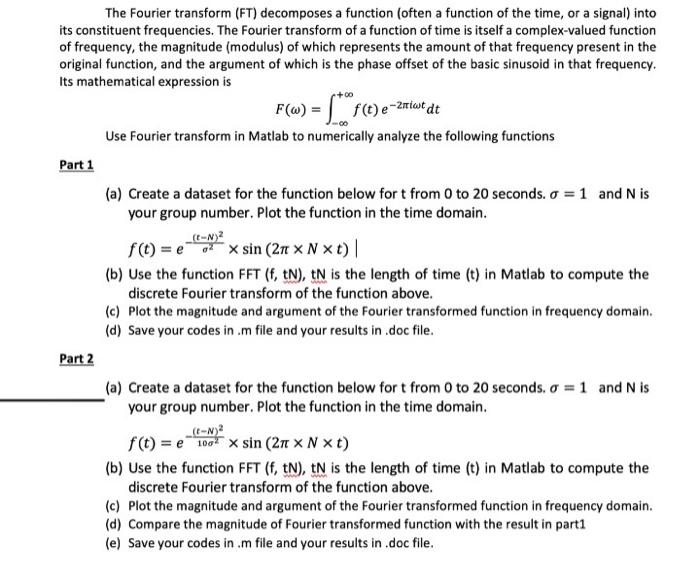
+00 The Fourier transform (FT) decomposes a function (often a function of the time, or a signal) into its constituent frequencies. The Fourier transform of a function of time is itself a complex-valued function of frequency, the magnitude (modulus) of which represents the amount of that frequency present in the original function, and the argument of which is the phase offset of the basic sinusoid in that frequency Its mathematical expression is F(w) = L760e-zatiot dt Use Fourier transform in Matlab to numerically analyze the following functions Part 1 (a) Create a dataset for the function below for t from 0 to 20 seconds. o = 1 and Nis your group number. Plot the function in the time domain. (t-N2 f(t)= ex sin (27 x Nxt) (b) Use the function FFT (f, EN), tN is the length of time (t) in Matlab to compute the discrete Fourier transform of the function above. (c) Plot the magnitude and argument of the Fourier transformed function in frequency domain. (d) Save your codes in.m file and your results in .doc file. Part 2 (a) Create a dataset for the function below for t from 0 to 20 seconds. o = 1 and Nis your group number. Plot the function in the time domain. Lt-N)* f(t) = e 107 x sin (21 x Nxt) (b) Use the function FFT (f, tn), tN is the length of time (t) in Matlab to compute the discrete Fourier transform of the function above. (c) Plot the magnitude and argument of the Fourier transformed function in frequency domain. (d) Compare the magnitude of Fourier transformed function with the result in part1 (e) Save your codes in.m file and your results in .doc file
Step by Step Solution
There are 3 Steps involved in it

Get step-by-step solutions from verified subject matter experts
 Study Help