







Question: help please Marketers fall into the Discounting Trap: And there may be no way out. Nearly every retaileras well as businesses such as hotels, rental
help please 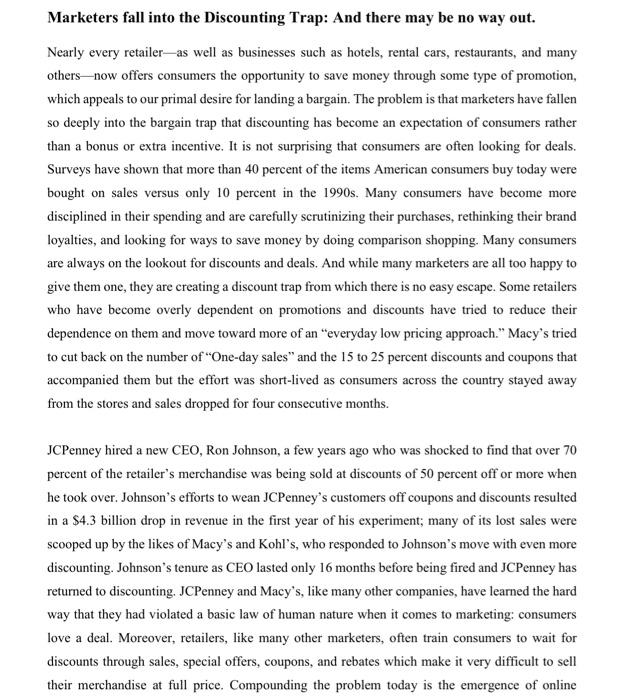
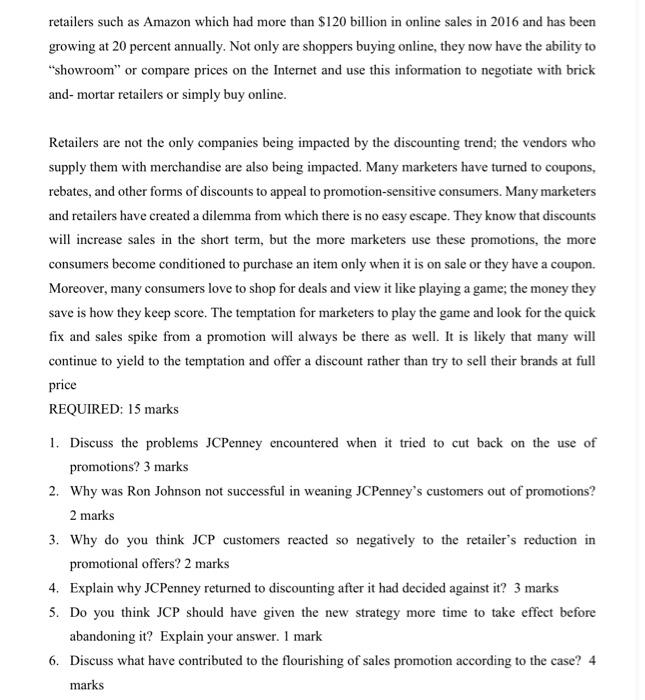
Marketers fall into the Discounting Trap: And there may be no way out. Nearly every retaileras well as businesses such as hotels, rental cars, restaurants, and many othersnow offers consumers the opportunity to save money through some type of promotion, which appeals to our primal desire for landing a bargain. The problem is that marketers have fallen so deeply into the bargain trap that discounting has become an expectation of consumers rather than a bonus or extra incentive. It is not surprising that consumers are often looking for deals. Surveys have shown that more than 40 percent of the items American consumers buy today were bought on sales versus only 10 percent in the 1990s. Many consumers have become more disciplined in their spending and are carefully scrutinizing their purchases, rethinking their brand loyalties, and looking for ways to save money by doing comparison shopping. Many consumers are always on the lookout for discounts and deals. And while many marketers are all too happy to give them one, they are creating a discount trap from which there is no easy escape. Some retailers who have become overly dependent on promotions and discounts have tried to reduce their dependence on them and move toward more of an "everyday low pricing approach." Macy's tried to cut back on the number of One-day sales" and the 15 to 25 percent discounts and coupons that accompanied them but the effort was short-lived as consumers across the country stayed away from the stores and sales dropped for four consecutive months. a JCPenney hired a new CEO, Ron Johnson, a few years ago who was shocked to find that over 70 percent of the retailer's merchandise was being sold at discounts of 50 percent off or more when he took over. Johnson's efforts to wean JCPenney's customers off coupons and discounts resulted in a $4.3 billion drop in revenue in the first year of his experiment; many of its lost sales were scooped up by the likes of Macy's and Kohl's, who responded to Johnson's move with even more discounting. Johnson's tenure as CEO lasted only 16 months before being fired and JCPenney has returned to discounting. JCPenney and Macy's, like many other companies, have learned the hard way that they had violated a basic law of human nature when it comes to marketing consumers love a deal. Moreover, retailers, like many other marketers, often train consumers to wait for discounts through sales, special offers, coupons, and rebates which make it very difficult to sell their merchandise at full price. Compounding the problem today is the emergence of online retailers such as Amazon which had more than $120 billion in online sales in 2016 and has been growing at 20 percent annually. Not only are shoppers buying online, they now have the ability to "showroom" or compare prices on the Internet and use this information to negotiate with brick and- mortar retailers or simply buy online. Retailers are not the only companies being impacted by the discounting trend; the vendors who supply them with merchandise are also being impacted. Many marketers have turned to coupons, rebates, and other forms of discounts to appeal to promotion-sensitive consumers. Many marketers and retailers have created a dilemma from which there is no easy escape. They know that discounts will increase sales in the short term, but the more marketers use these promotions, the more consumers become conditioned to purchase an item only when it is on sale or they have a coupon. Moreover, many consumers love to shop for deals and view it like playing a game; the money they save is how they keep score. The temptation for marketers to play the game and look for the quick fix and sales spike from a promotion will always be there as well. It is likely that many will continue to yield to the temptation and offer a discount rather than try to sell their brands at full price REQUIRED: 15 marks 1. Discuss the problems JCPenney encountered when it tried to cut back on the use of promotions? 3 marks 2. Why was Ron Johnson not successful in weaning JCPenney's customers out of promotions? 2 marks 3. Why do you think JCP customers reacted so negatively to the retailer's reduction in promotional offers? 2 marks 4. Explain why JCPenney returned to discounting after it had decided against it? 3 marks 5. Do you think JCP should have given the new strategy more time to take effect before abandoning it? Explain your answer. I mark 6. Discuss what have contributed to the flourishing of sales promotion according to the case? 4 marks Step by Step Solution
There are 3 Steps involved in it
1 Expert Approved Answer
Step: 1 Unlock

Question Has Been Solved by an Expert!
Get step-by-step solutions from verified subject matter experts
Step: 2 Unlock
Step: 3 Unlock
 Study Help