







Question: help please [NOTES: round all answers to 2 decimals; all studies are made up studies/data for practice] A physical therapist notices that many of her
help please
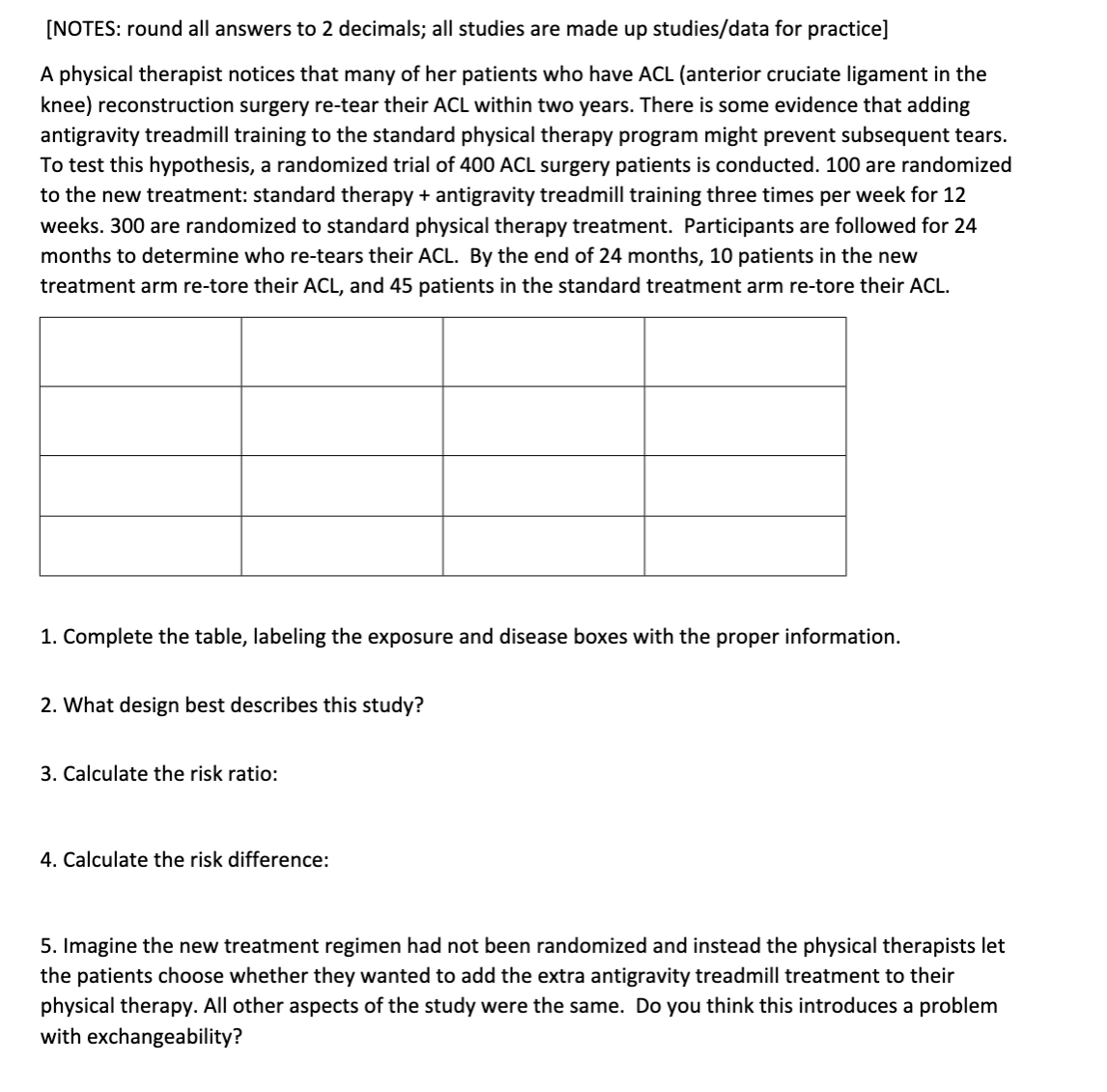
[NOTES: round all answers to 2 decimals; all studies are made up studies/data for practice] A physical therapist notices that many of her patients who have ACL (anterior cruciate ligament in the knee) reconstruction surgery retear their ACL within two years. There is some evidence that adding antigravity treadmill training to the standard physical therapy program might prevent subsequent tears. To test this hypothesis, a randomized trial of 400 ACL surgery patients is conducted. 100 are randomized to the new treatment: standard therapy + antigravity treadmill training three times per week for 12 weeks. 300 are randomized to standard physical therapy treatment. Participants are followed for 24 months to determine who re-tears their ACL. By the end of 24 months, 10 patients in the new treatment arm re-tore their ACL, and 45 patients in the standard treatment arm re-tore their ACL. 1. Complete the table, labeling the exposure and disease boxes with the proper information. 2. What design best describes this study? 3. Calculate the risk ratio: 4. Calculate the risk difference: 5. Imagine the new treatment regimen had not been randomized and instead the physical therapists let the patients choose whether they wanted to add the extra antigravity treadmill treatment to their physical therapy. All other aspects of the study were the same. Do you think this introduces a problem with exchangeability
Step by Step Solution
There are 3 Steps involved in it

Get step-by-step solutions from verified subject matter experts
 Study Help