







Question: Help Please! please number the answers Question 1 (1 point) A bond is issued 5-year bond at 7% coupon rate. The market interest rate for
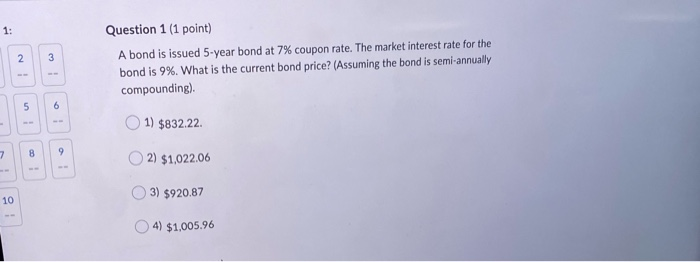
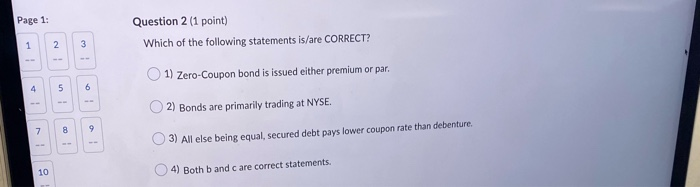
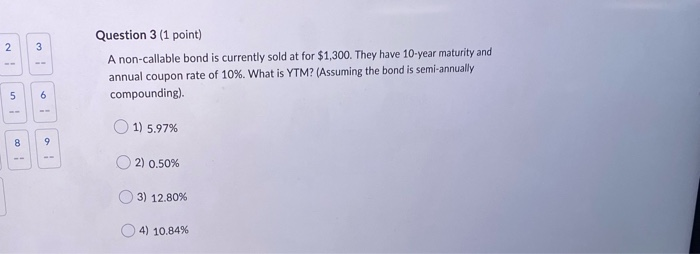
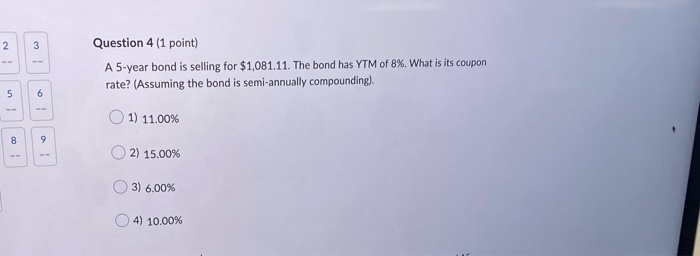
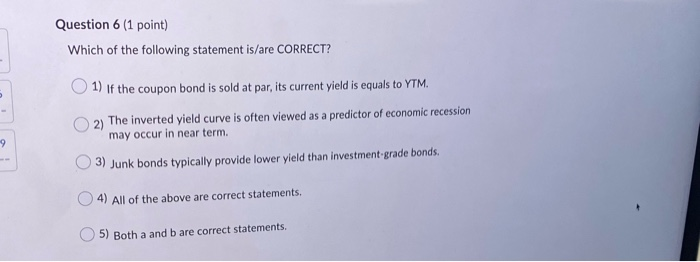
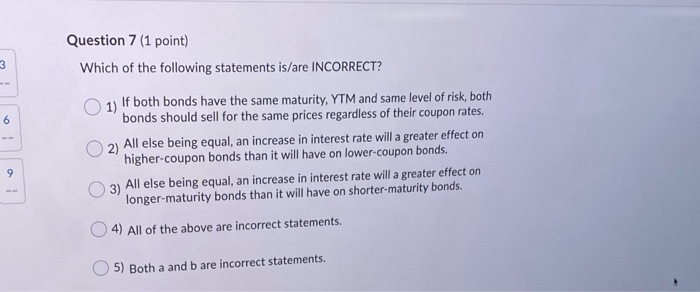
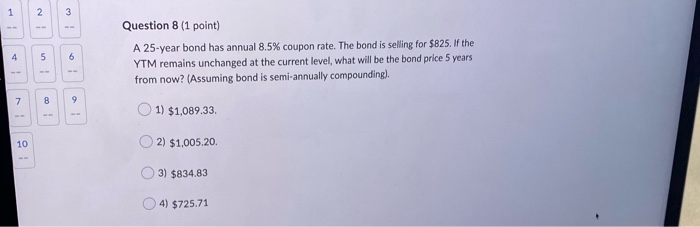
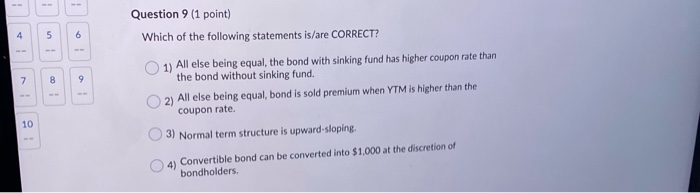
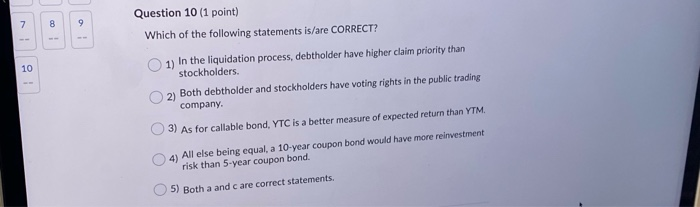
Question 1 (1 point) A bond is issued 5-year bond at 7% coupon rate. The market interest rate for the bond is 9%. What is the current bond price? (Assuming the bond is semi-annually compounding) 1) $832.22 2) $1,022.06 O3) $920.87 4) $1,005.96 Page 1: Question 2 (1 point) Which of the following statements is/are CORRECT? 1) Zero-Coupon bond is issued either premium or par. 2) Bonds are primarily trading at NYSE. 3) All else being equal, secured debt pays lower coupon rate than debenture. 4) Both b and c are correct statements. Question 3 (1 point) A non-callable bond is currently sold at for $1,300. They have 10-year maturity and annual coupon rate of 10%. What is YTM? (Assuming the bond is semi-annually compounding) 1) 5.97% 2) 0.50% 3) 12.80% 4) 10.84% Question 4 (1 point) A 5-year bond is selling for $1,081.11. The bond has YTM of 8%. What is its coupon rate? (Assuming the bond is semi-annually compounding). 56 1) 11.00% O2) 15.00% 3) 6.00% 4) 10.00% Page 1: Question 5 (1 point) A callable bond is currently selling for $1,250. Annual coupon payment $105 and 15 year maturity. The callable bond can be called in 5 years at $1,100. What is YTC? (Assuming the bond is semi-annually compounding). 1) 13.15% 2) 7.67% 3) 6.32% 4) 10.00% Question 6 (1 point) Which of the following statement is/are CORRECT? 1) If the coupon bond is sold at par, its current yield is equals to YTM. 2) The inverted yield curve is often viewed as a predictor of economic recession may occur in near term. o i 3) Junk bonds typically provide lower yield than investment grade bonds. 4) All of the above are correct statements. 5) Both a and b are correct statements. Question 7 (1 point) 3 Which of the following statements is/are INCORRECT? 1) If both bonds have the same maturity, YTM and same level of risk, both bonds should sell for the same prices regardless of their coupon rates. 2) All else being equal, an increase in interest rate will a greater effect on higher-coupon bonds than it will have on lower-coupon bonds. 3) All else being equal, an increase in interest rate will a greater effect on longer-maturity bonds than it will have on shorter-maturity bonds. 4) All of the above are incorrect statements. 5) Both a and b are incorrect statements. Question 8 (1 point) A 25-year bond has annual 8.5% coupon rate. The bond is selling for $825. If the YTM remains unchanged at the current level, what will be the bond price 5 years from now? (Assuming bond is semi-annually compounding) 1) $1,089.33 2) $1,005.20 3) $834.83 4) $725.71 Question 9 (1 point) Which of the following statements is/are CORRECT? 1 All else being equal, the bond with sinking fund has higher coupon rate than the bond without sinking fund. 2) All else being equal, bond is sold premium when YTM is higher than the coupon rate. 3) Normal term structure is upward sloping, 4) Convertible bond can be converted into $1.000 at the discretion of bondholders Question 10 (1 point) Which of the following statements is/are CORRECT? 1) In the liquidation process, debtholder have higher claim priority than stockholders. Both debtholder and stockholders have voting rights in the public trading company. 3) As for callable bond, YTC is a better measure of expected return than YTM All else being equal, a 10-year coupon bond would have more reinvestment risk than 5-year coupon bond. 5) Both a and care correct statements
Step by Step Solution
There are 3 Steps involved in it

Get step-by-step solutions from verified subject matter experts
 Study Help