







Question: HELP PLEASE QUICK A grocery store would like to gain insight into its customers' purchase to possibly improve its in-aisle product placement and cross-product promotions.
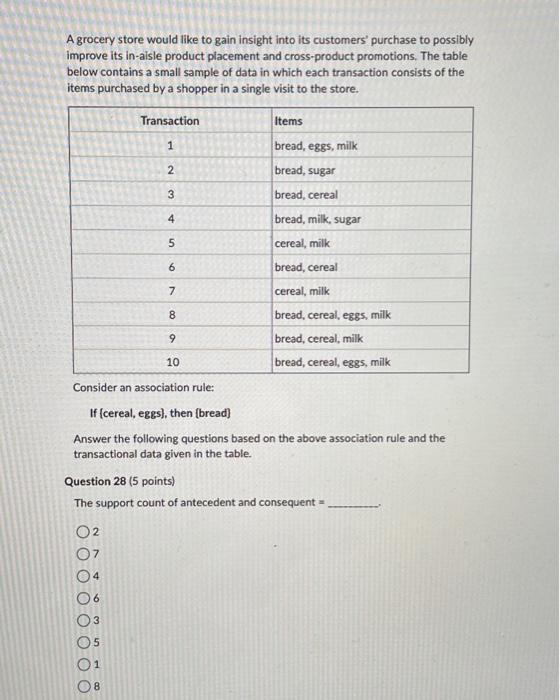
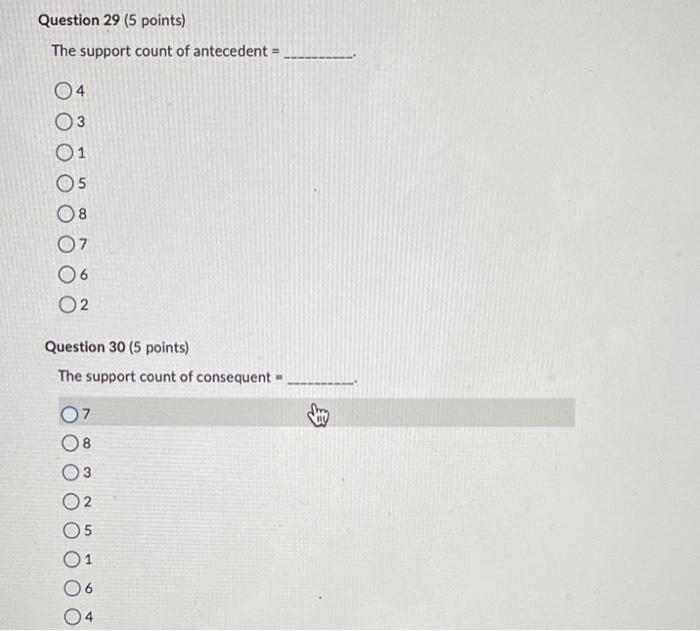
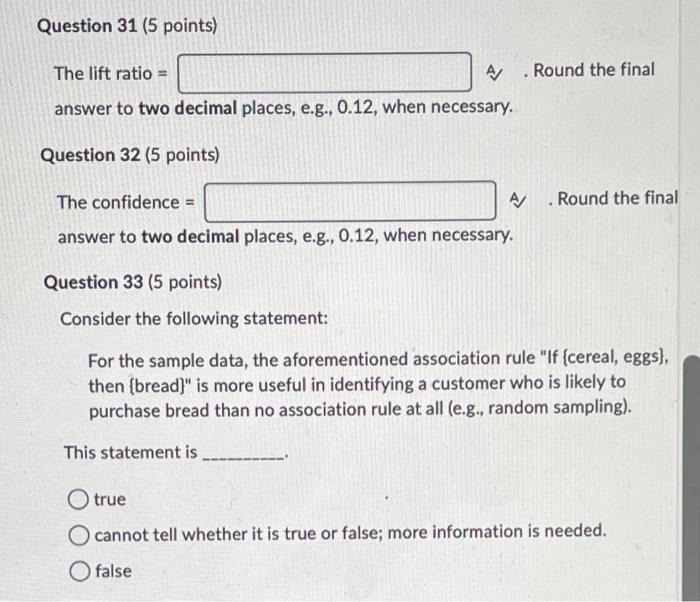
A grocery store would like to gain insight into its customers' purchase to possibly improve its in-aisle product placement and cross-product promotions. The table below contains a small sample of data in which each transaction consists of the items purchased by a shopper in a single visit to the store. Consider an association rule: If (cereal, eggs), then (bread] Answer the following questions based on the above association rule and the transactional data given in the table. Question 28 (5 points) The support count of antecedent and consequent = 2 7 4 6 3 5 1 8 The support count of antecedent = 4 3 1 5 8 7 6 2 Question 30 ( 5 points) The support count of consequent = \begin{tabular}{|r|} \hline 7 \\ \hline 8 \\ \hline 3 \\ \hline 2 \\ \hline 5 \\ \hline 1 \\ \hline 6 \\ \hline 4 \\ \hline \end{tabular} Consider the following statement: For the sample data, the aforementioned association rule "If \{cereal, eggs\}, then (bread)" is more useful in identifying a customer who is likely to purchase bread than no association rule at all (e.g., random sampling). This statement is true cannot tell whether it is true or false; more information is needed. false
Step by Step Solution
There are 3 Steps involved in it

Get step-by-step solutions from verified subject matter experts
 Study Help