







Question: Help please The graph below shows data taken on the position of a small massive cart attached to a spring as shown in the figure
Help please
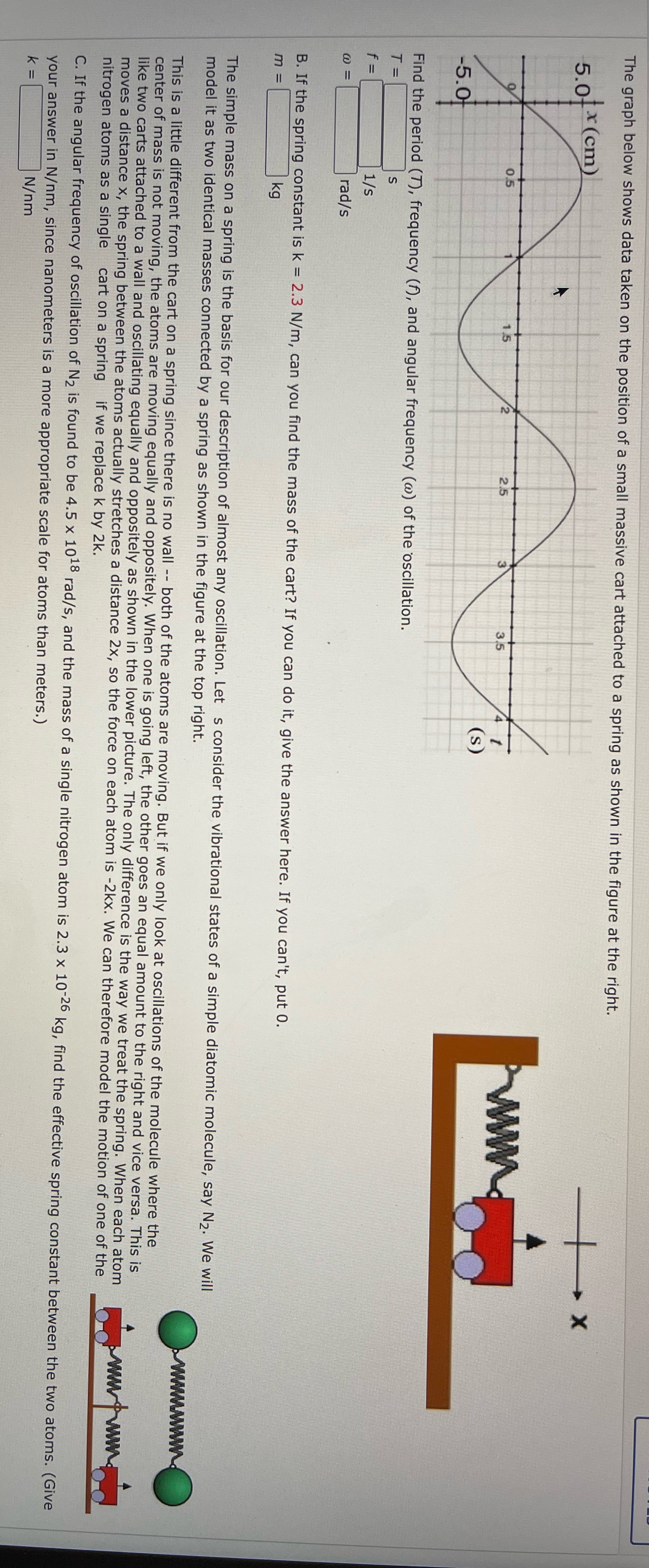
The graph below shows data taken on the position of a small massive cart attached to a spring as shown in the figure at the right. X 5.ofx (cm) 0.5 (s) Find the period (T), frequency (f), and angular frequency (@) of the oscillation. f = W = rad/s B. If the spring constant is k = 2.3 N/m, can you find the mass of the cart? If you can do it, give the answer here. If you can't, put 0. m = 2 The simple mass on a spring is the basis for our description of almost any oscillation. Let s consider the vibrational states of a simple diatomic molecule, say N2. We will model it as two identical masses connected by a spring as shown in the figure at the top right. This is a little different from the cart on a spring since there is no wall -- both of the atoms are moving. But if we only look at oscillations of the molecule where the center of mass is not moving, the atoms are moving equally and oppositely. When one is going left, the other goes an equal amount to the right and vice versa. This is like two carts attached to a wall and oscillating equally and oppositely as shown in the lower picture. The only difference is the way we treat the spring. When each atom moves a distance x, the spring between the atoms actually stretches a distance 2x, so the force on each atom is -2kx. We can therefore model the motion of one of the nitrogen atoms as a single cart on a spring if we replace k by 2k. C. If the angular frequency of oscillation of N2 is found to be 4.5 x 10¹⁸ rad/s, and the mass of a single nitrogen atom is 2.3 x 10⁻²⁶ kg, find the effective spring constant between the two atoms. (Give your answer in Nm, since nanometers is a more appropriate scale for atoms than meters.) k = Nm
Step by Step Solution
There are 3 Steps involved in it

Get step-by-step solutions from verified subject matter experts
 Study Help