







Question: Help Problem 1: Airline Seat Allocation and Yield Management (a) Two-stage SP problem: Seat allocation and passenger acceptance policy Northam Airlines is trying to decide
Help 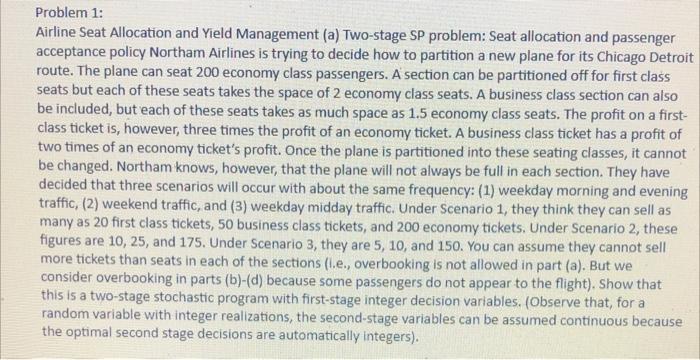
Problem 1: Airline Seat Allocation and Yield Management (a) Two-stage SP problem: Seat allocation and passenger acceptance policy Northam Airlines is trying to decide how to partition a new plane for its Chicago Detroit route. The plane can seat 200 economy class passengers. A section can be partitioned off for first class seats but each of these seats takes the space of 2 economy class seats. A business class section can also be included, but each of these seats takes as much space as 1.5 economy class seats. The profit on a first- class ticket is, however, three times the profit of an economy ticket. A business class ticket has a profit of two times of an economy ticket's profit. Once the plane is partitioned into these seating classes, it cannot be changed. Northam knows, however, that the plane will not always be full in each section. They have decided that three scenarios will occur with about the same frequency: (1) weekday morning and evening traffic, (2) weekend traffic, and (3) weekday midday traffic. Under Scenario 1, they think they can sell as many as 20 first class tickets, 50 business class tickets, and 200 economy tickets. Under Scenario 2, these figures are 10, 25, and 175. Under Scenario 3, they are 5, 10, and 150. You can assume they cannot sell more tickets than seats in each of the sections (.e., overbooking is not allowed in part (a). But we consider overbooking in parts (b)-(d) because some passengers do not appear to the flight). Show that this is a two-stage stochastic program with first-stage integer decision variables. (Observe that, for a random variable with integer realizations, the second-stage variables can be assumed continuous because the optimal second stage decisions are automatically integers). Problem 1: Airline Seat Allocation and Yield Management (a) Two-stage SP problem: Seat allocation and passenger acceptance policy Northam Airlines is trying to decide how to partition a new plane for its Chicago Detroit route. The plane can seat 200 economy class passengers. A section can be partitioned off for first class seats but each of these seats takes the space of 2 economy class seats. A business class section can also be included, but each of these seats takes as much space as 1.5 economy class seats. The profit on a first- class ticket is, however, three times the profit of an economy ticket. A business class ticket has a profit of two times of an economy ticket's profit. Once the plane is partitioned into these seating classes, it cannot be changed. Northam knows, however, that the plane will not always be full in each section. They have decided that three scenarios will occur with about the same frequency: (1) weekday morning and evening traffic, (2) weekend traffic, and (3) weekday midday traffic. Under Scenario 1, they think they can sell as many as 20 first class tickets, 50 business class tickets, and 200 economy tickets. Under Scenario 2, these figures are 10, 25, and 175. Under Scenario 3, they are 5, 10, and 150. You can assume they cannot sell more tickets than seats in each of the sections (.e., overbooking is not allowed in part (a). But we consider overbooking in parts (b)-(d) because some passengers do not appear to the flight). Show that this is a two-stage stochastic program with first-stage integer decision variables. (Observe that, for a random variable with integer realizations, the second-stage variables can be assumed continuous because the optimal second stage decisions are automatically integers)
Step by Step Solution
There are 3 Steps involved in it
1 Expert Approved Answer
Step: 1 Unlock

Question Has Been Solved by an Expert!
Get step-by-step solutions from verified subject matter experts
Step: 2 Unlock
Step: 3 Unlock
 Study Help