



Question: help question 5 Question 4) Pete enjoys goods x and y according to the utility function u(x, y) = x2/3y1/3. (a) Find Pete's marginal rate
help question 5
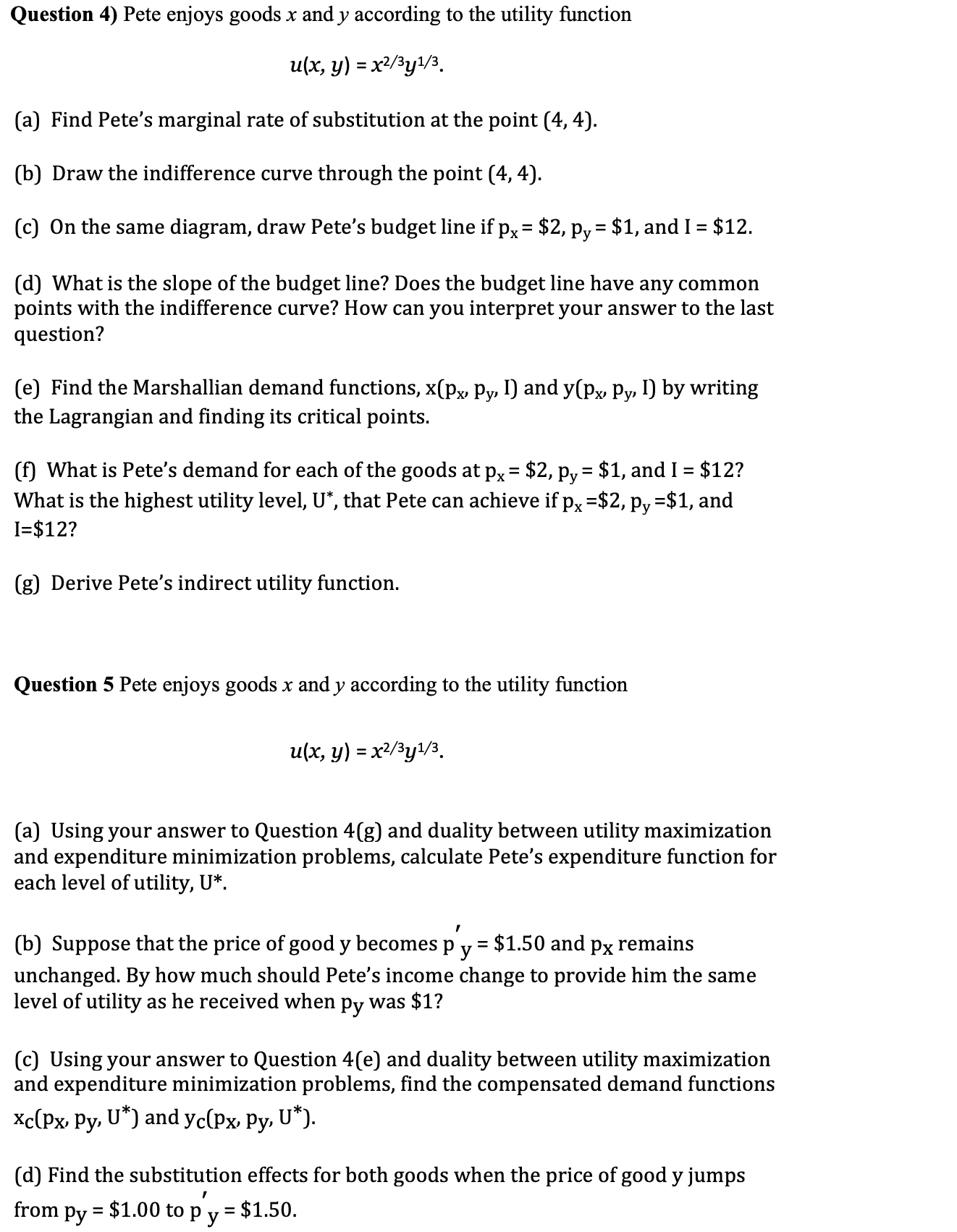
Question 4) Pete enjoys goods x and y according to the utility function u(x, y) = x2/3y1/3. (a) Find Pete's marginal rate of substitution at the point (4, 4). (b) Draw the indifference curve through the point (4, 4). (c) On the same diagram, draw Pete's budget line if px = $2, py = $1, and I = $12. (d) What is the slope of the budget line? Does the budget line have any common points with the indifference curve? How can you interpret your answer to the last question? (e) Find the Marshallian demand functions, x(Px, Py, I) and y(Px, Py, I) by writing the Lagrangian and finding its critical points. (f) What is Pete's demand for each of the goods at px = $2, py = $1, and I = $12? What is the highest utility level, U*, that Pete can achieve if px =$2, py =$1, and I=$12? (g) Derive Pete's indirect utility function. Question 5 Pete enjoys goods x and y according to the utility function u(x, y) = x2/3y1/3. (a) Using your answer to Question 4(g) and duality between utility maximization and expenditure minimization problems, calculate Pete's expenditure function for each level of utility, U*. (b) Suppose that the price of good y becomes p y = $1.50 and px remains unchanged. By how much should Pete's income change to provide him the same level of utility as he received when py was $1? (c) Using your answer to Question 4(e) and duality between utility maximization and expenditure minimization problems, find the compensated demand functions Xc(Px, Py, U*) and yc(Px, Py, U*). (d) Find the substitution effects for both goods when the price of good y jumps from py = $1.00 to P y = $1.50
Step by Step Solution
There are 3 Steps involved in it

Get step-by-step solutions from verified subject matter experts