







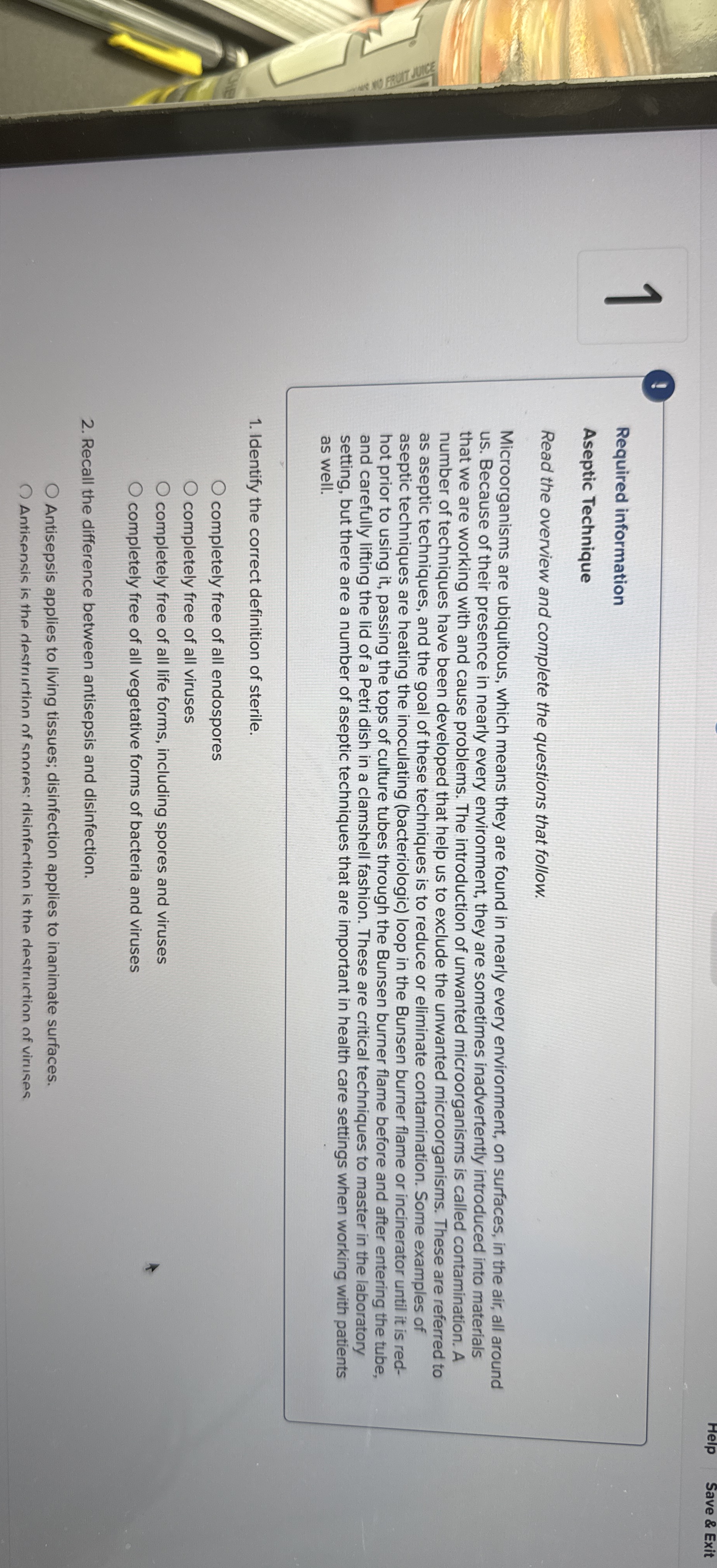
Question: Help Save & Exit 1 1 Required information Aseptic Technique Read the overview and complete the questions that follow. Microorganisms are ubiquitous, which means they
Help
Save & Exit
Required information
Aseptic Technique
Read the overview and complete the questions that follow.
Microorganisms are ubiquitous, which means they are found in nearly every environment, on surfaces, in the air, all around us Because of their presence in nearly every environment, they are sometimes inadvertently introduced into materials that we are working with and cause problems. The introduction of unwanted microorganisms is called contamination. A number of techniques have been developed that help us to exclude the unwanted microorganisms. These are referred to as aseptic techniques, and the goal of these techniques is to reduce or eliminate contamination. Some examples of aseptic techniques are heating the inoculating bacteriologic loop in the Bunsen burner flame or incinerator until it is redhot prior to using it passing the tops of culture tubes through the Bunsen burner flame before and after entering the tube, and carefully lifting the lid of a Petri dish in a clamshell fashion. These are critical techniques to master in the laboratory setting, but there are a number of aseptic techniques that are important in health care settings when working with patients as well.
Identify the correct definition of sterile.
completely free of all endospores
completely free of all viruses
completely free of all life forms, including spores and viruses
completely free of all vegetative forms of bacteria and viruses
Recall the difference between antisepsis and disinfection.
Antisepsis applies to living tissues; disinfection applies to inanimate surfaces.
Antisensis is the destruction of snores: disinfection is the deatruction of viruses
Step by Step Solution
There are 3 Steps involved in it
1 Expert Approved Answer
Step: 1 Unlock

Question Has Been Solved by an Expert!
Get step-by-step solutions from verified subject matter experts
Step: 2 Unlock
Step: 3 Unlock
 Study Help