







Question: help. show work and steps pls. I will leave positive review and comment We say that Y follows X if whenever X happens, Y must
help. show work and steps pls. I will leave positive review and comment
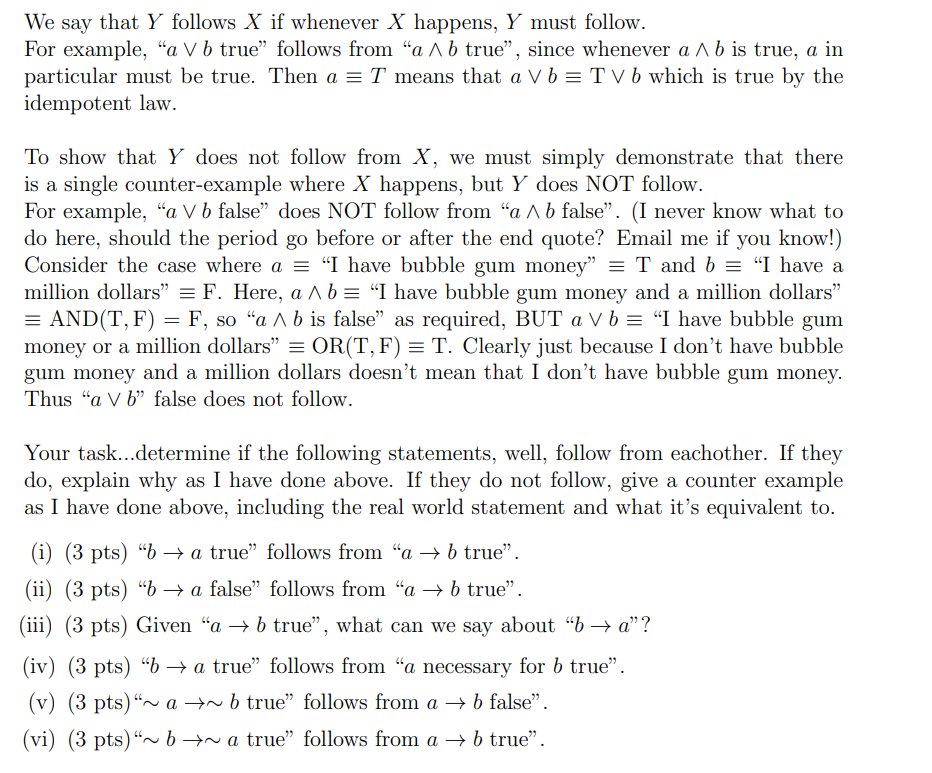
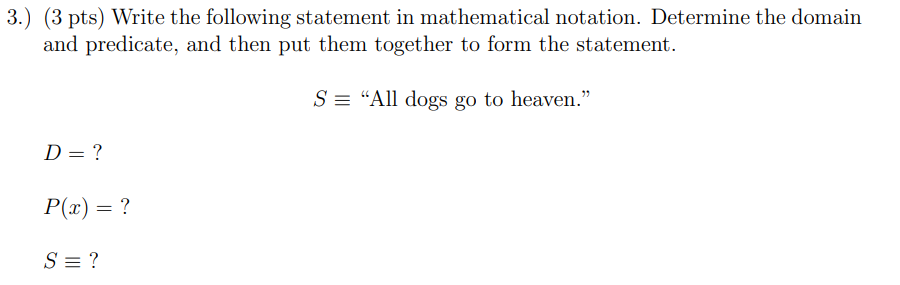
We say that Y follows X if whenever X happens, Y must follow. For example, "a V b true follows from "ab true, since whenever a Ab is true, a in particular must be true. Then a = T means that a Vb = T V b which is true by the idempotent law. To show that Y does not follow from X, we must simply demonstrate that there is a single counter-example where X happens, but Y does NOT follow. For example, "a V b false does NOT follow from a Ab false. (I never know what to do here, should the period go before or after the end quote? Email me if you know!) Consider the case where a = I have bubble gum money" = T and b = "I have a million dollars = F. Here, a Ab = "I have bubble gum money and a million dollars" = AND(T,F) = F, so a 1 b is false as required, BUT a V b = "I have bubble gum money or a million dollars = OR(T, F) = T. Clearly just because I don't have bubble gum money and a million dollars doesn't mean that I don't have bubble gum money. Thus "a V b false does not follow. Your task...determine if the following statements, well, follow from eachother. If they do, explain why as I have done above. If they do not follow, give a counter example as I have done above, including the real world statement and what it's equivalent to. (i) (3 pts) + a true follows from a + b true. (ii) (3 pts) b + a false follows from a + b true. (iii) (3 pts) Given a + b true, what can we say about 6 + a"? (iv) (3 pts) b + a true follows from a necessary for b true. (v) (3 pts)~ a + b true follows from a + b false. (vi) (3 pts)~ b + a true follows from a + b true. 3.) (3 pts) Write the following statement in mathematical notation. Determine the domain and predicate, and then put them together to form the statement. S = "All dogs go to heaven." D= ? P(x) = ? S = ? We say that Y follows X if whenever X happens, Y must follow. For example, "a V b true follows from "ab true, since whenever a Ab is true, a in particular must be true. Then a = T means that a Vb = T V b which is true by the idempotent law. To show that Y does not follow from X, we must simply demonstrate that there is a single counter-example where X happens, but Y does NOT follow. For example, "a V b false does NOT follow from a Ab false. (I never know what to do here, should the period go before or after the end quote? Email me if you know!) Consider the case where a = I have bubble gum money" = T and b = "I have a million dollars = F. Here, a Ab = "I have bubble gum money and a million dollars" = AND(T,F) = F, so a 1 b is false as required, BUT a V b = "I have bubble gum money or a million dollars = OR(T, F) = T. Clearly just because I don't have bubble gum money and a million dollars doesn't mean that I don't have bubble gum money. Thus "a V b false does not follow. Your task...determine if the following statements, well, follow from eachother. If they do, explain why as I have done above. If they do not follow, give a counter example as I have done above, including the real world statement and what it's equivalent to. (i) (3 pts) + a true follows from a + b true. (ii) (3 pts) b + a false follows from a + b true. (iii) (3 pts) Given a + b true, what can we say about 6 + a"? (iv) (3 pts) b + a true follows from a necessary for b true. (v) (3 pts)~ a + b true follows from a + b false. (vi) (3 pts)~ b + a true follows from a + b true. 3.) (3 pts) Write the following statement in mathematical notation. Determine the domain and predicate, and then put them together to form the statement. S = "All dogs go to heaven." D= ? P(x) = ? S =
Step by Step Solution
There are 3 Steps involved in it

Get step-by-step solutions from verified subject matter experts
 Study Help