







Question: Help solve Problem 4: International Emissions Trading. Two countries A and B each produce carbon emissions. With no emissions reduction, each country produces 1,000 units
Help solve
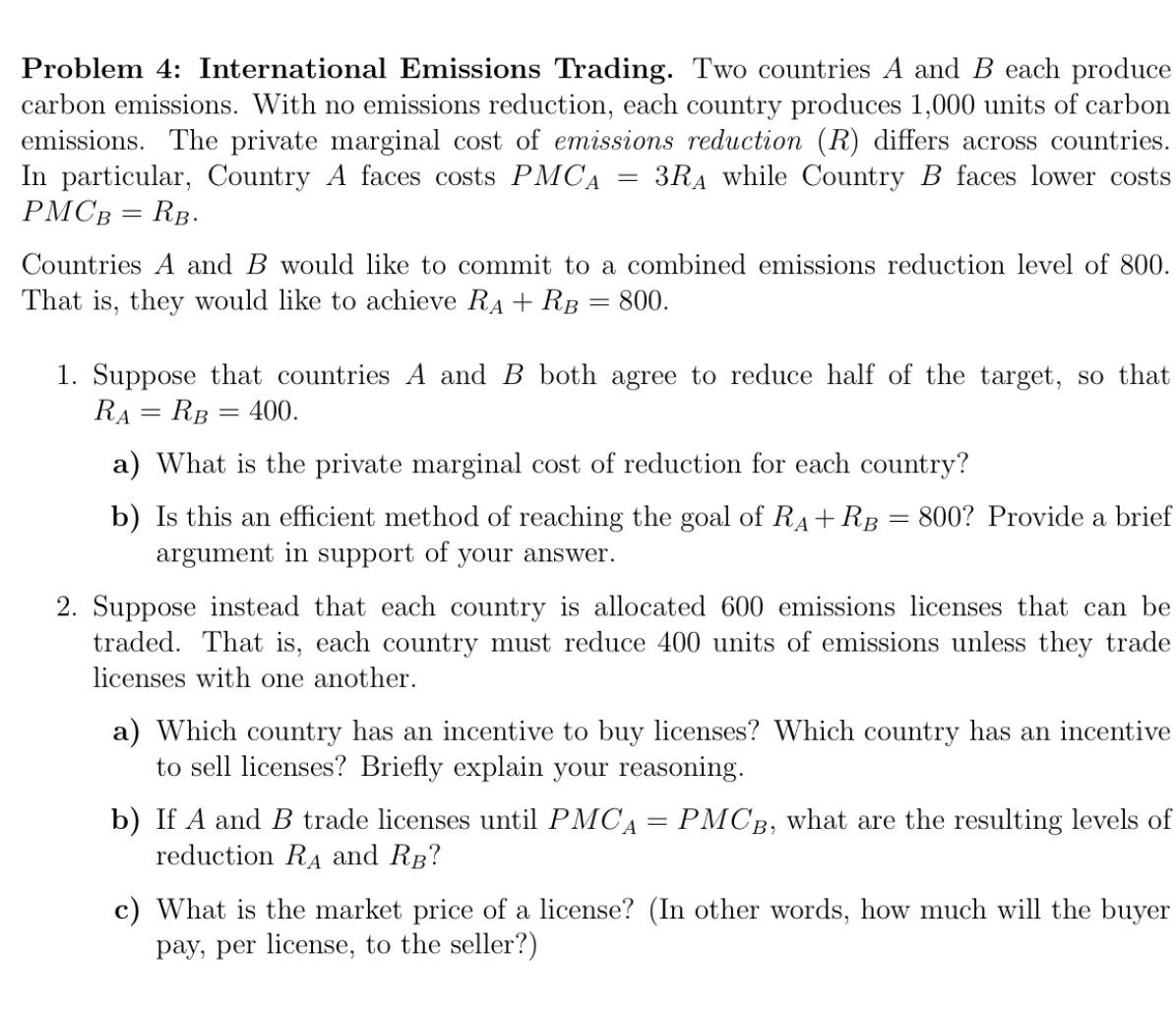
Problem 4: International Emissions Trading. Two countries A and B each produce carbon emissions. With no emissions reduction, each country produces 1,000 units of carbon emissions. The private marginal cost of emissions reduction (R) differs across countries. In particular, Country A faces costs PM CA = 3RA while Country B faces lower costs PM 03 = R3. Countries A and B would like to commit to a combined emissions reduction level of 800. That is, they would like to achieve R4 + R3 = 800. 1. Suppose that countries A and B both agree to reduce half of the target, so that RA = R3 = 400. a) What is the private marginal cost of reduction for each country? b) Is this an eicient method of reaching the goal of R A + R3 = 800? Provide a brief argument in support of your answer. 2. Suppose instead that each country is allocated 600 emissions licenses that can be traded. That is, each country must reduce 400 units of emissions unless they trade licenses with one another. a) Which country has an incentive to buy licenses? Which country has an incentive to sell licenses? Briey explain your reasoning. b) If A and B trade licenses until PM C A = PM CB, what are the resulting levels of reduction RA and RB? c) What is the market price of a license? (In other words, how much will the buyer pay, per license, to the seller?)
Step by Step Solution
There are 3 Steps involved in it

Get step-by-step solutions from verified subject matter experts
 Study Help