







Question: help solve problem, fill out all empty boxes Camron Robinson operates Camron's Cricket Farm in Canton, Georgia. Camron's raises about 18 million crickets a month.
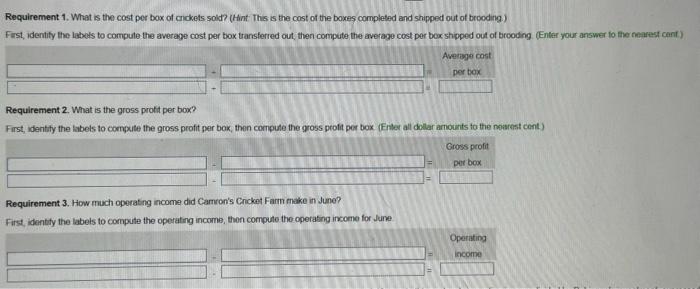
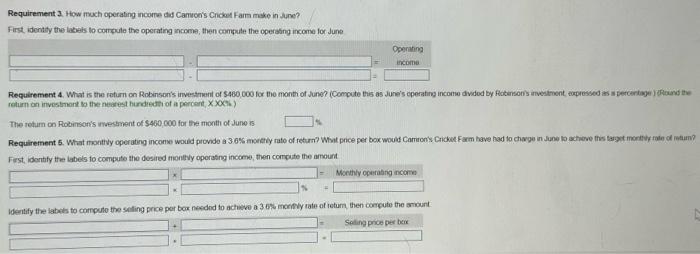
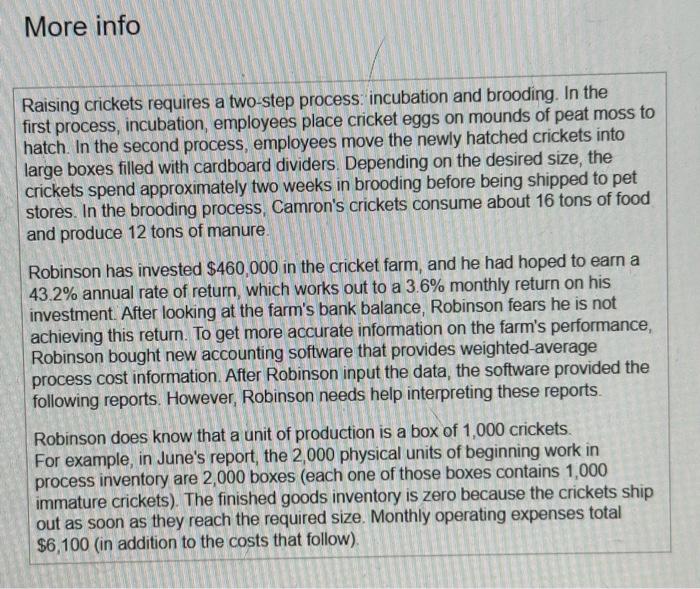
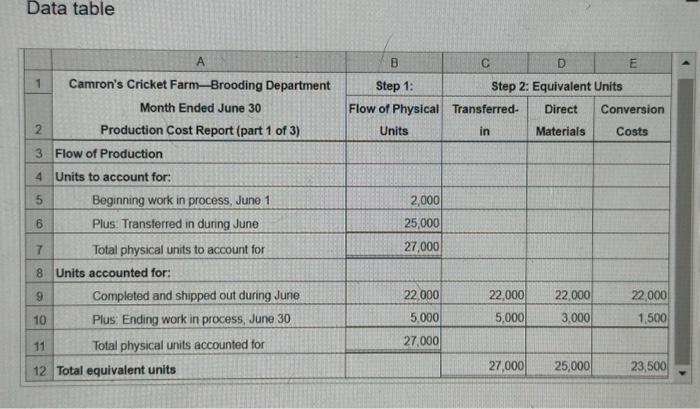
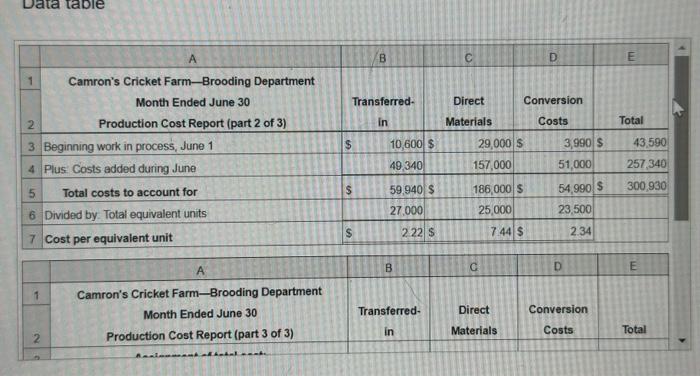
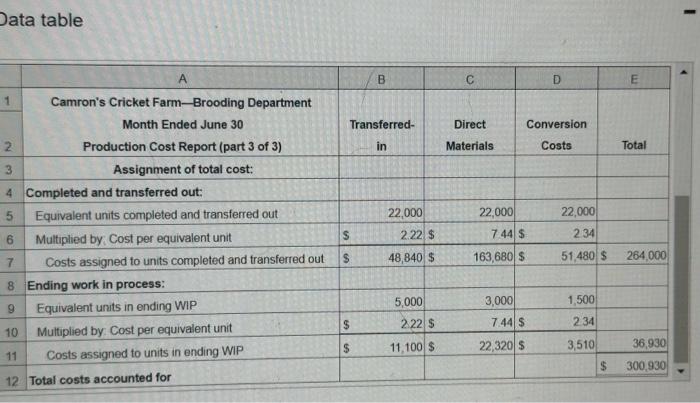
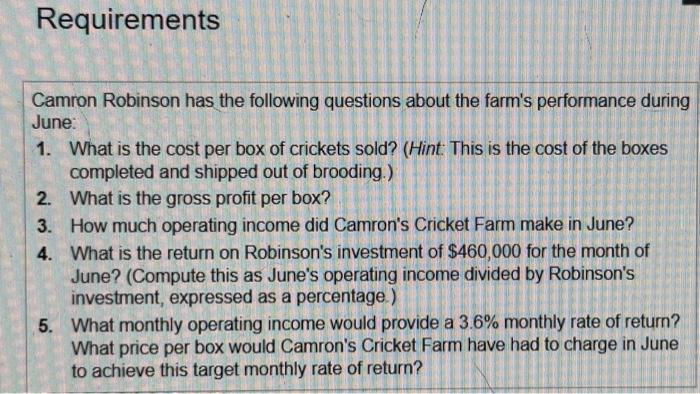
Camron Robinson operates Camron's Cricket Farm in Canton, Georgia. Camron's raises about 18 million crickets a month. Most are sold to pet stores at $12.80 for a box of 1,000 crickets. Pet stores sell the crickets for $0.05 to $0.10 each as live feed for reptiles. (Click on the icon to view additional information.) More info Raising crickets requires a two-step process incubation and brooding. In the first process, incubation, employees place cricket eggs on mounds of peat moss to hatch. In the second process, employees move the newly hatched crickets into large boxes filled with cardboard dividers. Depending on the desired size, the crickets spend approximately two weeks in brooding before being shipped to pet stores. In the brooding process, Camron's crickets consume about 16 tons of food and produce 12 tons of manure. Robinson has invested $460,000 in the cricket farm, and he had hoped to earn a 43.2% annual rate of return, which works out to a 3.6% monthly return on his investment. After looking at the farm's bank balance, Robinson fears he is not achieving this return. To get more accurate information on the farm's performance, Robinson bought new accounting software that provides weighted-average process cost information. After Robinson input the data, the software provided the following reports. However, Robinson needs help interpreting these reports. Robinson does know that a unit of production is a box of 1,000 crickets. For example, in June's report, the 2,000 physical units of beginning work in process inventory are 2,000 boxes (each one of those boxes contains 1,000 immature crickets). The finished goods inventory is zero because the crickets ship out as soon as they reach the required size. Monthly operating expenses total $6,100 (in addition to the costs that follow) Requirement 1. What is the cost per box of crickets soid? (Hint: This is the cost of the boxes completed and shipped out of brooding) First, identify the labols to compute the averape cost per box transferred out, then compute the average cost per bex shipped out of brooding (Enter your answer to fine nearest cent.) Requirement 2 . What is the gross protit per box? First, identity the labels to compute the gross profit per box, then cornpuste the gross profit per box. (Erter all dollar arnounts to the noarest cent) Requirement 3. How much operating income did Camron's Cncket Farm make in June? First identity the labels to compute the operating income, then compute the operating income for Jurve Requirement 2 How much operating income das Camuon's Cncket Fam make in June? First identiby the labeis lo compule the operating ncome, then compule the opersing income for June The return on Riobinson's umestrnent of $460,000 for the month of June is First, idontify the labels to computo the dosired monitiy oporating income, then concute the amount Jata table Uata table Camron Robinson has the following questions about the farm's performance during June: 1. What is the cost per box of crickets sold? (Hint: This is the cost of the boxes completed and shipped out of brooding.) 2. What is the gross profit per box? 3. How much operating income did Camron's Cricket Farm make in June? 4. What is the return on Robinson's investment of $460,000 for the month of June? (Compute this as June's operating income divided by Robinson's investment, expressed as a percentage.) 5. What monthly operating income would provide a 3.6% monthly rate of return? What price per box would Camron's Cricket Farm have had to charge in June to achieve this target monthly rate of return? Data table Camron Robinson operates Camron's Cricket Farm in Canton, Georgia. Camron's raises about 18 million crickets a month. Most are sold to pet stores at $12.80 for a box of 1,000 crickets. Pet stores sell the crickets for $0.05 to $0.10 each as live feed for reptiles. (Click on the icon to view additional information.) More info Raising crickets requires a two-step process incubation and brooding. In the first process, incubation, employees place cricket eggs on mounds of peat moss to hatch. In the second process, employees move the newly hatched crickets into large boxes filled with cardboard dividers. Depending on the desired size, the crickets spend approximately two weeks in brooding before being shipped to pet stores. In the brooding process, Camron's crickets consume about 16 tons of food and produce 12 tons of manure. Robinson has invested $460,000 in the cricket farm, and he had hoped to earn a 43.2% annual rate of return, which works out to a 3.6% monthly return on his investment. After looking at the farm's bank balance, Robinson fears he is not achieving this return. To get more accurate information on the farm's performance, Robinson bought new accounting software that provides weighted-average process cost information. After Robinson input the data, the software provided the following reports. However, Robinson needs help interpreting these reports. Robinson does know that a unit of production is a box of 1,000 crickets. For example, in June's report, the 2,000 physical units of beginning work in process inventory are 2,000 boxes (each one of those boxes contains 1,000 immature crickets). The finished goods inventory is zero because the crickets ship out as soon as they reach the required size. Monthly operating expenses total $6,100 (in addition to the costs that follow) Requirement 1. What is the cost per box of crickets soid? (Hint: This is the cost of the boxes completed and shipped out of brooding) First, identify the labols to compute the averape cost per box transferred out, then compute the average cost per bex shipped out of brooding (Enter your answer to fine nearest cent.) Requirement 2 . What is the gross protit per box? First, identity the labels to compute the gross profit per box, then cornpuste the gross profit per box. (Erter all dollar arnounts to the noarest cent) Requirement 3. How much operating income did Camron's Cncket Farm make in June? First identity the labels to compute the operating income, then compute the operating income for Jurve Requirement 2 How much operating income das Camuon's Cncket Fam make in June? First identiby the labeis lo compule the operating ncome, then compule the opersing income for June The return on Riobinson's umestrnent of $460,000 for the month of June is First, idontify the labels to computo the dosired monitiy oporating income, then concute the amount Jata table Uata table Camron Robinson has the following questions about the farm's performance during June: 1. What is the cost per box of crickets sold? (Hint: This is the cost of the boxes completed and shipped out of brooding.) 2. What is the gross profit per box? 3. How much operating income did Camron's Cricket Farm make in June? 4. What is the return on Robinson's investment of $460,000 for the month of June? (Compute this as June's operating income divided by Robinson's investment, expressed as a percentage.) 5. What monthly operating income would provide a 3.6% monthly rate of return? What price per box would Camron's Cricket Farm have had to charge in June to achieve this target monthly rate of return? Data table
Step by Step Solution
There are 3 Steps involved in it

Get step-by-step solutions from verified subject matter experts
 Study Help