



Question: 11. Twins Suppose 1/3 of twins are identical and 2/3 of twins are fraternal. If you are pregnant with twins of the same sex,
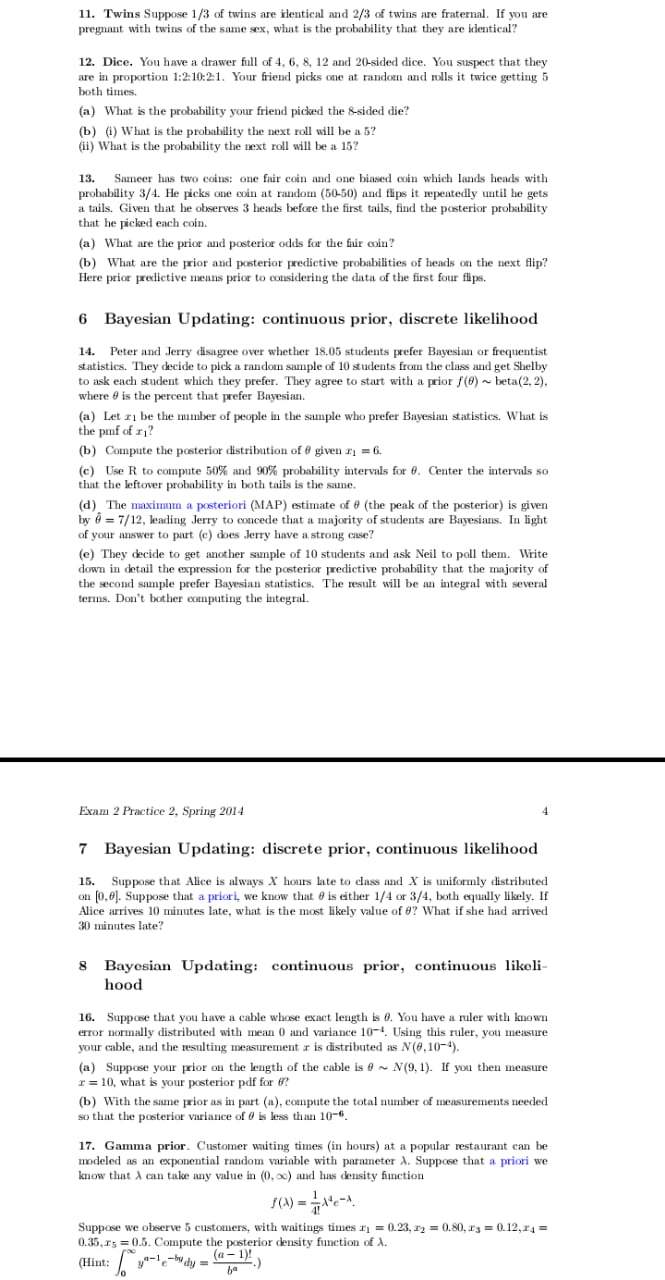
11. Twins Suppose 1/3 of twins are identical and 2/3 of twins are fraternal. If you are pregnant with twins of the same sex, what is the probability that they are identical? 12. Dice. You have a drawer full of 4, 6, 8, 12 and 20-sided dice. You suspect that they are in proportion 1:2:10:2:1. Your friend picks one at random and rolls it twice getting 5 both times. (a) What is the probability your friend picked the 8-sided die? (b) (i) What is the probability the next roll will be a 5? (ii) What is the probability the next roll will be a 15? 13. Sameer has two coins: one fair coin and one biased coin which lands heads with probability 3/4. He picks one coin at random (50-50) and flips it repeatedly until he gets a tails. Given that he observes 3 heads before the first tails, find the posterior probability that he picked each coin. (a) What are the prior and posterior odds for the fair coin? (b) What are the prior and posterior predictive probabilities of heads on the next flip? Here prior predictive means prior to considering the data of the first four flips. 6 Bayesian Updating: continuous prior, discrete likelihood 14. Peter and Jerry disagree over whether 18.05 students prefer Bayesian or frequentist statistics. They decide to pick a random sample of 10 students from the class and get Shelby to ask each student which they prefer. They agree to start with a prior f(6) ~ beta(2, 2), where is the percent that prefer Bayesian. (a) Let zi be the mumber of people in the sample who prefer Bayesian statistics. What is the pmf of 2? (b) Compute the posterior distribution of given r = 6. (e) Use R to compute 50% and 90% probability intervals for 6. Center the intervals so that the leftover probability in both tails is the same. (d) The maximum a posteriori (MAP) estimate of (the peak of the posterior) is given by =7/12, leading Jerry to concede that a majority of students are Bayesians. In light of your answer to part (e) does Jerry have a strong case? (e) They decide to get another sample of 10 students and ask Neil to poll them. Write down in detail the expression for the posterior predictive probability that the majority of the second sample prefer Bayesian statistics. The result will be an integral with several terms. Don't bother computing the integral. Exam 2 Practice 2, Spring 2014 7 Bayesian Updating: discrete prior, continuous likelihood 15. Suppose that Alice is always X hours late to class and X is uniformly distributed on [0,0]. Suppose that a priori, we know that is either 1/4 or 3/4, both equally likely. If Alice arrives 10 minutes late, what is the most likely value of #? What if she had arrived 30 minutes late? 8 Bayesian Updating: continuous prior, continuous likeli hood 16. Suppose that you have a cable whose exact length is 0. You have a ruler with known error normally distributed with mean 0 and variance 10-4. Using this ruler, you measure your cable, and the resulting measurement r is distributed as N(0,10-4). (a) Suppose your prior on the length of the cable is ~N(9,1). If you then measure r=10, what is your posterior pdf for 6? (b) With the same prior as in part (a), compute the total number of measurements needed so that the posterior variance of 0 is less than 10-6. 17. Gamma prior. Customer waiting times (in hours) at a popular restaurant can be modeled as an exponential random variable with parameter A. Suppose that a priori we know that A can take any value in (0, c) and has density fiction 10x=- Suppose we observe 5 customers, with waitings times r = 0.23, x2 = 0.80, x3 = 0.12,x4= 0.35,5=0.5. Compute the posterior density function of A. (Hint:dy= (a-1)) ba
Step by Step Solution
There are 3 Steps involved in it
Question 11 Twins Probability Given 13 of twins are identical 23 of twins are fraternal Identical twins are always the same sex Fraternal twins have a 50 chance of being the same sex Find The probabil... View full answer

Get step-by-step solutions from verified subject matter experts