







Question: help SummitCorp's David & Goliath David, a mid - level marketing manager at SummitCorp, had always prided himself on his work ethic and consistent
help SummitCorp's David & Goliath
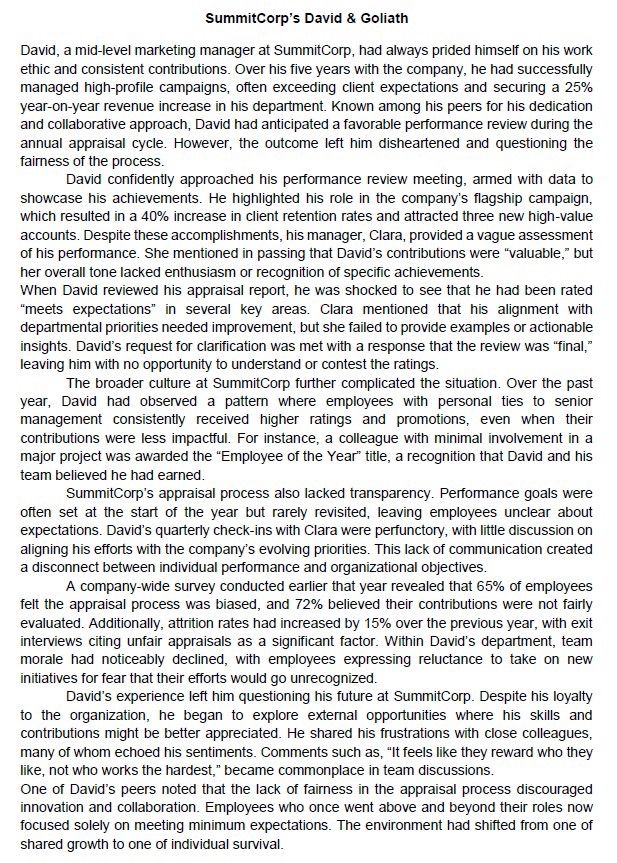
David, a midlevel marketing manager at SummitCorp, had always prided himself on his work ethic and consistent contributions. Over his five years with the company, he had successfully managed highprofile campaigns, often exceeding client expectations and securing a yearonyear revenue increase in his department. Known among his peers for his dedication and collaborative approach, David had anticipated a favorable performance review during the annual appraisal cycle. However, the outcome left him disheartened and questioning the fairness of the process.
David confidently approached his performance review meeting, armed with data to showcase his achievements. He highlighted his role in the company's flagship campaign, which resulted in a increase in client retention rates and attracted three new highvalue accounts. Despite these accomplishments, his manager, Clara, provided a vague assessment of his performance. She mentioned in passing that David's contributions were "valuable," but her overall tone lacked enthusiasm or recognition of specific achievements.
When David reviewed his appraisal report, he was shocked to see that he had been rated "meets expectations" in several key areas. Clara mentioned that his alignment with departmental priorities needed improvement, but she failed to provide examples or actionable insights. David's request for clarification was met with a response that the review was "final," leaving him with no opportunity to understand or contest the ratings.
The broader culture at SummitCorp further complicated the situation. Over the past year, David had observed a pattern where employees with personal ties to senior management consistently received higher ratings and promotions, even when their contributions were less impactful. For instance, a colleague with minimal involvement in a major project was awarded the "Employee of the Year" title, a recognition that David and his team believed he had earned.
SummitCorp's appraisal process also lacked transparency. Performance goals were often set at the start of the year but rarely revisited, leaving employees unclear about expectations. David's quarterly checkins with Clara were perfunctory, with little discussion on aligning his efforts with the company's evolving priorities. This lack of communication created a disconnect between individual performance and organizational objectives.
A companywide survey conducted earlier that year revealed that of employees felt the appraisal process was biased, and believed their contributions were not fairly evaluated. Additionally, attrition rates had increased by over the previous year, with exit interviews citing unfair appraisals as a significant factor. Within David's department, team morale had noticeably declined, with employees expressing reluctance to take on new initiatives for fear that their efforts would go unrecognized.
David's experience left him questioning his future at SummitCorp. Despite his loyalty to the organization, he began to explore external opportunities where his skills and contributions might be better appreciated. He shared his frustrations with close colleagues, many of whom echoed his sentiments Comments such asIt feels like they reward who they like, not who works the hardest," became commonplace in team discussions.
One of David's peers noted that the lack of fairness in the appraisal process discouraged innovation and collaboration. Employees who once went above and beyond their roles now focused solely on meeting minimum expectations. The environment had shifted from one of shared growth to one of individual survival. QUESTIONS
How can organizations ensure transparency in the performance appraisal process to build employee trust and mitigate perceptions of bias?
marks
What strategies can be implemented to ensure individual performance goals consistently align with organizational objectives throughout the appraisal period?
marks
What measures can management take to identify and eliminate favoritism or cronyism in the appraisal process, ensuring a fair and meritbased evaluation system?
marks
Assuming that the management wishes to revise its performance management system, suggest an innovative performance management method that best fits the company.
marks
Step by Step Solution
There are 3 Steps involved in it
1 Expert Approved Answer
Step: 1 Unlock

Question Has Been Solved by an Expert!
Get step-by-step solutions from verified subject matter experts
Step: 2 Unlock
Step: 3 Unlock
 Study Help