





Question: Help to answer the question she sent me and Let break it down, directly to the point So, what did you actually get out of
Help to answer the question she sent me and Let break it down, directly to the point
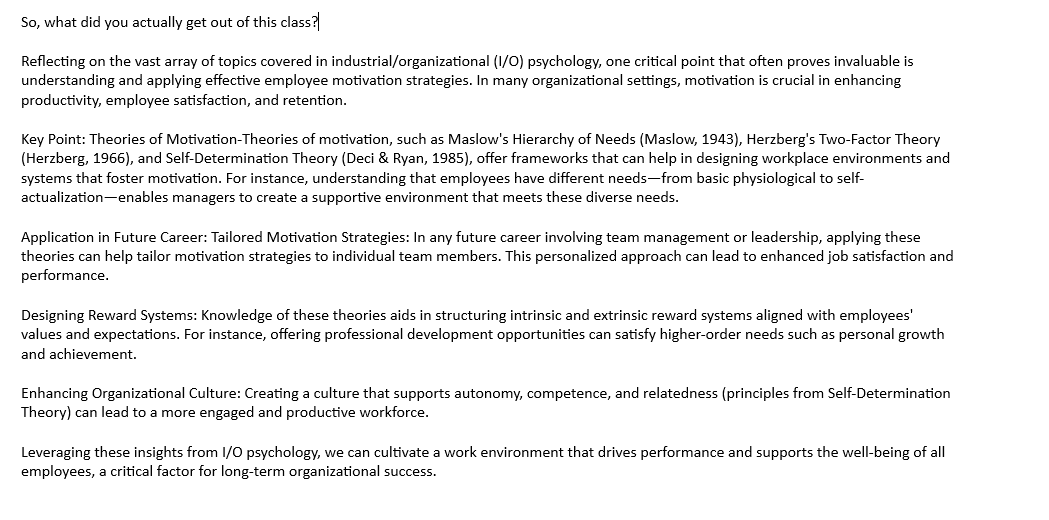
So, what did you actually get out of this class Reflecting on the vast array of topics covered in industrial/organizational (1/0) psychology, one critical point that often proves invaluable is understanding and applying effective employee motivation strategies. In many organizational settings, motivation is crucial in enhancing productivity, employee satisfaction, and retention. Key Point: Theories of Motivation-Theories of mativation, such as Maslow's Hierarchy of Needs (Maslow, 1943), Herzberg's Two-Factor Theory (Herzberg, 1966), and Self-Determination Theory (Deci & Ryan, 1985), offer frameworks that can help in designing workplace environments and systems that foster motivation. For instance, understanding that employees have different needsfrom basic physiological to self- actualizationenables managers to create a supportive environment that meets these diverse needs. Application in Future Career: Tailored Motivation Strategies: In any future career involving team management or leadership, applying these theories can help tailor motivation strategies to individual team members. This personalized approach can lead to enhanced job satisfaction and performance. Designing Reward Systems: Knowledge of these theories aids in structuring intrinsic and extrinsic reward systems aligned with employees' values and expectations. For instance, offering professional development opportunities can satisfy higher-order needs such as personal growth and achievement. Enhancing Organizational Culture: Creating a culture that supports autonomy, competence, and relatedness (principles from Self-Determination Theory) can lead to a more engaged and productive workforce. Leveraging these insights from 1/O psychology, we can cultivate a work environment that drives performance and supports the well-being of all employees, a critical factor for long-term organizational success

