Question: Help to write this paper based on the attached index; You know structured products as the result of financial engineering. Cash flows, maturities, risk, etc.
Help to write this paper based on the attached index;
You know structured products as the result of financial engineering. Cash flows, maturities, risk, etc. are re-engineered to accommodate the buyer of the security's needs ...
The objective of this exercise is to construct structured products and structured products portfolio to achieve your institution's unique goals, be it a non-investment grade portfolio; higher than money market returns on cash proxies; extended duration for asset / liability matching, etc. This asset class, as with hedge funds for example, is highly flexible ...
What about the optimization of structured products? Good question but a little more difficult given the unique engineering nature of the portfolios and cash flows. In the back of the textbook chapters, you see benchmarks for each of the major categories of structured products - and if you turn to Bloomberg, Morningstar, Thomson Reuters, etc., you will find many more or more specifically, data. By now, you have each engaged Excel Solver in FIN369 or FIN672. Engage it again here ....
As with the others, your deliverable will be a five (5) page executive summary with explanations of the portfolio risk / reward objectives and the nature of the sub portfolios.
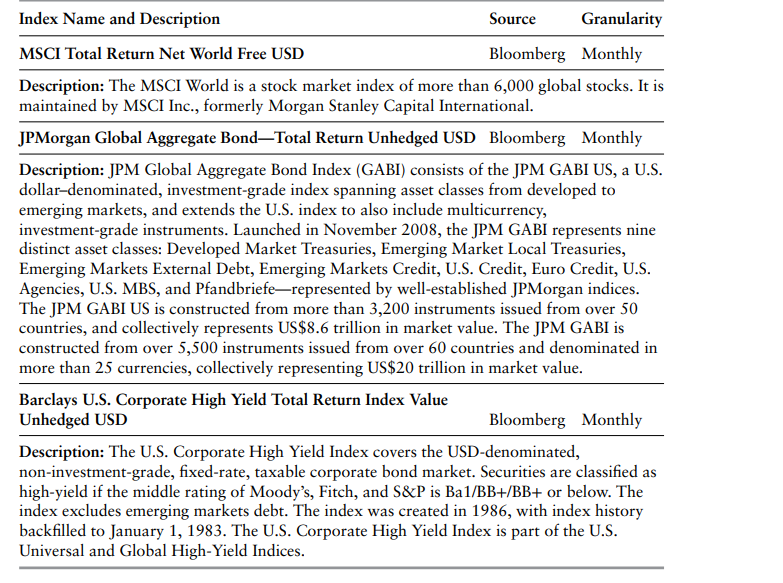
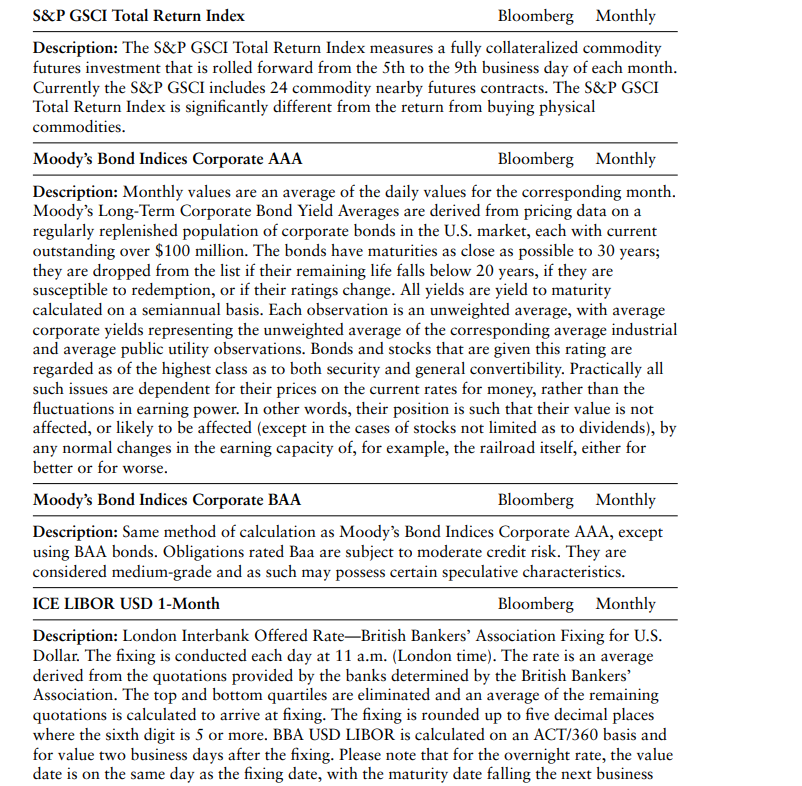
Index Name and Description Source Granularity MSCI Total Return Net World Free USD Bloomberg Monthly Description: The MSCI World is a stock market index of more than 6,000 global stocks. It is maintained by MSCI Inc., formerly Morgan Stanley Capital International. JPMorgan Global Aggregate Bond-Total Return Unhedged USD Bloomberg Monthly Description: JPM Global Aggregate Bond Index (GABI) consists of the JPM GABI US, a U.S. dollar-denominated, investment-grade index spanning asset classes from developed to emerging markets, and extends the U.S. index to also include multicurrency, investment-grade instruments. Launched in November 2008, the JPM GABI represents nine distinct asset classes: Developed Market Treasuries, Emerging Market Local Treasuries, Emerging Markets External Debt, Emerging Markets Credit, U.S. Credit, Euro Credit, U.S. Agencies, U.S. MBS, and Pfandbriefe-represented by well-established JPMorgan indices. The JPM GABI US is constructed from more than 3,200 instruments issued from over 50 countries, and collectively represents US$8.6 trillion in market value. The JPM GABI is constructed from over 5,500 instruments issued from over 60 countries and denominated in more than 25 currencies, collectively representing US$20 trillion in market value. Barclays U.S. Corporate High Yield Total Return Index Value Unhedged USD Bloomberg Monthly Description: The U.S. Corporate High Yield Index covers the USD-denominated, non-investment-grade, fixed-rate, taxable corporate bond market. Securities are classified as high-yield if the middle rating of Moody's, Fitch, and S&P is Bal/BB+/BB+ or below. The index excludes emerging markets debt. The index was created in 1986, with index history backfilled to January 1, 1983. The U.S. Corporate High Yield Index is part of the U.S. Universal and Global High-Yield Indices.S&P GSCI Total Return Index Bloomberg Monthly Description: The S&P GSCI Total Return Index measures a fully collateralized commodity futures investment that is rolled forward from the 5th to the 9th business day of each month. Currently the S&P GSCI includes 24 commodity nearby futures contracts. The S&P GSCI Total Return Index is significantly different from the return from buying physical commodities. Moody's Bond Indices Corporate AAA Bloomberg Monthly Description: Monthly values are an average of the daily values for the corresponding month. Moody's Long-Term Corporate Bond Yield Averages are derived from pricing data on a regularly replenished population of corporate bonds in the U.S. market, each with current outstanding over $100 million. The bonds have maturities as close as possible to 30 years; they are dropped from the list if their remaining life falls below 20 years, if they are susceptible to redemption, or if their ratings change. All yields are yield to maturity calculated on a semiannual basis. Each observation is an unweighted average, with average corporate yields representing the unweighted average of the corresponding average industrial and average public utility observations. Bonds and stocks that are given this rating are regarded as of the highest class as to both security and general convertibility. Practically all such issues are dependent for their prices on the current rates for money, rather than the fluctuations in earning power. In other words, their position is such that their value is not affected, or likely to be affected (except in the cases of stocks not limited as to dividends), by any normal changes in the earning capacity of, for example, the railroad itself, either for better or for worse. Moody's Bond Indices Corporate BAA Bloomberg Monthly Description: Same method of calculation as Moody's Bond Indices Corporate AAA, except using BAA bonds. Obligations rated Baa are subject to moderate credit risk. They are considered medium-grade and as such may possess certain speculative characteristics. ICE LIBOR USD 1-Month Bloomberg Monthly Description: London Interbank Offered RateBritish Bankers' Association Fixing for U.S. Dollar. The fixing is conducted each day at 11 a.m. (London time). The rate is an average derived from the quotations provided by the banks determined by the British Bankers' Association. The top and bottom quartiles are eliminated and an average of the remaining quotations 1s calculated to arrive at fixing. The fixing is rounded up to five decimal places where the sixth digit is 5 or more. BBA USD LIBOR is calculated on an ACT/360 basis and for value two business days after the fixing. Please note that for the overnight rate, the value date is on the same day as the fixing date, with the maturity date falling the next business
Step by Step Solution
There are 3 Steps involved in it
1 Expert Approved Answer
Step: 1 Unlock
Question Has Been Solved by an Expert!
Get step-by-step solutions from verified subject matter experts
Step: 2 Unlock
Step: 3 Unlock
Students Have Also Explored These Related Finance Questions!









 Study Help