







Question: Help with #1? 498 Part 5: Structuring Financing for the Growing Venture Internet Activities 1. Locate your state's small business credit facilita- tion Web page.
Help with #1?
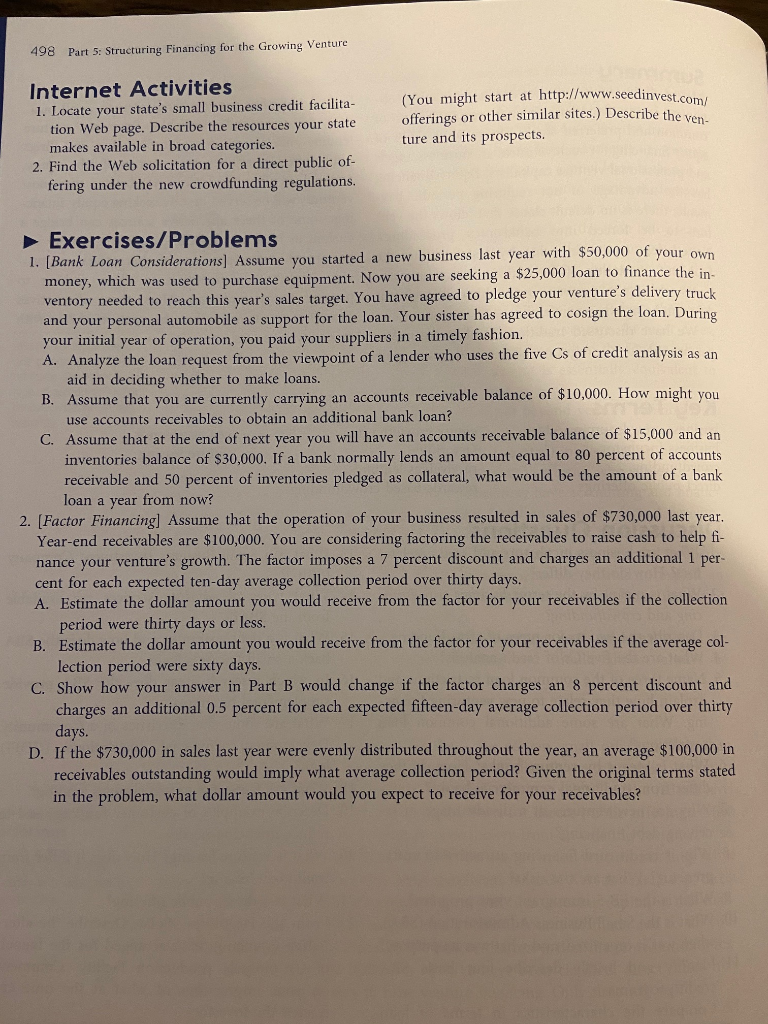
498 Part 5: Structuring Financing for the Growing Venture Internet Activities 1. Locate your state's small business credit facilita- tion Web page. Describe the resources your state makes available in broad categories. 2. Find the Web solicitation for a direct public of fering under the new crowdfunding regulations. (You might start at http://www.seedinvest.se offerings or other similar sites.) Describe the ven ture and its prospects. Exercises/Problems 1. (Bank Loan Considerations Assume you started a new business last year with $50,000 of your own money, which was used to purchase equipment. Now you are seeking a $25,000 loan to finance the in- ventory needed to reach this year's sales target. You have agreed to pledge your venture's delivery truck and your personal automobile as support for the loan. Your sister has agreed to cosign the loan. During your initial year of operation, you paid your suppliers in a timely fashion. A. Analyze the loan request from the viewpoint of a lender who uses the five Cs of credit analysis as an aid in deciding whether to make loans. B. Assume that you are currently carrying an accounts receivable balance of $10,000. How might you use accounts receivables to obtain an additional bank loan? C. Assume that at the end of next year you will have an accounts receivable balance of $15,000 and an inventories balance of $30,000. If a bank normally lends an amount equal to 80 percent of accounts receivable and 50 percent of inventories pledged as collateral, what would be the amount of a bank loan a year from now? 2. (Factor Financing) Assume that the operation of your business resulted in sales of $730,000 last year. Year-end receivables are $100,000. You are considering factoring the receivables to raise cash to help fi- nance your venture's growth. The factor imposes a 7 percent discount and charges an additional 1 per- cent for each expected ten-day average collection period over thirty days. A. Estimate the dollar amount you would receive from the factor for your receivables if the collection period were thirty days or less. B. Estimate the dollar amount you would receive from the factor for your receivables if the average col- lection period were sixty days. C. Show how your answer in Part B would change if the factor charges an 8 percent discount and charges an additional 0.5 percent for each expected fifteen-day average collection period over thirty days. D. If the $730,000 in sales last year were evenly distributed throughout the year, an average $100,000 in receivables outstanding would imply what average collection period? Given the original terms stated in the problem, what dollar amount would you expect to receive for your receivables
Step by Step Solution
There are 3 Steps involved in it

Get step-by-step solutions from verified subject matter experts
 Study Help