







Question: help with #1,#2 and #3 please - Calculate Hrxn using the values in table 1. Draw structures of reactants and products. Draw an arrow to
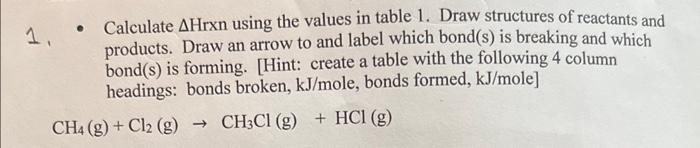
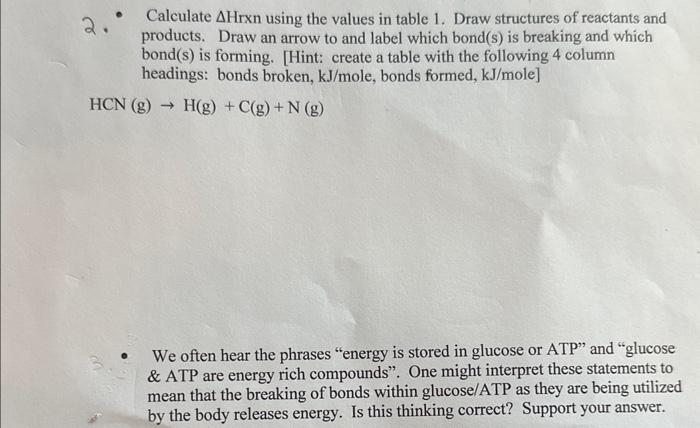
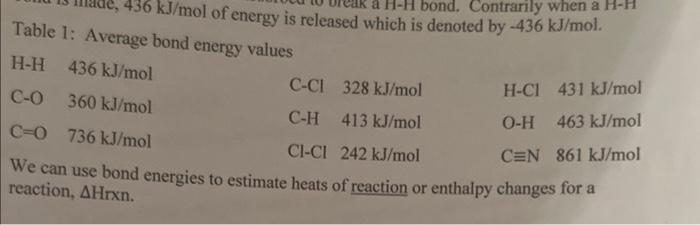
- Calculate Hrxn using the values in table 1. Draw structures of reactants and products. Draw an arrow to and label which bond(s) is breaking and which bond(s) is forming. [Hint: create a table with the following 4 column headings: bonds broken, kJ/ mole, bonds formed, kJ/mole] CH4(g)+Cl2(g)CH3Cl(g)+HCl(g) - Calculate Hrxn using the values in table 1. Draw structures of reactants and products. Draw an arrow to and label which bond(s) is breaking and which bond(s) is forming. [Hint: create a table with the following 4 column headings: bonds broken, kJ/ mole, bonds formed, kJ/mole ] HCN(g)H(g)+C(g)+N(g) - We often hear the phrases "energy is stored in glucose or ATP" and "glucose \& ATP are energy rich compounds". One might interpret these statements to mean that the breaking of bonds within glucose/ATP as they are being utilized by the body releases energy. Is this thinking correct? Support your answer. Table 1: Average bond energy values reaction, Hran
Step by Step Solution
There are 3 Steps involved in it

Get step-by-step solutions from verified subject matter experts
 Study Help