







Question: help with case analysis ,item need to be covered! Include references! Current and Future Implications of the Recommended Marketing Ideas: Identify current as well as
help with case analysis ,item need to be covered! Include references! 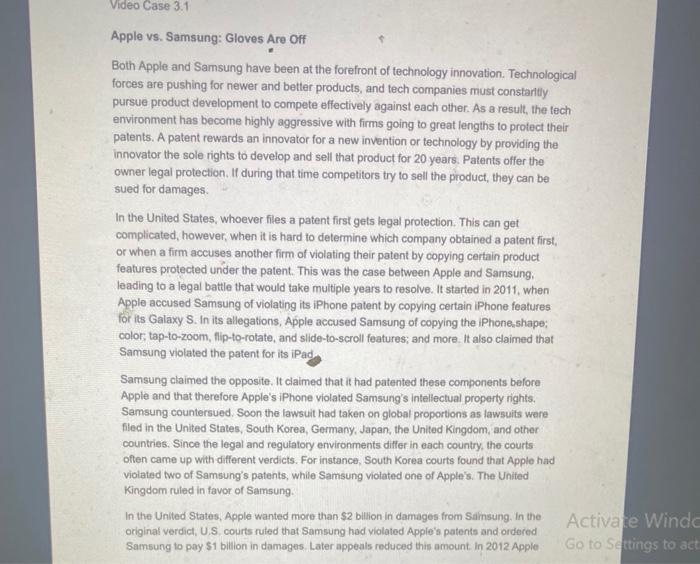
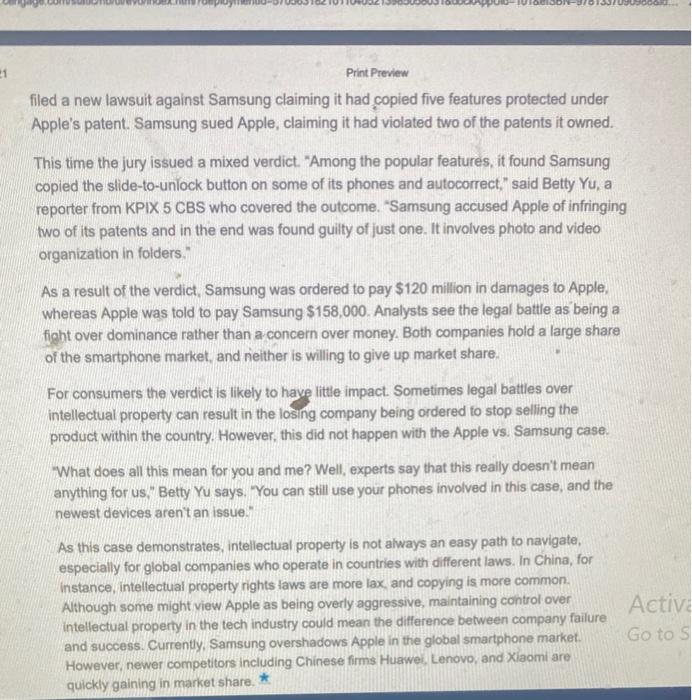
Video Case 3.1 Apple vs. Samsung: Gloves Are Off Both Apple and Samsung have been at the forefront of technology innovation. Technological forces are pushing for newer and better products, and tech companies must constantly pursue product development to compete effectively against each other. As a result, the tech environment has become highly aggressive with firms going to great lengths to protect their patents. A patent rewards an innovator for a new invention or technology by providing the innovator the sole rights to develop and sell that product for 20 years. Patents offer the owner legal protection. If during that time competitors try to sell the product, they can be sued for damages In the United States, whoever files a patent first gets legal protection. This can get complicated, however, when it is hard to determine which company obtained a patent first, or when a firm accuses another firm of violating their patent by copying certain product features protected under the patent. This was the case between Apple and Samsung, leading to a legal battle that would take multiple years to resolve. It started in 2011, when Apple accused Samsung of violating its iPhone patent by copying certain iPhone features for its Galaxy S. In its allegations, Apple accused Samsung of copying the IPhone,shape color; tap-to-zoom, flip-to-rotate, and slide-to-scroll features, and more. It also claimed that Samsung violated the patent for its iPad Samsung claimed the opposite. It claimed that it had patented these components before Apple and that therefore Apple's iPhone violated Samsung's intellectual property rights. Samsung countersued. Soon the lawsuit had taken on global proportions as lawsuits were filed in the United States, South Korea, Germany, Japan, the United Kingdom, and other countries. Since the legal and regulatory environments differ in each country, the courts often came up with different verdicts. For instance, South Korea courts found that Apple had violated two of Samsung's patents, while Samsung violated one of Apples. The United Kingdom ruled in favor of Samsung In the United States, Apple wanted more than $2 billion in damages from Salinsung. In the Activate Windo original verdict, U.S courts ruled that Samsung had violated Apple's patents and ordered Samsung to pay $1 billion in damages. Later appeals reduced this amount. In 2012 Apple Go to Settings to act 1 Print Preview filed a new lawsuit against Samsung claiming it had copied five features protected under Apple's patent. Samsung sued Apple, claiming it had violated two of the patents it owned. This time the jury issued a mixed verdict. "Among the popular features, it found Samsung copied the slide-to-unlock button on some of its phones and autocorrect," said Betty Yu, a reporter from KPIX 5 CBS who covered the outcome. "Samsung accused Apple of infringing two of its patents and in the end was found guilty of just one. It involves photo and video organization in folders." As a result of the verdict, Samsung was ordered to pay $120 million in damages to Apple, whereas Apple was told to pay Samsung $158,000. Analysts see the legal battle as being a fight over dominance rather than a concern over money. Both companies hold a large share of the smartphone market and neither is willing to give up market share. For consumers the verdict is likely to have little impact. Sometimes legal battles over intellectual property can result in the losing company being ordered to stop selling the product within the country. However, this did not happen with the Apple vs. Samsung case. "What does all this mean for you and me? Well, experts say that this really doesn't mean anything for us." Betty Yu says. "You can still use your phones involved in this case, and the newest devices aren't an issue. As this case demonstrates, intellectual property is not always an easy path to navigate, especially for global companies who operate in countries with different laws. In China, for instance, intellectual property rights laws are more lax and copying is more common. Although some might view Apple as being overly aggressive, maintaining control over intellectual property in the tech industry could mean the difference between company failure and success. Currently, Samsung overshadows Apple in the global smartphone market. However, newer competitors including Chinese firms Huawei, Lenovo, and Xiaomi are quickly gaining in market share. * Active Go to S - Current and Future Implications of the Recommended Marketing Ideas: Identify current as well as future implications and consequences of the recommendations/decisions you suggested.
- Fostering Market Orientation: Thoroughly explain how the interrelationships between the different parts and functions of the company can maximize positive outcomes with customers and suppliers in a competitive market.
- Examples of Global Marketing: Thoroughly discuss global business practices of the company featured in the case with relevant examples and evidence.
- Examples of Socially Responsible Business Practices: Thoroughly discuss socially responsible business practices of the company featured in the case with relevant examples and evidence.
Step by Step Solution
There are 3 Steps involved in it
1 Expert Approved Answer
Step: 1 Unlock

Question Has Been Solved by an Expert!
Get step-by-step solutions from verified subject matter experts
Step: 2 Unlock
Step: 3 Unlock
 Study Help