







Question: Help with Java, text-based adventure game AT&T LTE 3:15 PM a uno.mrooms3.net Homework 6: Adding Players, Monsters and Items Description: In the previous assignment, you
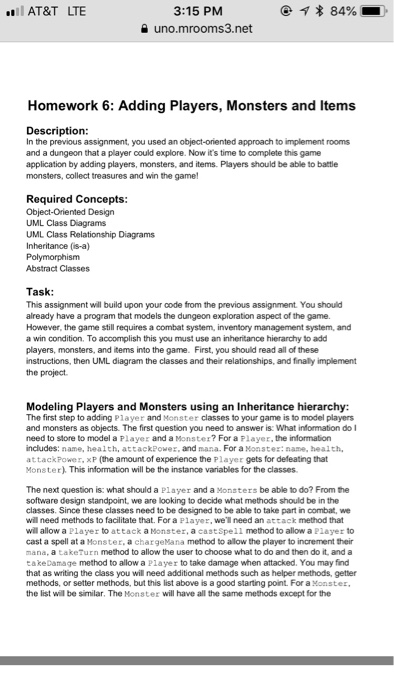
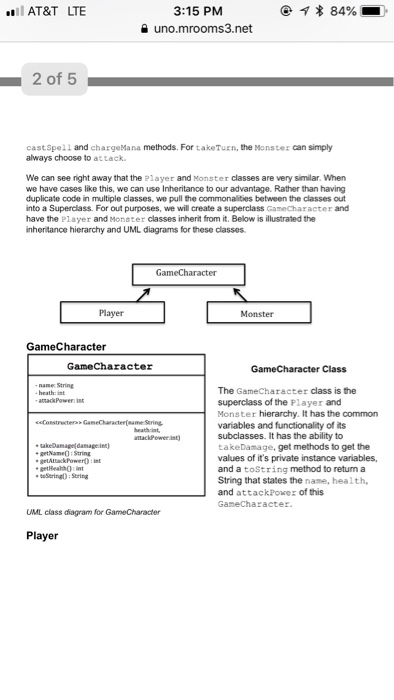
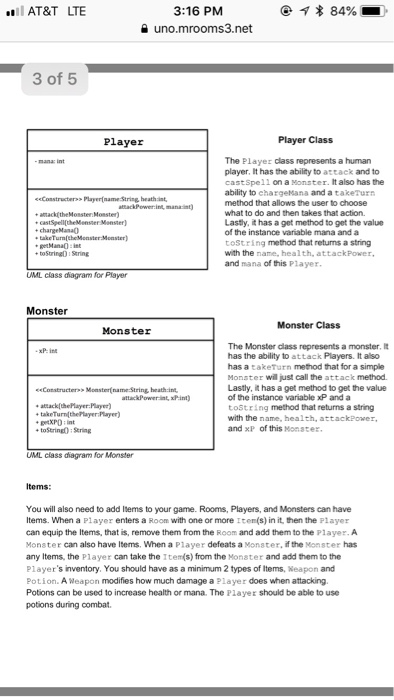
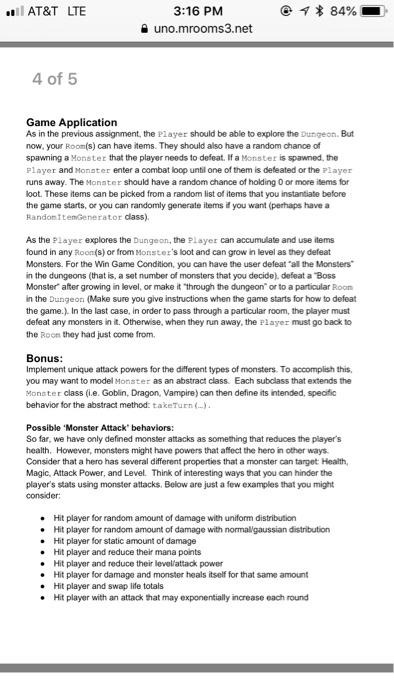
AT&T LTE 3:15 PM a uno.mrooms3.net Homework 6: Adding Players, Monsters and Items Description: In the previous assignment, you used an object-oriented approach to implement rooms and a dungeon that a player could explore. Now it's time to complete this game application by adding players, monsters, and items. Players should be able to battle monsters, collect treasures and win the game! Required Concepts: Object-Oriented Design UML Class Diagrams UML Class Relationship Diagrams Inheritance (is-a) Polymorphism Abstract Classes Task: This assignment will build upon your code from the previous assignment You should already have a program that models the dungeon exploration aspect of the game. However, the game still requires a combat system, inventory management system, and a win condition. To accomplish this you must use an inheritance hierarchy to add players, monsters, and items into the game. First, you should read all of these instructions, then UML diagram the classes and their relationships, and finaly implement the project Modeling Players and Monsters using an Inheritance hierarchy: The first step to adding Player and Monster classes to your game is to model players and monsters as objects. The first question you need to answer is: What information do I need to store to model a Player and a Monster? For a Player, the information includes: name, health, attackPowex, and mana. For a Nonstes: name, health, attackPower, xP (the amount of experience the Player gets for defeating that Monster) This information will be the instance variables for the classes. The next question is: what should a Player and a Monsters be able to do? From the software design standpoint, we are looking to decide what methods should be in the classes. Since these classes need to be designed to be able to take part in combat, we will need methods to facilitate that. For a Player, well need an attack method that will allow a P cast a spell at a Monster, a chargeMana method to allow the player to increment their mana, a takeTurn method to allow the user to choose what to do and then do it, and a takeDamage method to allow a Player to take damage when attacked. You may find that as writing the class you will need additional methods such as helper methods, getter methods, or setter methods, but this list above is a good starting point. For a Monster, the list will be similar. The Monster will have all the same methods except for the layer to attack a Monster, a castSpell method to allow a Player to AT&T LTE 3:15 PM a uno.mrooms3.net Homework 6: Adding Players, Monsters and Items Description: In the previous assignment, you used an object-oriented approach to implement rooms and a dungeon that a player could explore. Now it's time to complete this game application by adding players, monsters, and items. Players should be able to battle monsters, collect treasures and win the game! Required Concepts: Object-Oriented Design UML Class Diagrams UML Class Relationship Diagrams Inheritance (is-a) Polymorphism Abstract Classes Task: This assignment will build upon your code from the previous assignment You should already have a program that models the dungeon exploration aspect of the game. However, the game still requires a combat system, inventory management system, and a win condition. To accomplish this you must use an inheritance hierarchy to add players, monsters, and items into the game. First, you should read all of these instructions, then UML diagram the classes and their relationships, and finaly implement the project Modeling Players and Monsters using an Inheritance hierarchy: The first step to adding Player and Monster classes to your game is to model players and monsters as objects. The first question you need to answer is: What information do I need to store to model a Player and a Monster? For a Player, the information includes: name, health, attackPowex, and mana. For a Nonstes: name, health, attackPower, xP (the amount of experience the Player gets for defeating that Monster) This information will be the instance variables for the classes. The next question is: what should a Player and a Monsters be able to do? From the software design standpoint, we are looking to decide what methods should be in the classes. Since these classes need to be designed to be able to take part in combat, we will need methods to facilitate that. For a Player, well need an attack method that will allow a P cast a spell at a Monster, a chargeMana method to allow the player to increment their mana, a takeTurn method to allow the user to choose what to do and then do it, and a takeDamage method to allow a Player to take damage when attacked. You may find that as writing the class you will need additional methods such as helper methods, getter methods, or setter methods, but this list above is a good starting point. For a Monster, the list will be similar. The Monster will have all the same methods except for the layer to attack a Monster, a castSpell method to allow a Player to
Step by Step Solution
There are 3 Steps involved in it

Get step-by-step solutions from verified subject matter experts
 Study Help