



Question: help with these parts i got them wrong (Bond valuation relationships) Arizona Public Utilities issued a bond that pays $80 in interest, with a $1,000

help with these parts i got them wrong
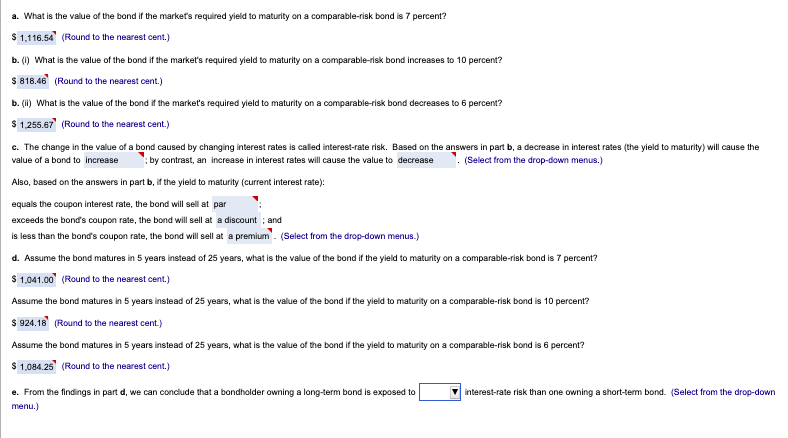
(Bond valuation relationships) Arizona Public Utilities issued a bond that pays $80 in interest, with a $1,000 par value. It matures in 25 years. The market's required yield to maturity on a comparable-risk bond is 6 percent. a. Calculate the value of the bond. b. How does the value change if the market's required yield to maturity on a comparable-risk bond (i) increases to 11 percent or (ii) decreases to 5 percent? c. Explain the implications of your answers in part b as they relate to interest-rate risk. premium bonds, and discount bonds. d. Assume that the bond matures in 5 years instead of 25 years. Recompute your answers in parts a and b. e. Explain the implications of your answers in part d as they relate to interest-rate risk, premium bonds, and discount bonds. a. What is the value of the bond if the marker's required yield to maturity on a comparable-risk bond is 7 percent? $ 1,116.54 (Round to the nearest cent.) b. (0) What is the value of the bond if the market's required yield to maturity on a comparable-risk bond increases to 10 percent? $ 818.46 (Round to the nearest cont.) b. (W) What is the value of the bond if the market's required yield to maturity on a comparable-risk bond decreases to 6 percent? $ 1.255.67" (Round to the nearest cent.) c. The change in the value of a bond caused by changing interest rates is called interest-rate risk. Based on the answers in part b, a decrease in interest rates (the yield to maturity) will cause the value of a bond to increase by contrast, an increase in interest rates will cause the value to decrease (Select from the drop-down menus.) Also, based on the answers in part b, if the yield to maturity (current interest rate). equals the coupon interest rate, the bond will sell at par exceeds the bonds coupon rate, the bond will sell at a discount ; and is less than the bond's coupon rate, the bond will sell at a premium. (Select from the drop-down menus.) d. Assume the bond matures in 5 years instead of 25 years, what is the value of the bond if the yield to maturity on a comparable-risk bond is 7 percent? $ 1,041.00 (Round to the nearest cent.) Assume the bond matures in 5 years instead of 25 years, what is the value of the bond if the yield to maturity on a comparable-risk bond is 10 percent? $ 924.18 (Round to the nearest cent.) Assume the bond matures in 5 years instead of 25 years, what is the value of the bond if the yield to maturity on a comparable-risk bond is 6 percent? $ 1.084.25" (Round to the nearest cent.) e. From the findings in part d, we can conclude that a bondholder owning a long-term bond is exposed to interest-rate risk than one owning a short-term bond. (Select from the drop-down menu.)
Step by Step Solution
There are 3 Steps involved in it

Get step-by-step solutions from verified subject matter experts