







Question: Help with this HW problem please. The box with A-G is to help with dropdown for req. 1 and 2. I have screenshotted choices for
Help with this HW problem please. The box with A-G is to help with dropdown for req. 1 and 2. I have screenshotted choices for 3 as well. Please show work it helps me understand where you are getting your calculations!!

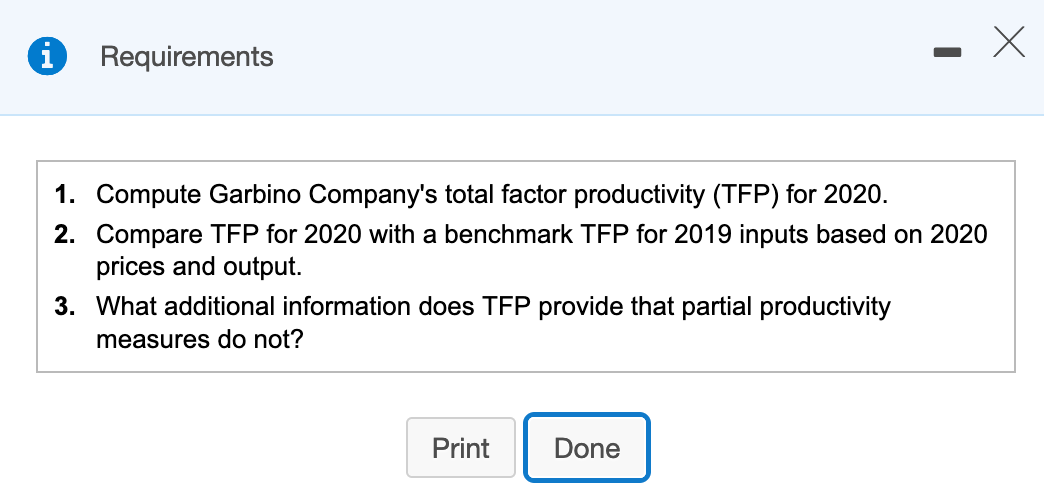
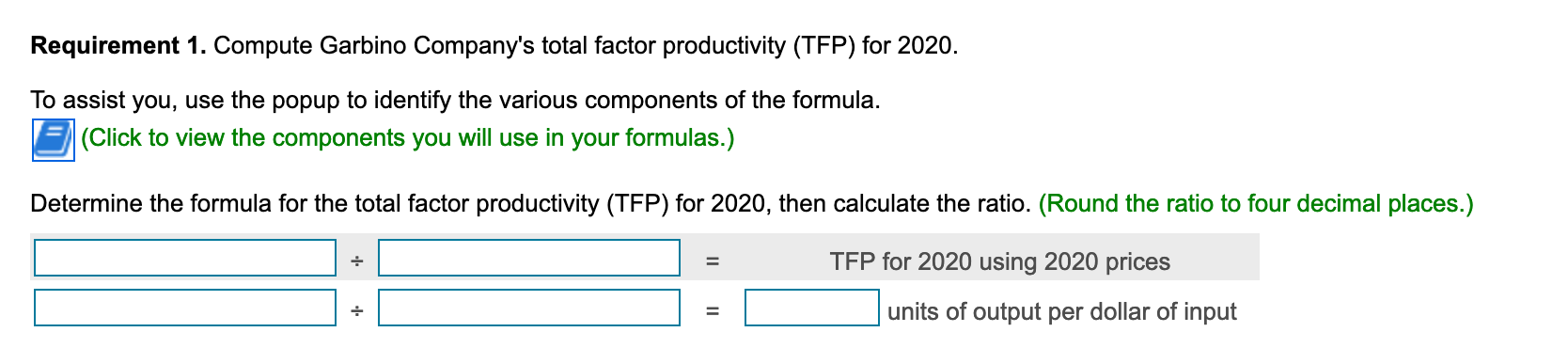
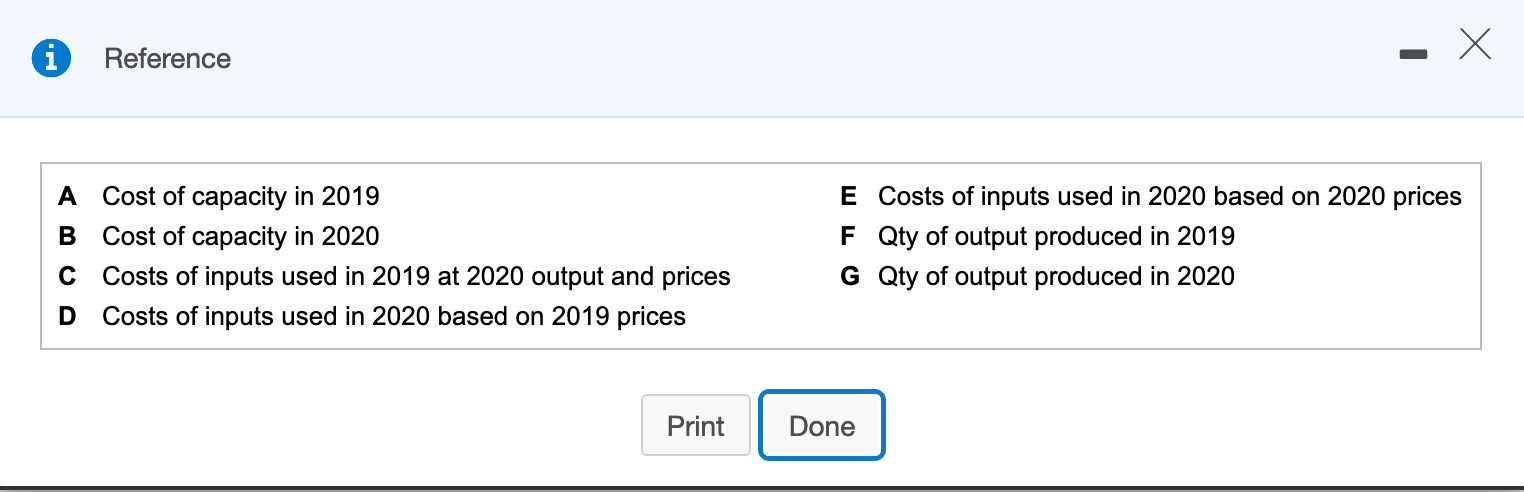





Garbino Company manufactures wallets from fabric. In 2019, Garbino made 2,520,000 wallets using 2,000,000 yards of fabric. In 2019, Garbino has capacity to make 3,307,500 wallets and incurs a cost of $11,576,250 for this capacity. In 2020, Garbino plans to make 2,646,000 wallets, make fabric use more efficient, and reduce capacity. Suppose that in 2020 Garbino makes 2,646,000 wallets, uses 1,764,000 yards of fabric, and reduces capacity to 2,700,000 wallets at a cost of $9,720,000. Assume the fabric costs $4.50 per yard in 2020 and $4.60 per yard in 2019. Read the requirements. i Requirements 1. Compute Garbino Company's total factor productivity (TFP) for 2020. 2. Compare TFP for 2020 with a benchmark TFP for 2019 inputs based on 2020 prices and output. 3. What additional information does TFP provide that partial productivity measures do not? Print Done Requirement 1. Compute Garbino Company's total factor productivity (TFP) for 2020. To assist you, use the popup to identify the various components of the formula. (Click to view the components you will use in your formulas.) Determine the formula for the total factor productivity (TFP) for 2020, then calculate the ratio. (Round the ratio to four decimal places.) TFP for 2020 using 2020 prices units of output per dollar of input = i Reference A Cost of capacity in 2019 B Cost of capacity in 2020 C Costs of inputs used in 2019 at 2020 output and prices D Costs of inputs used in 2020 based on 2019 prices E Costs of inputs used in 2020 based on 2020 prices F Qty of output produced in 2019 G Qty of output produced in 2020 Print Done Requirement 2. Compare TFP for 2020 with a benchmark TFP for 2019 inputs based on 2020 prices and output. To assist you, use the popup to identify the various components of the formula. (Click to view the components you will use in your formulas.) Begin by determining the formula used to calculate the benchmark TFP for 2019 inputs based on 2020 output, then complete the calculation. (Round the ratio to four decimal places.) Benchmark TFP units of output per dollar of input i Reference A Cost of capacity in 2019 B Cost of capacity in 2020 C Costs of inputs used in 2019 at 2020 output and prices D Costs of inputs used in 2020 based on 2019 prices E Costs of inputs used in 2020 based on 2020 prices F Qty of output produced in 2019 G Qty of output produced in 2020 Print Done (Round the percentage to the nearest tenth percent, X.X%.) The total factor productivity by % from 2019 to 2020. Requirement 3. What additional information does TFP provide that partial productivity measures do not? A major advantage of TFP over partial productivity measures is that TFP and so measures gains from using fewer physical inputs and substitution among inputs. Partial productivities be combined to indicate the overall effect on cost as a result of these individual improvements. The total factor productivity vby % from 2019 to 2020. Requirement 3. What additiona s TFP provide that partial productivity measures do not? decreased A major advantage of TFP over increased ity measures is that TEP and so measures gains from using fewer physical inputs and substitution among inputs. Partial productivities be combined to indicate the overall effect on cost as a result of these individual improvements. Choose from any list or enter any number in the input fields and then continue to the next question. ? and so measures gains from using fewer physical inputs and substitution among inputs. Partial A major advantage of TFP over partial productivity measures is that TFP productivities be combined to indicate the overall effect on cost : combines the productivity of all inputs Choose from any list or enter any number in the input fields and then looks at each input separately The total factc by % from 2019 to 2020. can Requirement A major advar ial information does TFP provide that partial productivity measures do not? cannot r partial productivity measures is that TFP and so measures gains from using fewer physical inputs and substitution among inputs. Partial be combined to indicate the overall effect on cost as a result of these individual improvements. productivities Choose from any list or enter any number in the input fields and then continue to the next question. Garbino Company manufactures wallets from fabric. In 2019, Garbino made 2,520,000 wallets using 2,000,000 yards of fabric. In 2019, Garbino has capacity to make 3,307,500 wallets and incurs a cost of $11,576,250 for this capacity. In 2020, Garbino plans to make 2,646,000 wallets, make fabric use more efficient, and reduce capacity. Suppose that in 2020 Garbino makes 2,646,000 wallets, uses 1,764,000 yards of fabric, and reduces capacity to 2,700,000 wallets at a cost of $9,720,000. Assume the fabric costs $4.50 per yard in 2020 and $4.60 per yard in 2019. Read the requirements. i Requirements 1. Compute Garbino Company's total factor productivity (TFP) for 2020. 2. Compare TFP for 2020 with a benchmark TFP for 2019 inputs based on 2020 prices and output. 3. What additional information does TFP provide that partial productivity measures do not? Print Done Requirement 1. Compute Garbino Company's total factor productivity (TFP) for 2020. To assist you, use the popup to identify the various components of the formula. (Click to view the components you will use in your formulas.) Determine the formula for the total factor productivity (TFP) for 2020, then calculate the ratio. (Round the ratio to four decimal places.) TFP for 2020 using 2020 prices units of output per dollar of input = i Reference A Cost of capacity in 2019 B Cost of capacity in 2020 C Costs of inputs used in 2019 at 2020 output and prices D Costs of inputs used in 2020 based on 2019 prices E Costs of inputs used in 2020 based on 2020 prices F Qty of output produced in 2019 G Qty of output produced in 2020 Print Done Requirement 2. Compare TFP for 2020 with a benchmark TFP for 2019 inputs based on 2020 prices and output. To assist you, use the popup to identify the various components of the formula. (Click to view the components you will use in your formulas.) Begin by determining the formula used to calculate the benchmark TFP for 2019 inputs based on 2020 output, then complete the calculation. (Round the ratio to four decimal places.) Benchmark TFP units of output per dollar of input i Reference A Cost of capacity in 2019 B Cost of capacity in 2020 C Costs of inputs used in 2019 at 2020 output and prices D Costs of inputs used in 2020 based on 2019 prices E Costs of inputs used in 2020 based on 2020 prices F Qty of output produced in 2019 G Qty of output produced in 2020 Print Done (Round the percentage to the nearest tenth percent, X.X%.) The total factor productivity by % from 2019 to 2020. Requirement 3. What additional information does TFP provide that partial productivity measures do not? A major advantage of TFP over partial productivity measures is that TFP and so measures gains from using fewer physical inputs and substitution among inputs. Partial productivities be combined to indicate the overall effect on cost as a result of these individual improvements. The total factor productivity vby % from 2019 to 2020. Requirement 3. What additiona s TFP provide that partial productivity measures do not? decreased A major advantage of TFP over increased ity measures is that TEP and so measures gains from using fewer physical inputs and substitution among inputs. Partial productivities be combined to indicate the overall effect on cost as a result of these individual improvements. Choose from any list or enter any number in the input fields and then continue to the next question. ? and so measures gains from using fewer physical inputs and substitution among inputs. Partial A major advantage of TFP over partial productivity measures is that TFP productivities be combined to indicate the overall effect on cost : combines the productivity of all inputs Choose from any list or enter any number in the input fields and then looks at each input separately The total factc by % from 2019 to 2020. can Requirement A major advar ial information does TFP provide that partial productivity measures do not? cannot r partial productivity measures is that TFP and so measures gains from using fewer physical inputs and substitution among inputs. Partial be combined to indicate the overall effect on cost as a result of these individual improvements. productivities Choose from any list or enter any number in the input fields and then continue to the next
Step by Step Solution
There are 3 Steps involved in it

Get step-by-step solutions from verified subject matter experts
 Study Help