Question: HELP!!Please no AI STEP 1: Using the passage below, construct a paraphrase of a portion of the text, naming the source and incorporating the paraphrase
HELP!!Please no AI
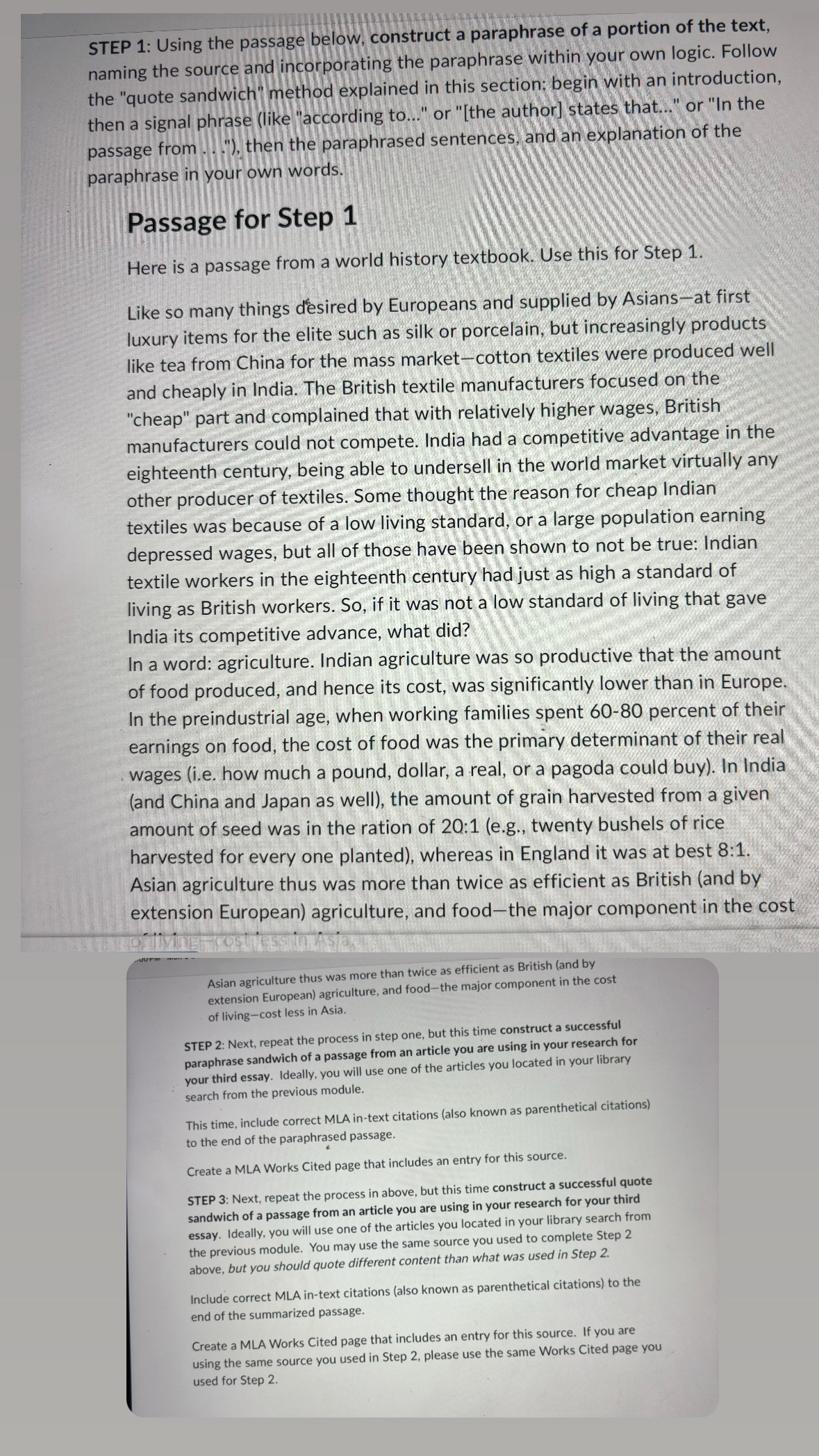
STEP 1: Using the passage below, construct a paraphrase of a portion of the text, naming the source and incorporating the paraphrase within your own logic. Follow the "quote sandwich" method explained in this section: begin with an introduction, then a signal phrase (like "according to..." or "[the author] states that..." or "In the passage from . . "), then the paraphrased sentences, and an explanation of the paraphrase in your own words. Passage for Step 1 Here is a passage from a world history textbook. Use this for Step 1. Like so many things desired by Europeans and supplied by Asians-at first luxury items for the elite such as silk or porcelain, but increasingly products like tea from China for the mass market-cotton textiles were produced well and cheaply in India. The British textile manufacturers focused on the "cheap" part and complained that with relatively higher wages, British manufacturers could not compete. India had a competitive advantage in the eighteenth century, being able to undersell in the world market virtually any other producer of textiles. Some thought the reason for cheap Indian textiles was because of a low living standard, or a large population earning depressed wages, but all of those have been shown to not be true: Indian textile workers in the eighteenth century had just as high a standard of living as British workers. So, if it was not a low standard of living that gave India its competitive advance, what did? In a word: agriculture. Indian agriculture was so productive that the amount of food produced, and hence its cost, was significantly lower than in Europe. In the preindustrial age, when working families spent 60-80 percent of their earnings on food, the cost of food was the primary determinant of their real wages (i.e. how much a pound, dollar, a real, or a pagoda could buy). In India (and China and Japan as well), the amount of grain harvested from a given amount of seed was in the ration of 20:1 (e.g., twenty bushels of rice harvested for every one planted), whereas in England it was at best 8:1. Asian agriculture thus was more than twice as efficient as British (and by extension European) agriculture, and food-the major component in the cost Asian agriculture thus was more than twice as efficient as British (and by extension European) agriculture, and food-the major component in the cost of living-cost less in Asia. STEP 2: Next, repeat the process in step one, but this time construct a successful paraphrase sandwich of a passage from an article you are using in your research for your third essay. Ideally, you will use one of the articles you located in your library search from the previous module. This time, include correct MLA in-text citations (also known as parenthetical citations) to the end of the paraphrased passage. Create a MLA Works Cited page that includes an entry for this source. STEP 3: Next, repeat the process in above, but this time construct a successful quote sandwich of a passage from an article you are using in your research for your third essay. Ideally, you will use one of the articles you located in your library search from the previous module. You may use the same source you used to complete Step 2 above, but you should quote different content than what was used in Step 2. Include correct MLA in-text citations (also known as parenthetical citations) to the end of the summarized passage. Create a MLA Works Cited page that includes an entry for this source. If you are using the same source you used in Step 2, please use the same Works Cited page you used for Step 2









 Study Help