







Question: Here, a digital system comprising 3 registers (A, B, C) and an arithmetic unit is shown (left), along with the system's control circuit (right). The
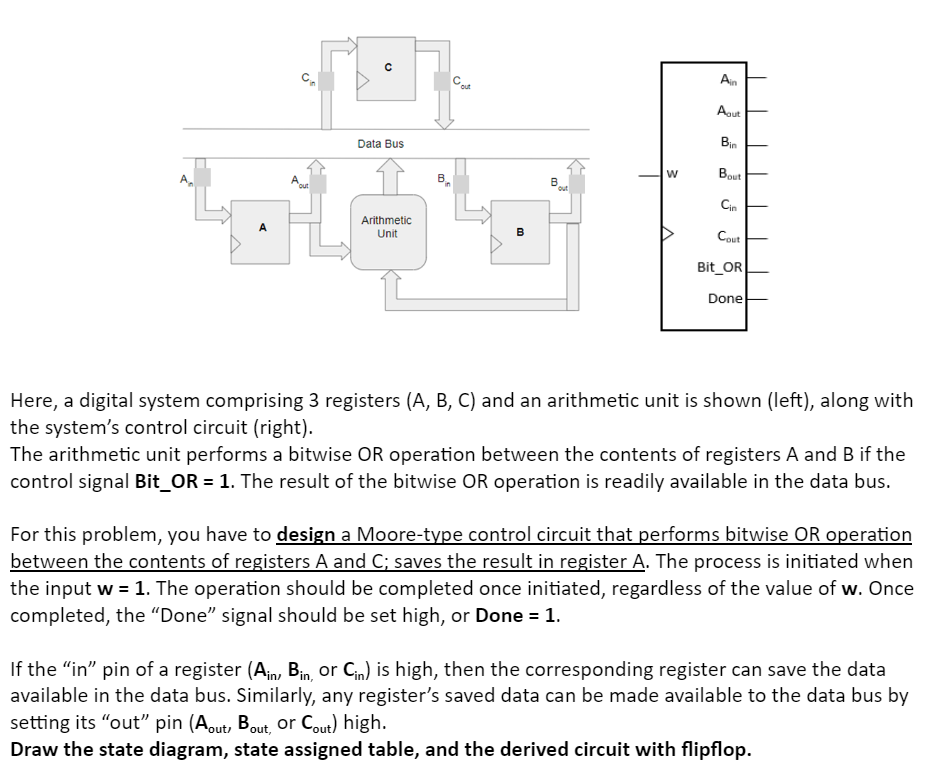
Here, a digital system comprising 3 registers (A, B, C) and an arithmetic unit is shown (left), along with the system's control circuit (right). The arithmetic unit performs a bitwise OR operation between the contents of registers A and B if the control signal Bit_OR =1. The result of the bitwise OR operation is readily available in the data bus. For this problem, you have to design a Moore-type control circuit that performs bitwise OR operation between the contents of registers A and C; saves the result in register A. The process is initiated when the input w=1. The operation should be completed once initiated, regardless of the value of w. Once completed, the "Done" signal should be set high, or Done =1. If the " in " pin of a register (Ain,Bin,, or Cin) is high, then the corresponding register can save the data available in the data bus. Similarly, any register's saved data can be made available to the data bus by setting its "out" pin (Aout,Bout,, or Cout) high. Draw the state diagram, state assigned table, and the derived circuit with flipflop
Step by Step Solution
There are 3 Steps involved in it

Get step-by-step solutions from verified subject matter experts
 Study Help