







Question: Here a tree is used to organize the calculation rather than a table. We will discuss this method in Week 2. Problem 3. {20 pts.)
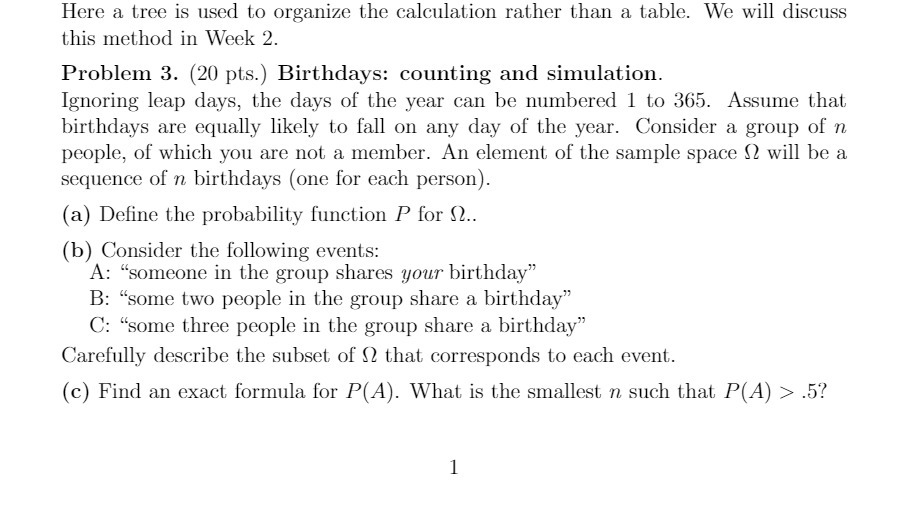
Here a tree is used to organize the calculation rather than a table. We will discuss this method in Week 2. Problem 3. {20 pts.) Birthdays: counting and simulation. Ignoring leap days, the days of the year can be numbered 1 to 365. Assume that birthdays are equally likely to fall on any day of the year. Consider a group of it people, of which you are not a member. An element of the sample space S! will be a sequence of n birthdays (one for each person}. (a) Dene the probability function P for 52.. (b) Consider the following events: A: \"someone in the group shares your birthday\" B: \"some two people in the group share a birthday" C: \"some three people in the group share a birthday" Carefully describe the subset of f2 that corresponds to each event. (c) Find an exact formula for P-[A]. What is the smallest n such that P[A} > .5
Step by Step Solution
There are 3 Steps involved in it

Get step-by-step solutions from verified subject matter experts
 Study Help