



Question: Here are data on three hedge funds. Each fund charges its investors an incentive fee of 20% of total returns. Suppose initially that a fund
Here are data on three hedge funds. Each fund charges its investors an incentive fee of 20% of total returns. Suppose initially that a fund of funds (FF) manager buys equal amounts of each of these funds, also charging its investors a 20% incentive fee. For simplicity, assume also that management fees other than incentive fees are zero for all funds.
| Hedge Fund 1 | Hedge Fund 2 | Hedge Fund 3 | |
|---|---|---|---|
| Start of year value (millions) | $ 180 | $ 180 | $ 180 |
| Gross portfolio rate of return | 15% | 25% | 40% |
Required:
a. Compute the rate of return after incentive fees to an investor in the fund of funds.
b. Suppose that instead of buying shares in each of the three hedge funds, a stand-alone (SA) hedge fund purchases the same portfolio as the three underlying funds. The total value and composition of the SA fund is therefore identical to the one that would result from aggregating the three hedge funds. Consider an investor in the SA fund. After paying 20% incentive fees, what would be the value of the investors portfolio at the end of the year?
d. Now suppose that the return on the portfolio held by hedge fund 3 were 40% rather than +40%. Recalculate your answers to parts (a) and (b).
Question 2
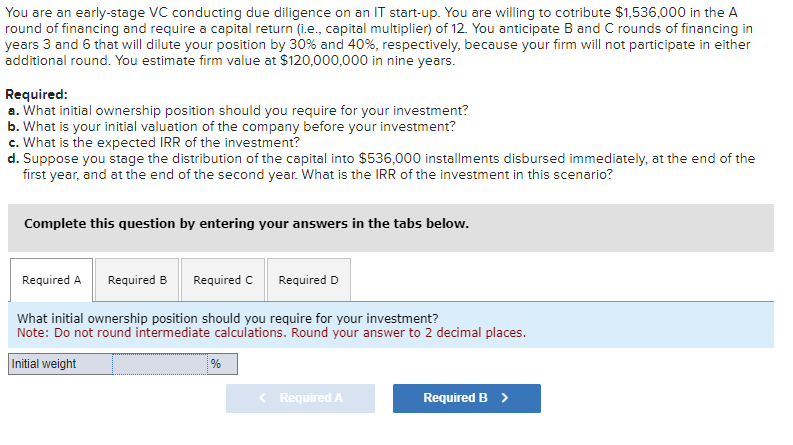
You are an early-stage VC conducting due diligence on an IT start-up. You are willing to cotribute $1,536,000 in the A round of financing and require a capital return (i.e., capital multiplier) of 12 . You anticipate B and C rounds of financing in years 3 and 6 that will dilute your position by 30% and 40%, respectively, because your firm will not participate in either additional round. You estimate firm value at $120,000,000 in nine years. Required: a. What initial ownership position should you require for your investment? b. What is your initial valuation of the company before your investment? c. What is the expected IRR of the investment? d. Suppose you stage the distribution of the capital into $536,000 installments disbursed immediately, at the end of the first year, and at the end of the second year. What is the IRR of the investment in this scenario? Complete this question by entering your answers in the tabs below. What initial ownership position should you require for your investment? Note: Do not round intermediate calculations. Round your answer to 2 decimal places
Step by Step Solution
There are 3 Steps involved in it

Get step-by-step solutions from verified subject matter experts