







Question: Here are the definitions for U = (Uo, U1, . .., U2) and V = (Vo, V1, . .., V24). Ui Vi WJ O 2
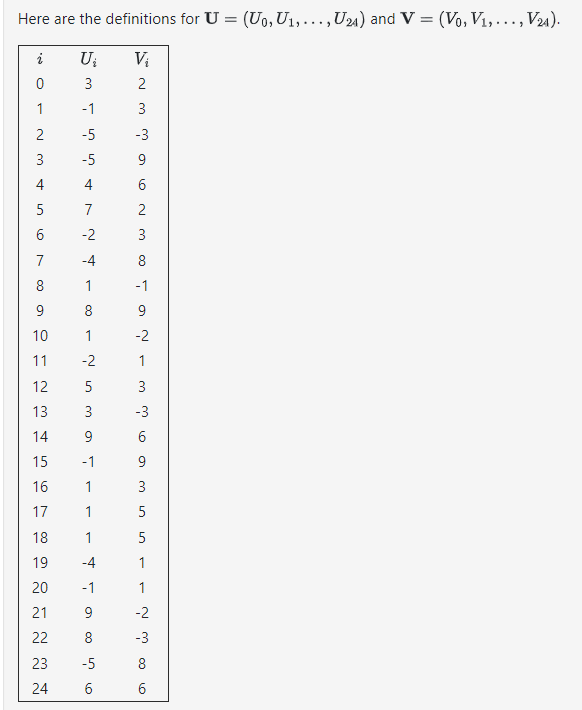
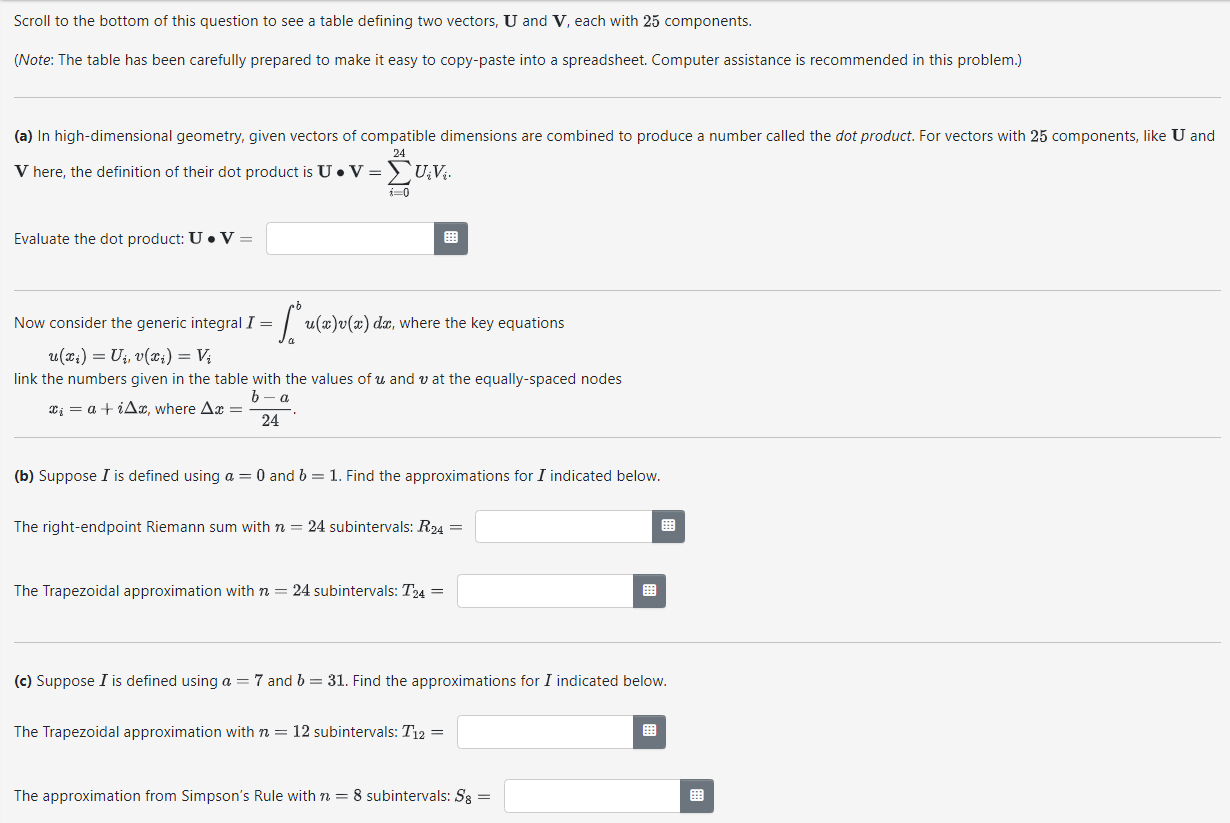
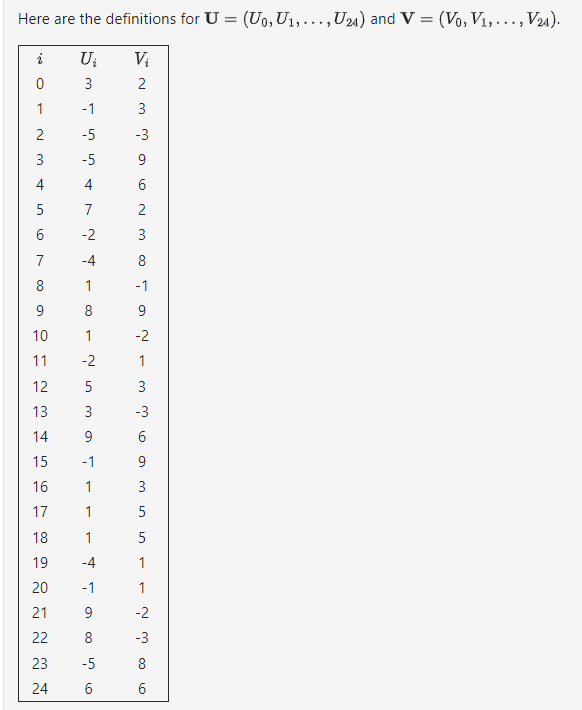
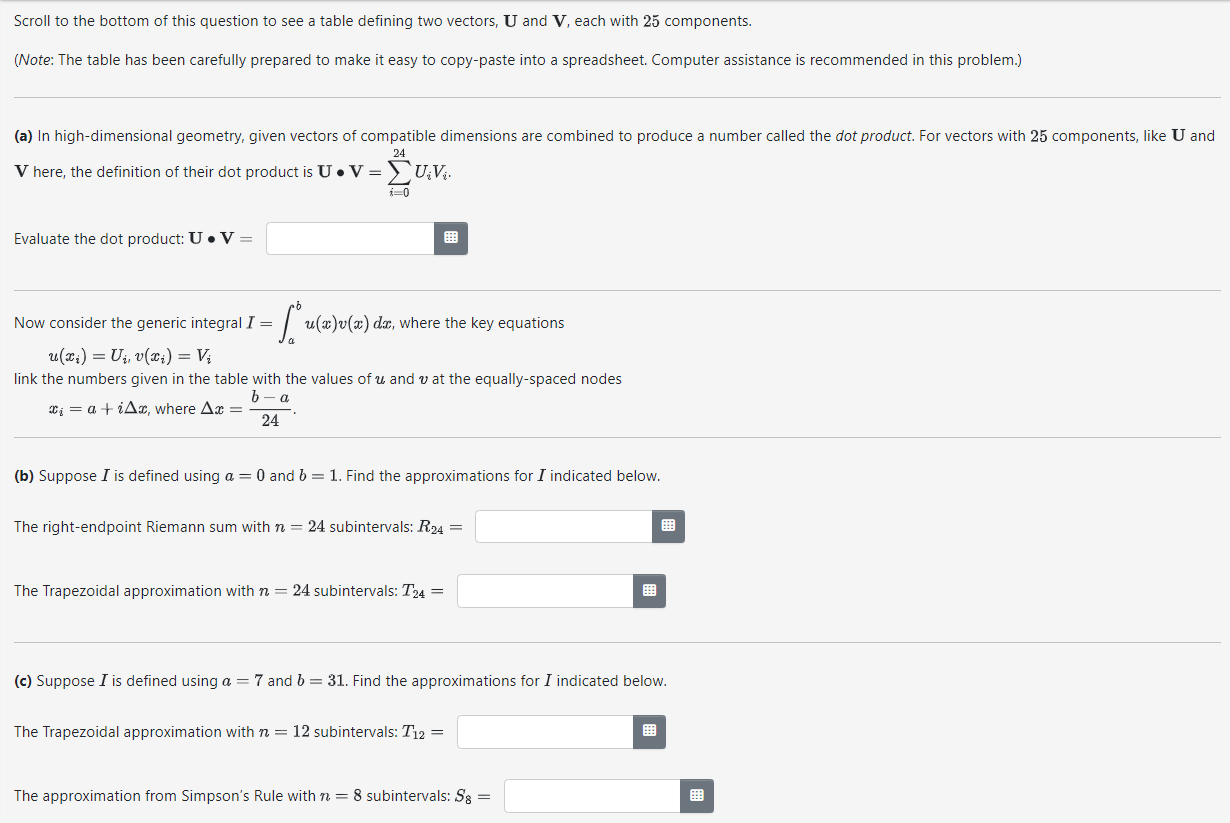
Here are the definitions for U = (Uo, U1, . .., U2) and V = (Vo, V1, . .., V24). Ui Vi WJ O 2 -1 3 -3 18 19 20 21 22 -3 23 Co 24 6 6Scroll to the bottom of this question to see a table defining two vectors, U and V, each with 25 components. (Note: The table has been carefully prepared to make it easy to copy-paste into a spreadsheet. Computer assistance is recommended in this problem.) (a) In high-dimensional geometry, given vectors of compatible dimensions are combined to produce a number called the dot product. For vectors with 25 components, like U and 24 V here, the definition of their dot product is U . V = \\U.Vi. 1 0 Evaluate the dot product: U . V = BEE NOW consider the generic integral f - / w(x)v(x) da, where the key equations u(I;) = Uj, v(ri) = Vi link the numbers given in the table with the values of u and v at the equally-spaced nodes ci = a + ic, where Ax = b- a 24 (b) Suppose I is defined using a = 0 and b = 1. Find the approximations for I indicated below. The right-endpoint Riemann sum with n = 24 subintervals: R24 = The Trapezoidal approximation with n = 24 subintervals: T24 = (c) Suppose I is defined using a = 7 and b = 31. Find the approximations for I indicated below. The Trapezoidal approximation with n = 12 subintervals: T12 = HEE The approximation from Simpson's Rule with n = 8 subintervals: S's = BEE
Step by Step Solution
There are 3 Steps involved in it

Get step-by-step solutions from verified subject matter experts
 Study Help