







Question: Here are the reactions in Problem 1.1: For each example reaction in Problem 1.1, state how many conserved quantities there are and write down that
 Here are the reactions in Problem 1.1:
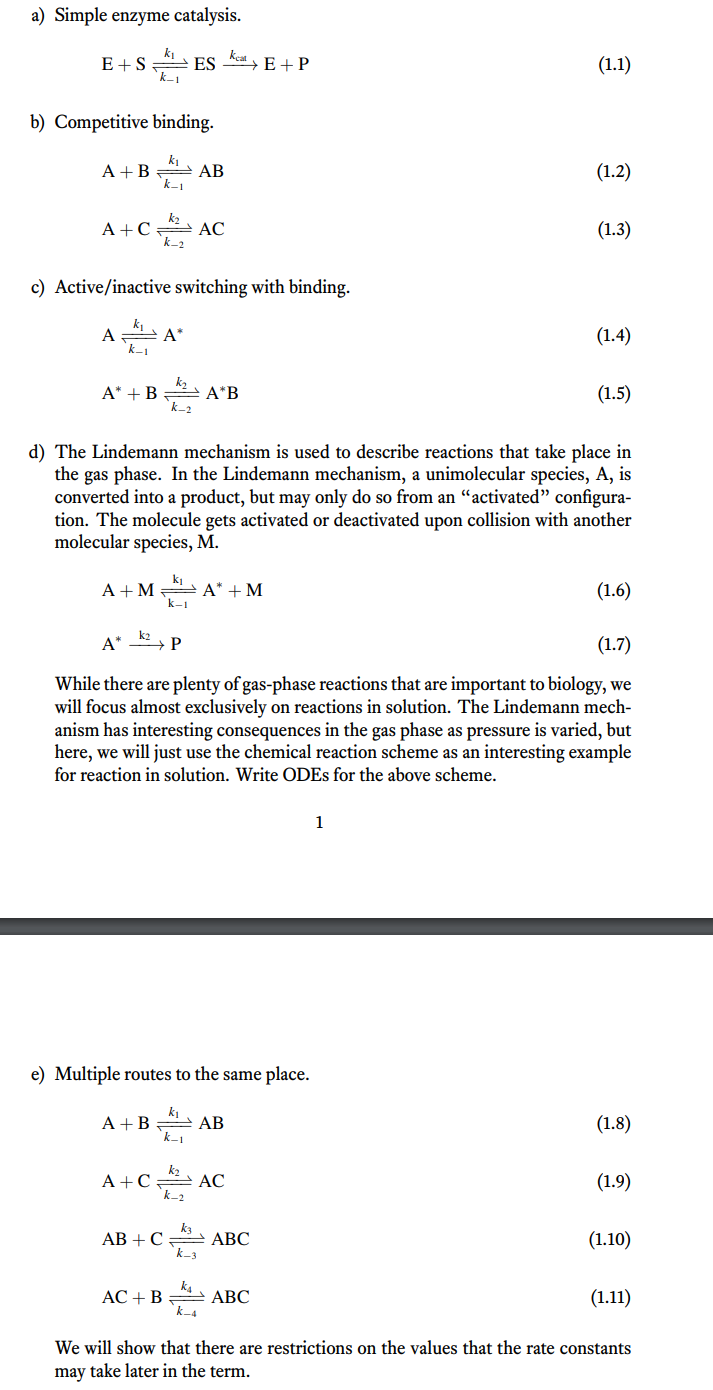
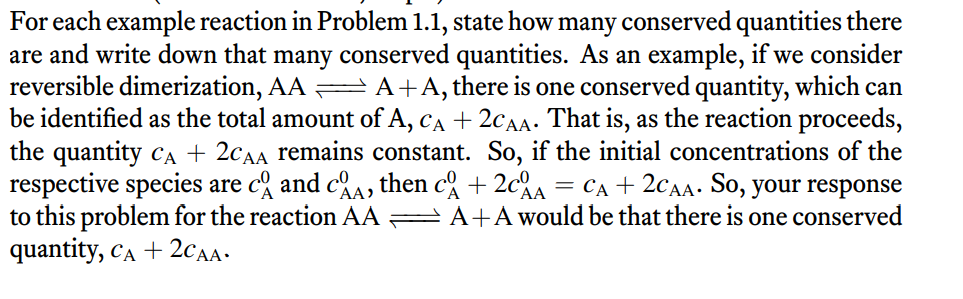
For each example reaction in Problem 1.1, state how many conserved quantities there are and write down that many conserved quantities. As an example, if we consider reversible dimerization, AAA+A, there is one conserved quantity, which can be identified as the total amount of A,cA+2cAA. That is, as the reaction proceeds, the quantity cA+2cAA remains constant. So, if the initial concentrations of the respective species are cA0 and cAA0, then cA0+2cAA0=cA+2cAA. So, your response to this problem for the reaction AAA+A would be that there is one conserved quantity, cA+2cAA. a) Simple enzyme catalysis. E+Sk1k1ESkcatE+P b) Competitive binding. c) Active/inactive switching with binding. Ak1k1AA+Bk2k2AB d) The Lindemann mechanism is used to describe reactions that take place in the gas phase. In the Lindemann mechanism, a unimolecular species, A, is converted into a product, but may only do so from an "activated" configuration. The molecule gets activated or deactivated upon collision with another molecular species, M. A+Mk1k1A+MAk2P While there are plenty of gas-phase reactions that are important to biology, we will focus almost exclusively on reactions in solution. The Lindemann mechanism has interesting consequences in the gas phase as pressure is varied, but here, we will just use the chemical reaction scheme as an interesting example for reaction in solution. Write ODEs for the above scheme. 1 e) Multiple routes to the same place. A+BB1k1ABA+Ck2k2ACAB+Ck3k3ABCAC+Bk4k4ABC We will show that there are restrictions on the values that the rate constants may take later in the term
Step by Step Solution
There are 3 Steps involved in it

Get step-by-step solutions from verified subject matter experts
 Study Help