







Question: Here demo please no incorrect answers DEMO: This demonstration problem shows A Deck of Cards and the Addition Rule for Disjoint Events Suppose that a
Here demo please no incorrect answers
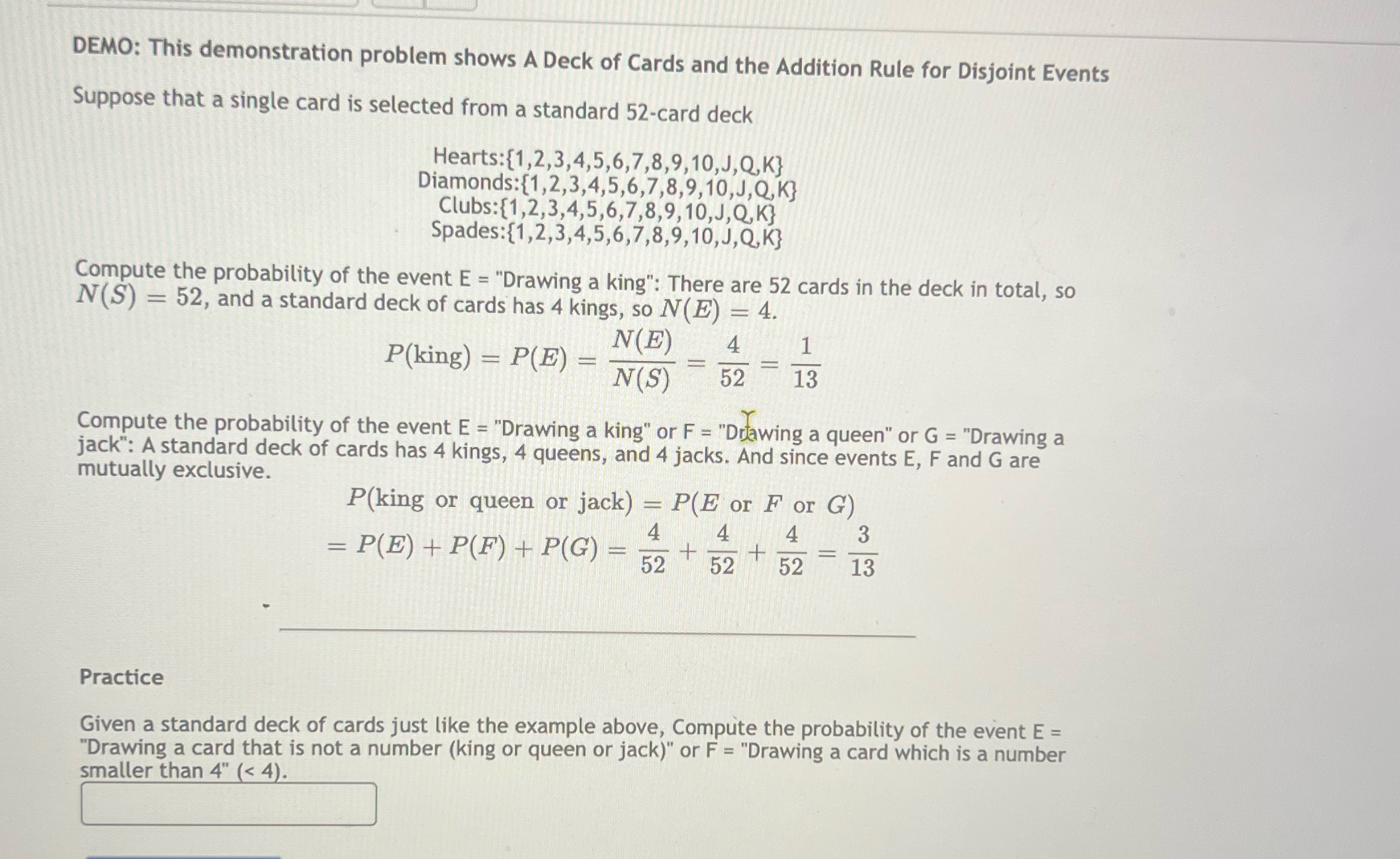
DEMO: This demonstration problem shows A Deck of Cards and the Addition Rule for Disjoint Events Suppose that a single card is selected from a standard 52-card deck Hearts: {1,2,3,4,5,6,7,8,9, 10,J,Q,K} Diamonds: {1,2,3,4,5,6,7,8,9, 10,J,Q, K} Clubs: {1,2,3,4,5,6,7,8,9, 10,J,Q, K} Spades: {1,2,3,4,5,6,7,8,9, 10,J,Q, K} Compute the probability of the event E = "Drawing a king": There are 52 cards in the deck in total, so N(S) = 52, and a standard deck of cards has 4 kings, so N ( E) = 4. N(E 4 P(king) = P(E) - N( S) 52 13 Compute the probability of the event E = "Drawing a king" or F = "Drawing a queen" or G = "Drawing a jack": A standard deck of cards has 4 kings, 4 queens, and 4 jacks. And since events E, F and G are mutually exclusive. P(king or queen or jack) = P(E or F or G) 4 4 4 3 = P(E) + P(F) + P(G) - 52 52 52 13 Practice Given a standard deck of cards just like the example above, Compute the probability of the event E = "Drawing a card that is not a number (king or queen or jack)" or F = "Drawing a card which is a number smaller than 4" (
Step by Step Solution
There are 3 Steps involved in it

Get step-by-step solutions from verified subject matter experts
 Study Help