







Question: Here is a C program that prints out the process id, the parent process id, the process user id, and group id. Please type it
Here is a C program that prints out the process id, the parent process id, the process user id, and group id. Please type it in your computer and save as task1.c. Now compile it and run it to see how it works. Include your screenshots in your submission.
.#include
#include
intmain (void)
{
printf ( " I am process %ld " , (long)getpid () );
printf ( "My parent is %ld " , (long)getppid () );
printf ( " Process user id is %ld " , (long)getuid () );
printf ( "Group id is %ld " , (long)getgid () );
return0;
}
Task1.c
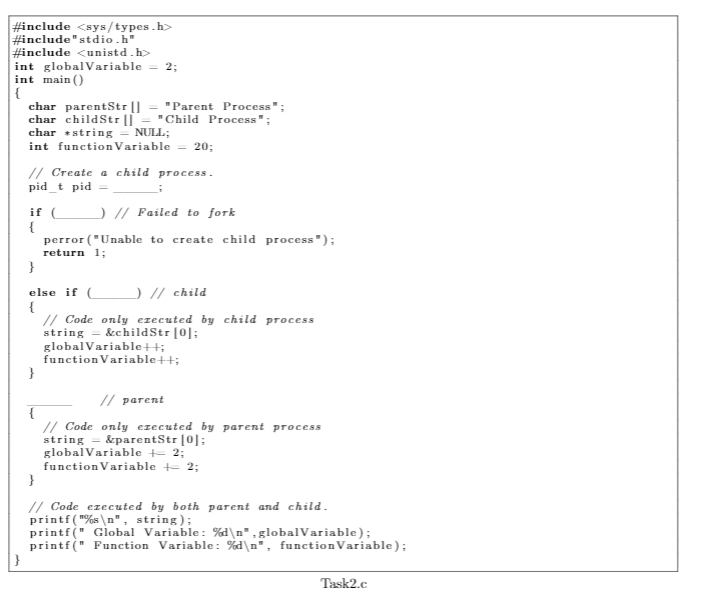
To create a new process, you can use the system call fork(void). Incomplete code is given below. The fork(void)system call is used to create a child process. Replace the ______ with proper code. It should work as follows.
For the parent process, the program will print out "Parent Process: Global variable: 4 Function variable: 22";
For the child process, it will print out "Child Process: Global variable: 3 Function variable: 21".
#include
Step by Step Solution
There are 3 Steps involved in it

Get step-by-step solutions from verified subject matter experts
 Study Help