







Question: Here is a data: Problem 3: Data file: Caffeine and Endurance 2 To test for the effect of caffeine on the endurance of cyclists, nine
Here is a data:
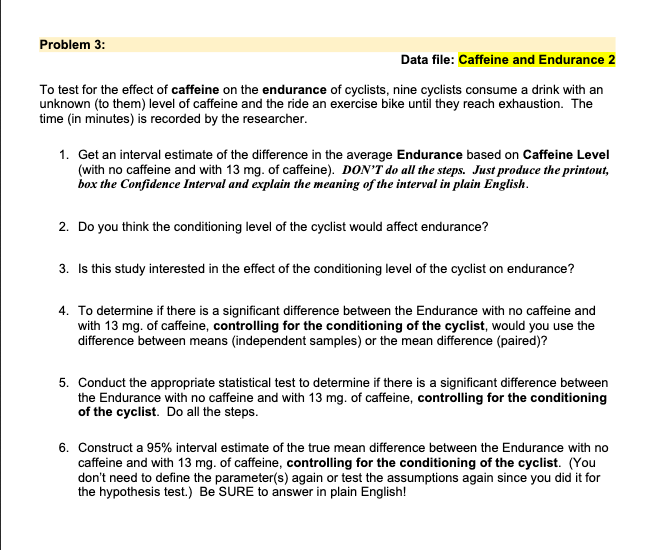
Problem 3: Data file: Caffeine and Endurance 2 To test for the effect of caffeine on the endurance of cyclists, nine cyclists consume a drink with an unknown (to them) level of caffeine and the ride an exercise bike until they reach exhaustion. The time (in minutes) is recorded by the researcher. 1. Get an interval estimate of the difference in the average Endurance based on Caffeine Level (with no caffeine and with 13 mg. of caffeine). DON'T do all the steps. Just produce the printout, box the Confidence Interval and explain the meaning of the interval in plain English. 2. Do you think the conditioning level of the cyclist would affect endurance? 3. Is this study interested in the effect of the conditioning level of the cyclist on endurance? 4. To determine if there is a significant difference between the Endurance with no caffeine and with 13 mg. of caffeine, controlling for the conditioning of the cyclist, would you use the difference between means (independent samples) or the mean difference (paired)? 5. Conduct the appropriate statistical test to determine if there is a significant difference between the Endurance with no caffeine and with 13 mg. of caffeine, controlling for the conditioning of the cyclist. Do all the steps. 6. Construct a 95% interval estimate of the true mean difference between the Endurance with no caffeine and with 13 mg. of caffeine, controlling for the conditioning of the cyclist. (You don't need to define the parameter(s) again or test the assumptions again since you did it for the hypothesis test.) Be SURE to answer in plain English
Step by Step Solution
There are 3 Steps involved in it

Get step-by-step solutions from verified subject matter experts
 Study Help