







Question: HERE IS A LINK WHERE YOU CAN FIND THE STD.JAR LIBRARIES. ITS UNDER THE NAME 'Linux-based Virtual Machine' AND SAYS IO LIBRARIES. https://www.swamiiyer.net/cs210/course_info.html here is
HERE IS A LINK WHERE YOU CAN FIND THE STD.JAR LIBRARIES. ITS UNDER THE NAME 'Linux-based Virtual Machine' AND SAYS IO LIBRARIES.
https://www.swamiiyer.net/cs210/course_info.html
here is the code template, please follow:
package edu.umb.cs210.p2; import dsa.LinkedQueue; import stdlib.StdOut; public class Josephus { protected static LinkedQueue calculateJosephus(String[] args) { // Get N and M from command line as ints. ... // Create a queue q and enqueue integers // 1, 2, ... N. ... // Create a queue outQ to store the ordering ... int i = 0; // As long as q is not empty: increment i; // dequeue an element pos; if M divides i, // enqueue pos to outQ, otherwise enqueue pos to q. ... // Return outQ ... } // Entry point. [DO NOT EDIT] public static void main(String[] args) { for (int i : calculateJosephus(args)) { StdOut.println(i); } } }
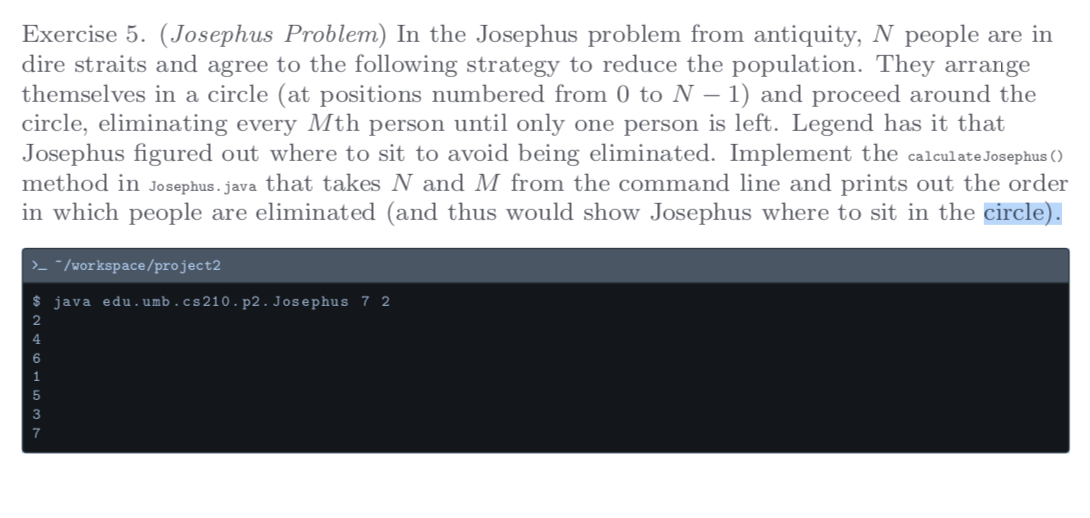
Exercise 5. (Josephus Problem. In the Josephus problem from antiquity, N people are in dire straits and agree to the following strategy to reduce the population. They arrange themselves in a circle (at positions numbered from 0 to N 1) and proceed around the circle, eliminating every Mth person until only one person is left. Legend has it that Josephus figured out where to sit to avoid being eliminated. Implement the calculate Josephus () method in Josephus.java that takes N and M from the command line and prints out the order in which people are eliminated and thus would show Josephus where to sit in the circle). > "/workspace/project2 java edu.umb.cs210.p2.Josephus 7 2 vwo ON
Step by Step Solution
There are 3 Steps involved in it

Get step-by-step solutions from verified subject matter experts
 Study Help