Question: Here is a practical example of EVM (Earned Value Management). Three values, BCWS, BCWP, and AC, are all cumulative. Acronyms: BCWS (Budgeted Cost of Work
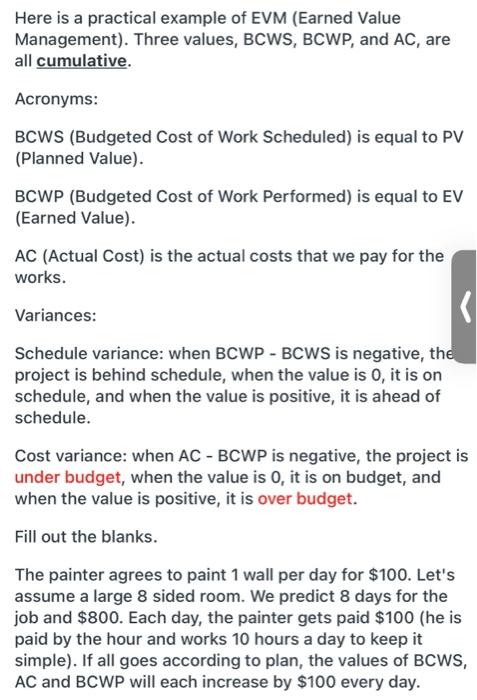
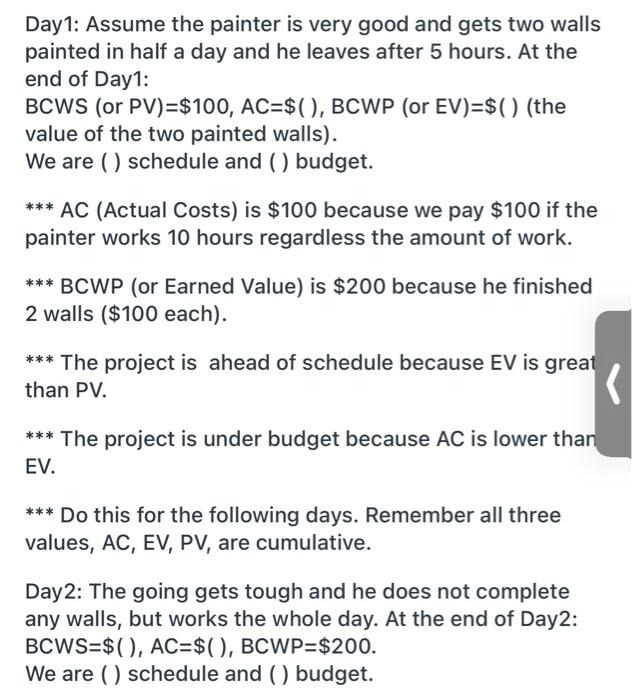
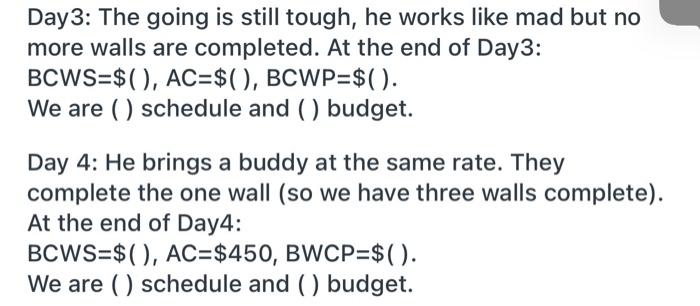
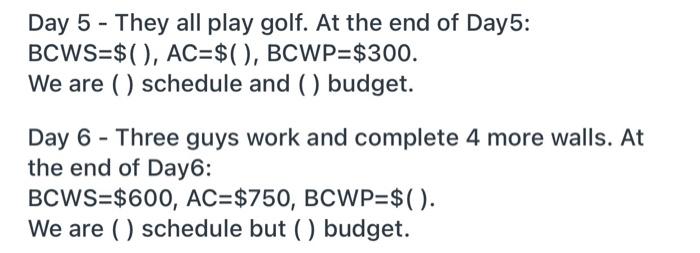
Here is a practical example of EVM (Earned Value Management). Three values, BCWS, BCWP, and AC, are all cumulative. Acronyms: BCWS (Budgeted Cost of Work Scheduled) is equal to PV (Planned Value). BCWP (Budgeted Cost of Work Performed) is equal to EV (Earned Value). AC (Actual Cost) is the actual costs that we pay for the works. Variances: Schedule variance: when BCWP - BCWS is negative, the project is behind schedule, when the value is 0, it is on schedule, and when the value is positive, it is ahead of schedule. Cost variance: when AC - BCWP is negative, the project is under budget, when the value is 0, it is on budget, and when the value is positive, it is over budget. Fill out the blanks. The painter agrees to paint 1 wall per day for $100. Let's assume a large 8 sided room. We predict 8 days for the job and $800. Each day, the painter gets paid $100 (he is paid by the hour and works 10 hours a day to keep it simple). If all goes according to plan, the values of BCWS, AC and BCWP will each increase by $100 every day. Day1: Assume the painter is very good and gets two walls painted in half a day and he leaves after 5 hours. At the end of Day1: BCWS (or PV)=$100, AC=$(), BCWP (or EV)=$( (the value of the two painted walls). We are () schedule and () budget. *** AC (Actual Costs) is $100 because we pay $100 if the painter works 10 hours regardless the amount of work. *** BCWP (or Earned Value) is $200 because he finished 2 walls ($100 each). *** The project is ahead of schedule because EV is great than PV. s *** The project is under budget because AC is lower than EV. *** Do this for the following days. Remember all three values, AC, EV, PV, are cumulative. Day2: The going gets tough and he does not complete any walls, but works the whole day. At the end of Day2: BCWS=$(), AC=$(), BCWP=$200. We are () schedule and ( budget. Day 3: The going is still tough, he works like mad but no more walls are completed. At the end of Day3: BCWS=$(), AC=$(), BCWP=$(). We are () schedule and () budget. Day 4: He brings a buddy at the same rate. They complete the one wall (so we have three walls complete). At the end of Day4: BCWS=$(), AC=$450, BWCP=$(). We are () schedule and () budget. Day 5 - They all play golf. At the end of Day5: BCWS=$(), AC=$(), BCWP=$300. We are () schedule and () budget. Day 6 - Three guys work and complete 4 more walls. At the end of Day6: BCWS=$600, AC=$750, BCWP=$(). We are () schedule but () budget









 Study Help