







Question: Here is a well-known bit of applied mathematics, sometimes called the Newsboy Problem, or the Christmas Tree Problem. In the example which gives the problem
Here is a well-known bit of applied mathematics, sometimes called the Newsboy Problem, or the Christmas Tree Problem. In the example which gives the problem its common name, a newsboy buys a quantity of papers q to sell on a busy urban street corner early in the morning. The demand for newspapers on a given morning is a random variable X. If X > q he sells all the papers he bought earlier in the day, but he doesn't have time to go the newspaper office to try to get any more papers. On the other hand, if X b > c > 0.
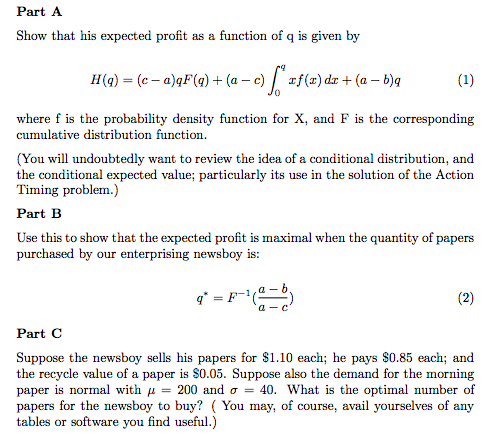
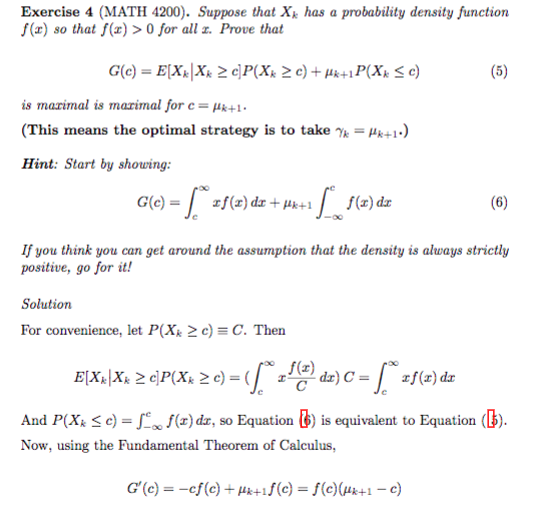
Part A Show that his expected profit as a function of q is given by H(q) = (c - a)qF(q) + (a -c) / of(x) dx + (a - b)q (1) where f is the probability density function for X, and F is the corresponding cumulative distribution function. (You will undoubtedly want to review the idea of a conditional distribution, and the conditional expected value; particularly its use in the solution of the Action Timing problem.) Part B Use this to show that the expected profit is maximal when the quantity of papers purchased by our enterprising newsboy is: b. (2) Part C Suppose the newsboy sells his papers for $1.10 each; he pays $0.85 each; and the recycle value of a paper is $0.05. Suppose also the demand for the morning paper is normal with a = 200 and o = 40. What is the optimal number of papers for the newsboy to buy? ( You may, of course, avail yourselves of any tables or software you find useful.)Exercise 4 (MATH 4200). Suppose that Xx has a probability density function f(x) so that f(x) > 0 for all z. Prove that G(c) = E[Xx|Xx 2 c]P(Xx 2 c) + /*+1 P(Xx S c) (5) is marimal is marimal for c = #x+1. (This means the optimal strategy is to take * = #*+1.) Hint: Start by showing: G(e ) = [ af(x) da + uk+1 { {(z) de (6) If you think you can get around the assumption that the density is always strictly positive, go for it! Solution For convenience, let P(Xx 2 c) = C. Then E[XxXx 2 cJP(Xx 20) - ( aPan)c - f af(x)dx And P(Xk S c) = [". f(x) dx, so Equation [) is equivalent to Equation (). Now, using the Fundamental Theorem of Calculus, G'(c) = -of(c) + ux+If(c) = f(c)(ux+1 - c)
Step by Step Solution
There are 3 Steps involved in it

Get step-by-step solutions from verified subject matter experts
 Study Help