



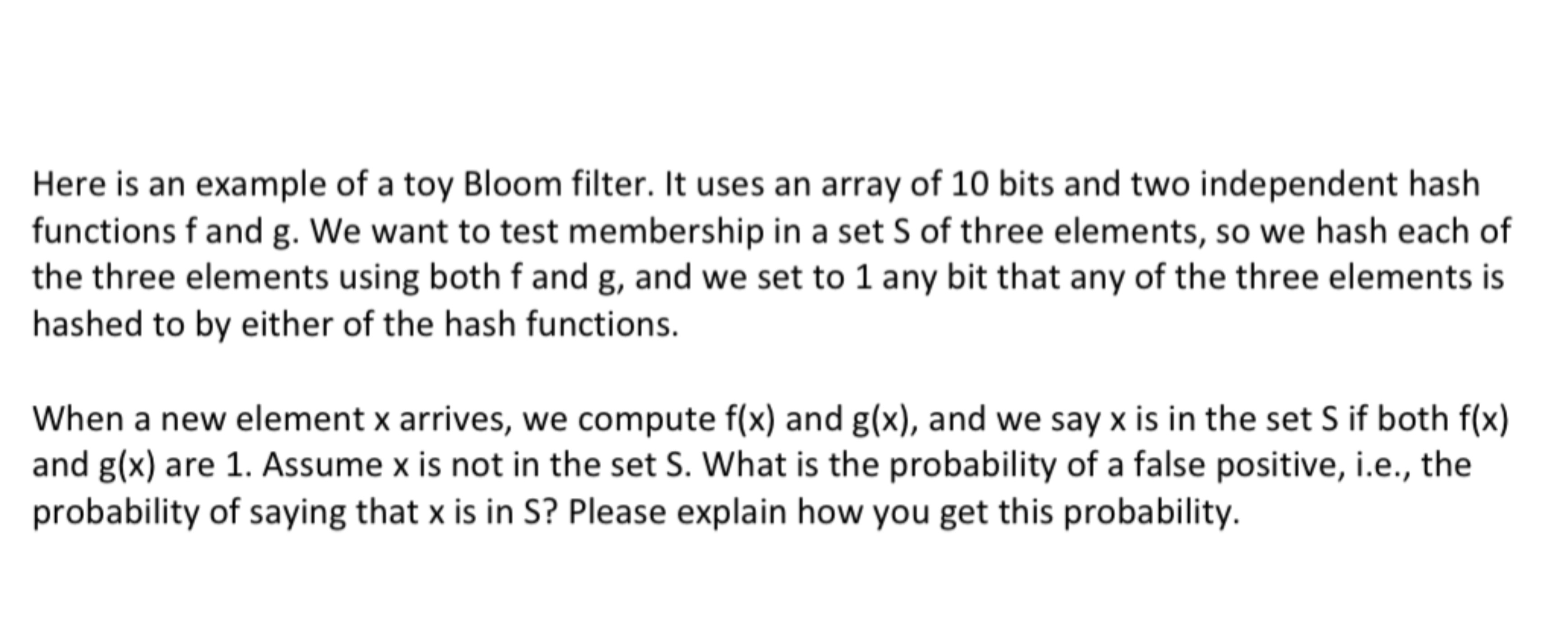
Question: Here is an example of a toy Bloom filter. It uses an array of 1 0 bits and two independent hash functions f and g
Here is an example of a toy Bloom filter. It uses an array of bits and two independent hash
functions and We want to test membership in a set of three elements, so we hash each of
the three elements using both and and we set to any bit that any of the three elements is
hashed to by either of the hash functions.
When a new element arrives, we compute and and we say is in the set if both
and are Assume is not in the set What is the probability of a false positive, ie the
probability of saying that is in Please explain how you get this probability.
Step by Step Solution
There are 3 Steps involved in it
1 Expert Approved Answer
Step: 1 Unlock

Question Has Been Solved by an Expert!
Get step-by-step solutions from verified subject matter experts
Step: 2 Unlock
Step: 3 Unlock