







Question: Here is another example to demonstrate the effect of computer architecture knowledge on your understanding ot source programs. Traditionally, removing a node from a linked
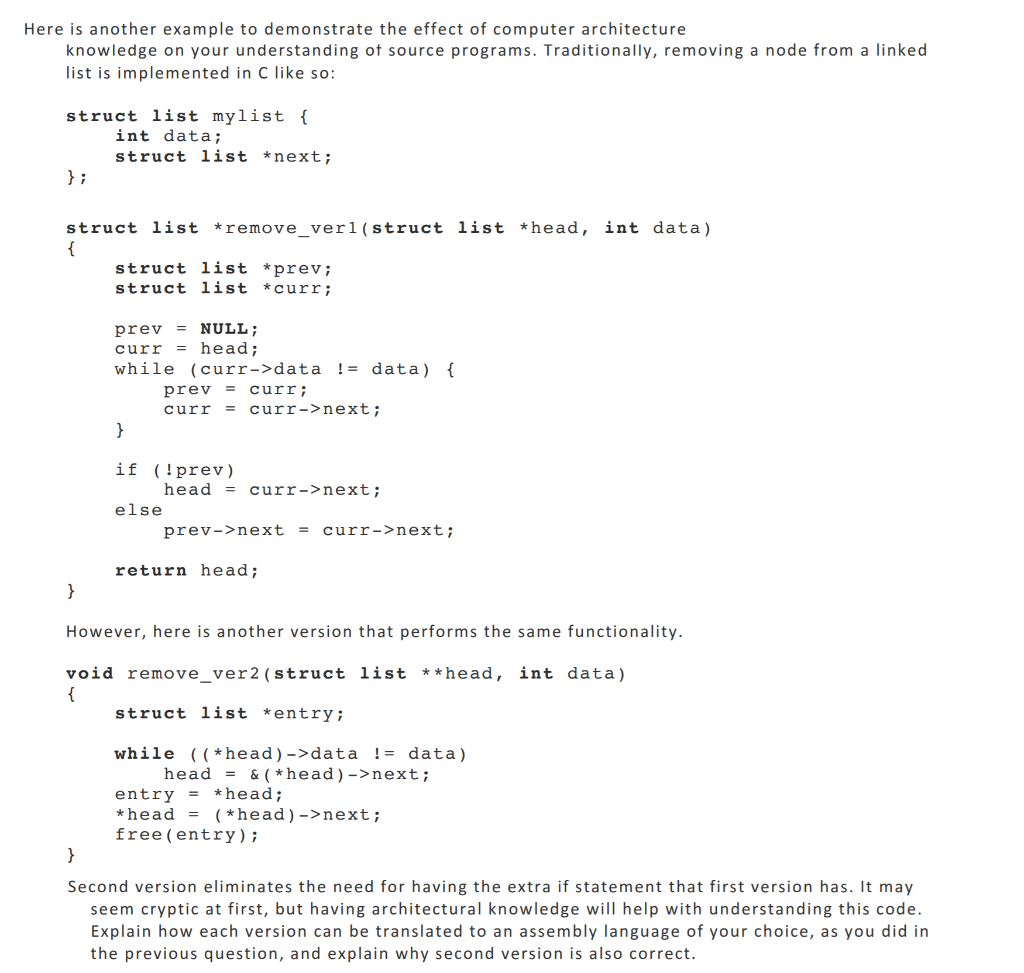
Here is another example to demonstrate the effect of computer architecture knowledge on your understanding ot source programs. Traditionally, removing a node from a linked list is implemented in C like so: struct list mylist [ int data; struct list *next struct list *remove_verl (struct list *head, int data) struct list *prev; struct list *curr; prev = NULL ; curr - head; while (curr->data- data) prev curr; curr -curr->next; if (prev) head = curr->next; else prev->next curr->next; = return head; However, here is another version that performs the same functionality. void remove_ver2 (struct list **head, int data) struct list *entry while ((*head)->data !- data) head -& (*head) ->next; entry *head; *head (*head )->next; free (entry); Second version eliminates the need for having the extra if statement that first version has. It may seem cryptic at first, but having architectural knowledge will help with understanding this code. Explain how each version can be translated to an assembly language of your choice, as you did in the previous question, and explain why second version is also correct. Here is another example to demonstrate the effect of computer architecture knowledge on your understanding ot source programs. Traditionally, removing a node from a linked list is implemented in C like so: struct list mylist [ int data; struct list *next struct list *remove_verl (struct list *head, int data) struct list *prev; struct list *curr; prev = NULL ; curr - head; while (curr->data- data) prev curr; curr -curr->next; if (prev) head = curr->next; else prev->next curr->next; = return head; However, here is another version that performs the same functionality. void remove_ver2 (struct list **head, int data) struct list *entry while ((*head)->data !- data) head -& (*head) ->next; entry *head; *head (*head )->next; free (entry); Second version eliminates the need for having the extra if statement that first version has. It may seem cryptic at first, but having architectural knowledge will help with understanding this code. Explain how each version can be translated to an assembly language of your choice, as you did in the previous question, and explain why second version is also correct
Step by Step Solution
There are 3 Steps involved in it

Get step-by-step solutions from verified subject matter experts
 Study Help