







Question: Here is my question. A simple random sample of 13 four-cylinder cars is obtained, and the braking distances are measure. The mean bra king distance
Here is my question.
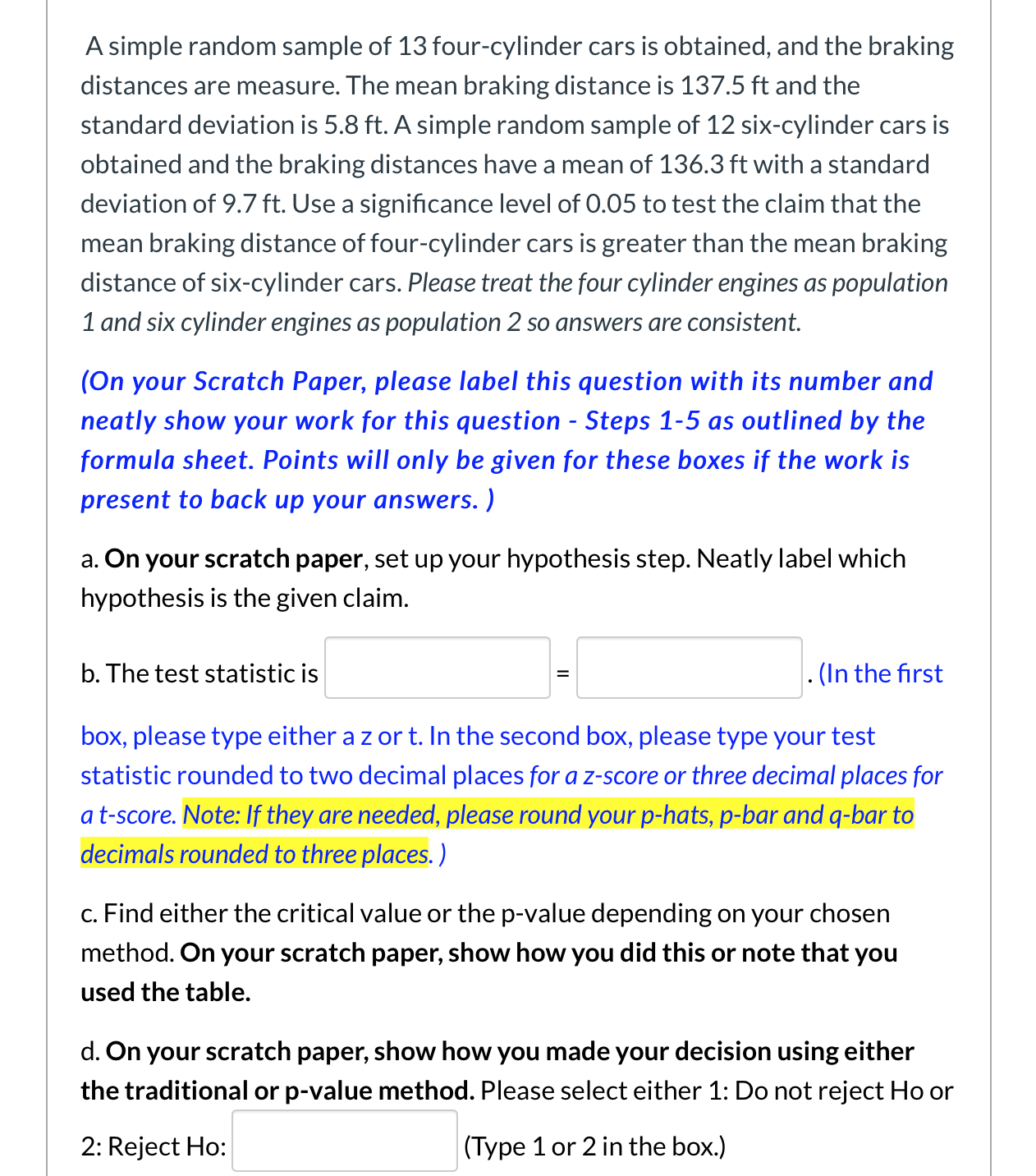
A simple random sample of 13 four-cylinder cars is obtained, and the braking distances are measure. The mean bra king distance is 137.5 ft and the standard deviation is 5.8 ft. A simple random sample of 12 six-cylinder cars is obtained and the braking distances have a mean of 136.3 ft with a standard deviation of 9.7 ft. Use a signicance level of 0.05 to test the claim that the mean bra king distance of four-cylinder cars is greater than the mean braking distance of six-cylinder cars. Please treat the four cylinder engines as population 1 and six cylinder engines as population 2 so answers are consistent. (On your Scratch Paper, please label this question with its number and neatly show your work for this question - Steps 1-5 as outlined by the formula sheet. Points will only be given for these boxes if the work is present to back up your answers. ) a. On your scratch paper, set up your hypothesis step. Neatly label which hypothesis is the given claim. b. The test statistic is .(In the rst box, please type either a z or t. In the second box, please type your test statistic rounded to two decimal places for a z-score or three decimal places for a t-score. Note: if they are needed, please round your p-hats, pbar and q-bar to decimals rounded to three places. ) c. Find either the critical value or the p-value depending on your chosen method. On your scratch paper, show how you did this or note that you used the table. d. On your scratch paper, show how you made your decision using either the traditional or p-value method. Please select either 1: Do not reject H0 or 2: Reject Ho: (Type 1 or 2 in the box.)
Step by Step Solution
There are 3 Steps involved in it

Get step-by-step solutions from verified subject matter experts
 Study Help