







Question: Here is the additional document: Your Name, Today's Date Quest Specialty Travel Last Minute Travel Deals For an adventure sooner rather than later, check out
Here is the additional document:
Your Name, Today's Date
Quest Specialty Travel Last Minute Travel Deals
For an adventure sooner rather than later, check out this month's last minute travel deals. Each of the trips listed below begins in the next few weeks, so immediate booking is essential. These special travel deals on select adventures change frequently and sell out fast. For personal assistance from a QST travel specialist call 1-833-555-TOUR (1-833-555-8687) or visit www.questspecialtytravel.com. Our online booking process is fast, easy, and secure.
Trip Dates Cost Rajasthan Desert Safari Oct. 1-15 $1,645 Everest Base Camp Trek Oct. 7-28 $1,950 Cycling in Provence Oct. 13-20 $1,120 Inca Highlands Explorer Oct. 14-28 $1,140
Rajasthan Desert Safari
An unforgettable journey by plane, rail, bus, and camel through the colorful, undulating landscape of Rajasthan and the Great Thar desert, this tour explores the forts, temples, palaces, and bazaars of the fabled cities along old camel caravan routes. Participants choose between the Camel Safari and the Maharaja Experience. Accommodations are hotels, with camping on the Camel Safari. 15 days. Arrive/Depart Delhi.
Camel Safari
The 2-day camel safari begins in the small 12th century caravan city of Jaisalmer. After completing the camel safari last year, New York Times travel writer Edith Das described the experience:
Traversing the starkly beautiful dunes of the desert wilderness, we delighted at the sight of herds of chinkara antelope and treasured a glimpse of the Great Indian bustard. Near the end, Jaisalmer reappeared like a vision from the Arabian Nights, its intriguingly carved yellow stone towers rising mirage-like out of the horizon.
Maharaja Experience
The 2-day tour explores the magical fort in Jaisalmer, with plenty of personal time for shopping and relaxing.
Everest Base Camp Trek
Following the classic Everest expedition route, this trek leads hikers past the colorful fluttering prayer flags and Buddhist monasteries of traditional Sherpa villages, to the foot of Mount Everest. We rendezvous in Katmandu, fly to Lukla, and traverse the pine and rhododendron forests of the Dudh Kosi River valley to Namche Bazaar, the bustling center of the Sherpa region. From there we ascend Kala Pattar, high above the tree line, for suburb views of Everest, Lhotse, and Nuptse. Two nights at the Everest base camp allows us ample time to explore the base of the mountain, before returning to Lukla via the lost valleys, high mountain passes, and remote villages of the Khumbu region. Accommodations include a hotel in Katmandu and 17 nights camping. 22 days. Arrive/Depart Katmandu.
The following 3-day add-ons are available. Choose one:
Royal Chitwan National Park Pokhara -- Valley of Lakes Temples of Janakpur Trishuli River Rafting Adventure
Last-minute participants in the Everest Base Camp trek must be able to arrange the following by September 25:
A valid entry visa for Nepal. Vaccination or protection against malaria, typhoid, infectious hepatitis, tetanus, and polio. Travel insurance that includes medical evacuation and repatriation of remains. A medical examination certifying the participant is fit enough to trek eight or nine hours a day at a maximum altitude of 18,200 feet.
Cycling in Provence
The fertile, rambling terrain of Provence provides the backdrop for this easy-going trip. Days are spent cycling between pleasant medieval towns and delightful villages, with ample time to linger at the sights along the way. At night, we relax in the comfort and warmth of small, local hotels. The average daily ride is 30 miles, but there are options for longer routes if you want to cycle more. 8 days. Arrive/Depart Nice.
Inca Highlands Explorer
This epic overland adventure combines the highlights of Inca civilization with an astonishing five-day Andean trek through cloud forests and snow-capped peaks to the ancient Inca site of Machu Picchu. We then travel by road to gorgeous Lake Titicaca, birthplace of the Inca legend, and on to La Paz, Bolivia, the world's highest capital city. Accommodations include camping and hotels. 15 days. Arrive Lima/Depart La Paz.
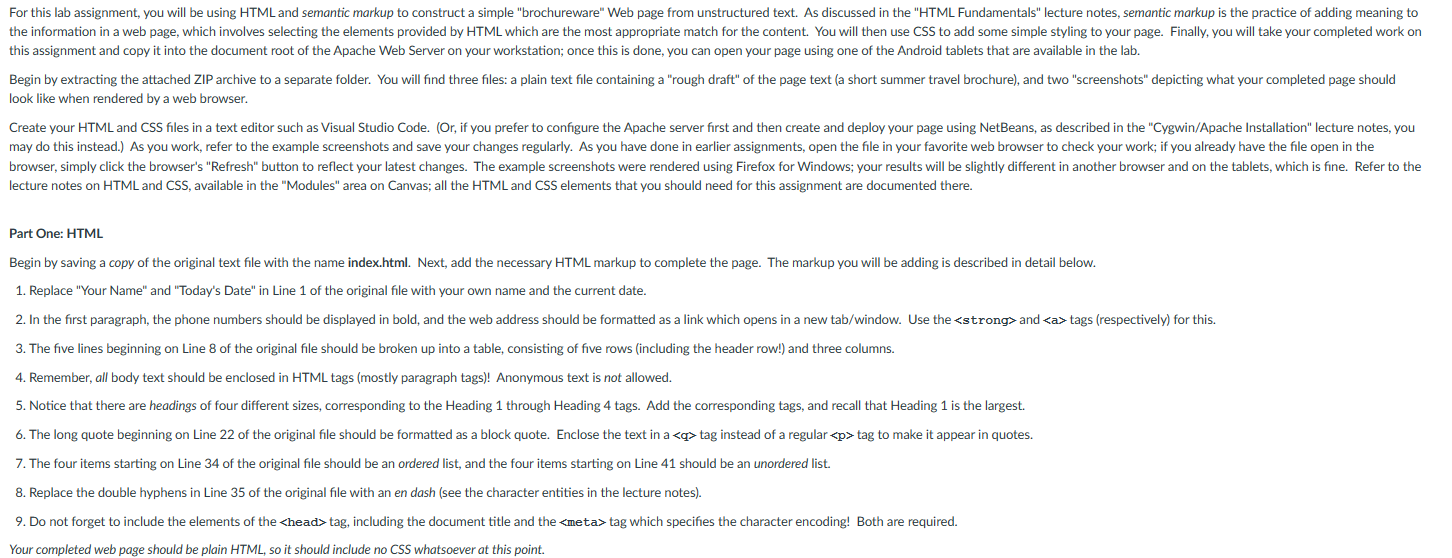
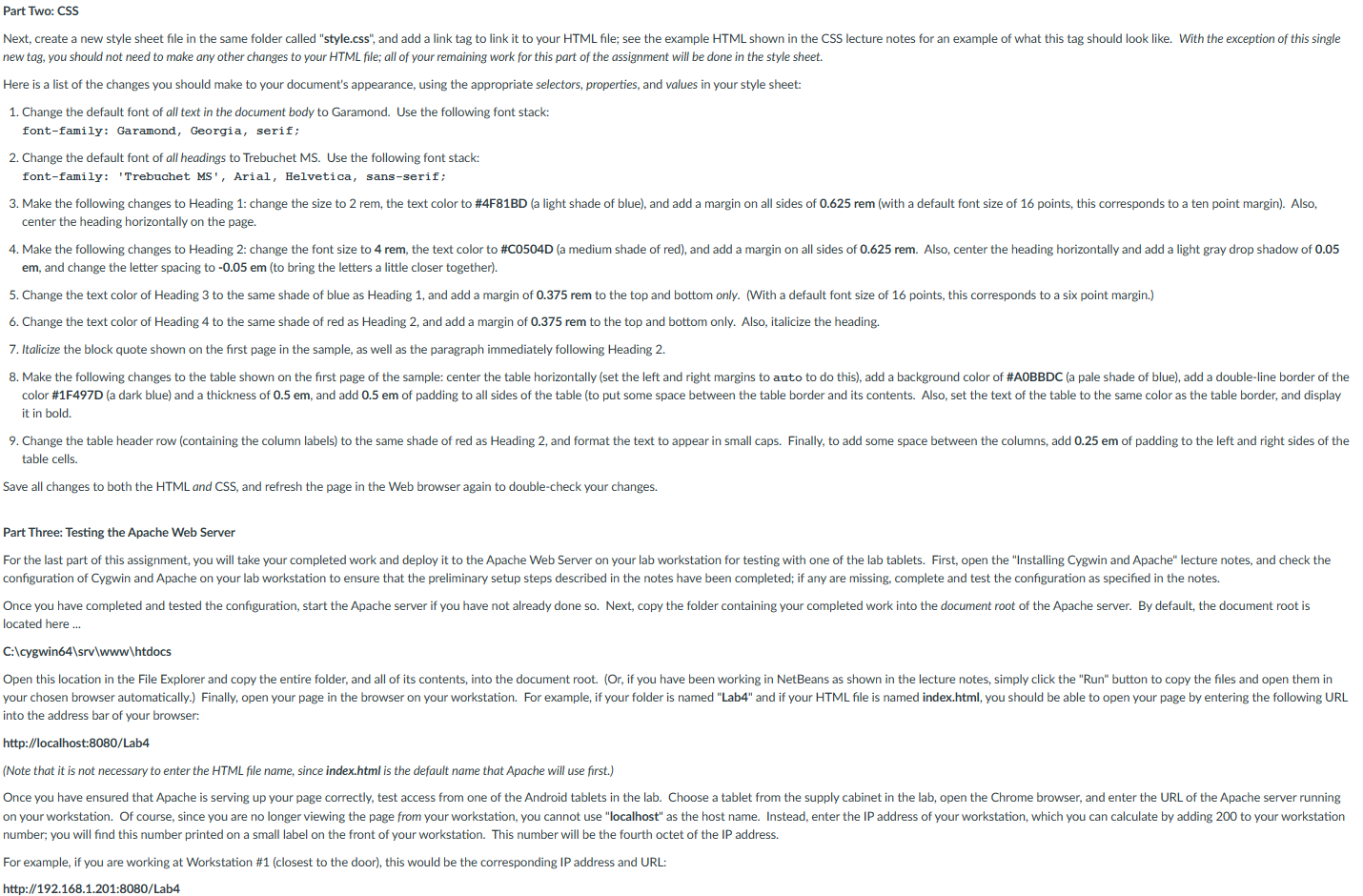
For this lab assignment, you will be using HIML and semantic markup to construct a simple "brochureware" Web page from unstructured text. As discussed in the "HIML-undamentals" lecture notes, semantic markup is the practice of adding meaning to the information in a web page, which involves selecting the elements provided by HTML which are the most appropriate match for the content. You will then use CSS to add some simple styling to your page. Finally, you will take your completed work on this assignment and copy it into the document root of the Apache Web Server on your workstation; once this is done, you can open your page using one of the Android tablets that are available in the lab. Begin by extracting the attached ZIP archive to a separate folder. You will find three files: a plain text file containing a "rough draft" of the page text (a short summer travel brochure), and two "screenshots" depicting what your completed page should look like when rendered by a web browser. Create your HTML and CSS files in a text editor such as Visual Studio Code. (Or, if you prefer to configure the Apache server first and then create and deploy your page using NetBeans, as described in the "Cygwin/Apache Installation" lecture notes, you may do this instead.) As you work, refer to the example screenshots and save your changes regularly. As you have done in earlier assignments, open the file in your favorite web browser to check your work; if you already have the file open in the browser, simply click the browser's "Refresh" button to reflect your latest changes. The example screenshots were rendered using Firefox for Windows; your results will be slightly different in another browser and on the tablets, which is fine. Refer to the lecture notes on HTML and CSS, available in the "Modules" area on Canvas; all the HTML and CSS elements that you should need for this assignment are documented there. Part One: HTML 1. Replace "Your Name" and "Today's Date" in Line 1 of the original file with your own name and the current date. 3. The five lines beginning on Line 8 of the original file should be broken up into a table, consisting of five rows (including the header row!) and three columns. 4. Remember, all body text should be enclosed in HTML tags (mostly paragraph tags)! Anonymous text is not allowed. 7. The four items starting on Line 34 of the original file should be an ordered list, and the four items starting on Line 41 should be an unordered list. 8. Replace the double hyphens in Line 35 of the original file with an en dash (see the character entities in the lecture notes). 9. Do not forget to include the elements of the tag, including the document title and the tag which specifies the character encoding! Both are required. Your completed web page should be plain HTML, so it should include no CSS whatsoever at this point. new tag, you should not need to make any other changes to your HTML file; all of your remaining work for this part of the assignment will be done in the style sheet. Here is a list of the changes you should make to your document's appearance, using the appropriate selectors, properties, and values in your style sheet: 1. Change the default font of all text in the document body to Garamond. Use the following font stack: font-family: Garamond, Georgia, serif; 2. Change the default font of all headings to Trebuchet MS. Use the following font stack: font-family: 'Trebuchet MS', Arial, Helvetica, sans-serif; center the heading horizontally on the page. em, and change the letter spacing to -0.05 em (to bring the letters a little closer together). 5. Change the text color of Heading 3 to the same shade of blue as Heading 1 , and add a margin of 0.375 rem to the top and bottom only. (With a default font size of 16 points, this corresponds to a six point margin.) 6. Change the text color of Heading 4 to the same shade of red as Heading 2, and add a margin of 0.375 rem to the top and bottom only. Also, italicize the heading. 7. Italicize the block quote shown on the first page in the sample, as well as the paragraph immediately following Heading 2. it in bold. table cells. Save all changes to both the HTML and CSS, and refresh the page in the Web browser again to double-check your changes. Part Three: Testing the Apache Web Server ocated here ... into the address bar of your browser: ittp://localhost:8080/Lab4 (Note that it is not necessary to enter the HTML file name, since index.html is the default name that Apache will use first.) number; you will find this number printed on a small label on the front of your workstation. This number will be the fourth octet of the IP address. For example, if you are working at Workstation \#1 (closest to the door), this would be the corresponding IP address and URL: tttp://192.168.1.201:8080/Lab4
Step by Step Solution
There are 3 Steps involved in it

Get step-by-step solutions from verified subject matter experts
 Study Help