







Question: Here is the code we were provided to finish the assignement on. (Only got to put code where it says finish writing code here. Everything
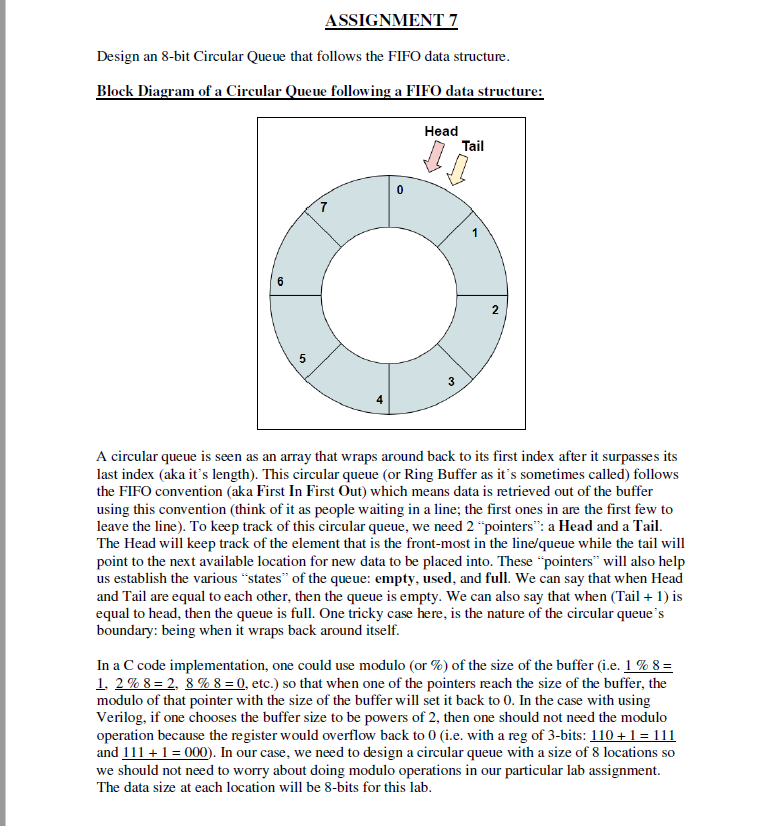

Here is the code we were provided to finish the assignement on. (Only got to put code where it says "finish writing code here". Everything else is already pretty much provided)
`timescale 1ns / 1ps
//////////////////////////////////////////////////////////////////////////////////
// Company:
// Engineer:
//
// Create Date: 10/11/2018 03:23:05 PM
// Design Name:
// Module Name: Circular_Queue
// Project Name:
// Target Devices:
// Tool Versions:
// Description:
//
// Dependencies:
//
// Revision:
// Revision 0.01 - File Created
// Additional Comments:
//
//////////////////////////////////////////////////////////////////////////////////
module Circular_Queue(
input [7:0]dataIn,
input clk,enqueue,dequeue,
output reg full,empty,
output [7:0]dataOut
);
// enqueue = "place" and dequeue = "remove"
// Declare State Constants...
localparam [1:0]
EMPTY = 2'b00,
USED = 2'b01,
FULL = 2'b10;
// Declare Circular Queue...
reg [7:0]buffer[7:0];
// Declare Registers...
reg [2:0]head,headNext,tail,tailNext;
reg [1:0]state,stateNext;
reg emptyNext,fullNext;
initial
begin
head = 'd0;
tail = 'd0;
headNext = 'd0;
tailNext = 'd0;
state = 'd0;
stateNext = 'd0;
full = 0;
fullNext = 0;
empty = 1;
emptyNext = 1;
end
// Current State Logic...
always@(posedge clk)
begin
state
head
tail
full
empty
end
// Next State Logic...
always@*
begin
stateNext = state;
headNext = head;
tailNext = tail;
emptyNext = empty;
fullNext = full;
case(stateNext)
EMPTY:
begin
if(enqueue)
begin
// Finish writing code here...
end
else
stateNext = EMPTY;
end
USED:
begin
if(enqueue)
begin
// Finish writing code here...
end
else if(dequeue)
begin
// Finish writing code here...
end
else
stateNext = USED;
end
FULL:
begin
if(enqueue)
stateNext = FULL;
else if(dequeue)
begin
// Finish writing code here...
end
else
stateNext = FULL;
end
endcase
end
assign dataOut = buffer[head];
endmodule
ASSIGNMENT 7 Design an 8-bit Circular Queue that follows the FIFO data structure Block Diagram of a Circular Queue following a FIFO data structure: Head Tail 5 3 4 A circular queue is seen as an array that wraps around back to its first index after it surpasses its last index (aka it's length). This circular queue (or Ring Buffer as it's sometimes called) follows the FIFO convention (aka First In First Out) which means data is retrieved out of the buffer using this convention (think of it as people waiting in a line; the first ones in are the first few to leave the line). To keep track of this circular queue, we need 2 "pointers": a Head and a Tail The Head will keep track of the element that is the front-most in the line/queue while the tail will point to the next available location for new data to be placed into. These "pointers" will also help us establish the various states" of the queue: empty, used, and full. We can say that when Head and Tail are equal to each other, then the queue is empty. We can also say that when (Tail1) is equal to head, then the queue is full. One tricky case here, is the nature of the circular queue 's boundary: being when it wraps back around itself In a C code implementation, one could use modulo (or %) of the size of the buffer (ie. 1 % 8 2 % 8-2. 8 % 8-0, etc.) so that when one of the pointers reach the size of the buffer, the modulo of that pointer with the size of the buffer will set it back to 0. In the case with using Verilog, if one chooses the buffer size to be powers of 2, then one should not need the modulo operation because the register would overflow back to 0 (ie. with a reg of 3-bits: 110 + 1 = 1 1 1 and 11 1 + 1 = 000. In our case, we need to design a circular queue with a size of 8 locations so we should not need to worry about doing modulo operations in our particular lab assignment. The data size at each location will be 8-bits for this lab ASSIGNMENT 7 Design an 8-bit Circular Queue that follows the FIFO data structure Block Diagram of a Circular Queue following a FIFO data structure: Head Tail 5 3 4 A circular queue is seen as an array that wraps around back to its first index after it surpasses its last index (aka it's length). This circular queue (or Ring Buffer as it's sometimes called) follows the FIFO convention (aka First In First Out) which means data is retrieved out of the buffer using this convention (think of it as people waiting in a line; the first ones in are the first few to leave the line). To keep track of this circular queue, we need 2 "pointers": a Head and a Tail The Head will keep track of the element that is the front-most in the line/queue while the tail will point to the next available location for new data to be placed into. These "pointers" will also help us establish the various states" of the queue: empty, used, and full. We can say that when Head and Tail are equal to each other, then the queue is empty. We can also say that when (Tail1) is equal to head, then the queue is full. One tricky case here, is the nature of the circular queue 's boundary: being when it wraps back around itself In a C code implementation, one could use modulo (or %) of the size of the buffer (ie. 1 % 8 2 % 8-2. 8 % 8-0, etc.) so that when one of the pointers reach the size of the buffer, the modulo of that pointer with the size of the buffer will set it back to 0. In the case with using Verilog, if one chooses the buffer size to be powers of 2, then one should not need the modulo operation because the register would overflow back to 0 (ie. with a reg of 3-bits: 110 + 1 = 1 1 1 and 11 1 + 1 = 000. In our case, we need to design a circular queue with a size of 8 locations so we should not need to worry about doing modulo operations in our particular lab assignment. The data size at each location will be 8-bits for this lab
Step by Step Solution
There are 3 Steps involved in it

Get step-by-step solutions from verified subject matter experts
 Study Help