







Question: Here is the Example 1.2 (b) below: (2) (a) Following Example 1.2(d), show that the coordinate charts given there for RPn provide an atlas for
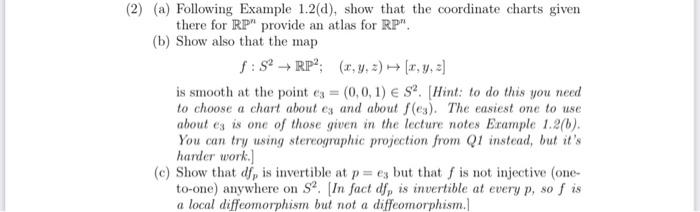
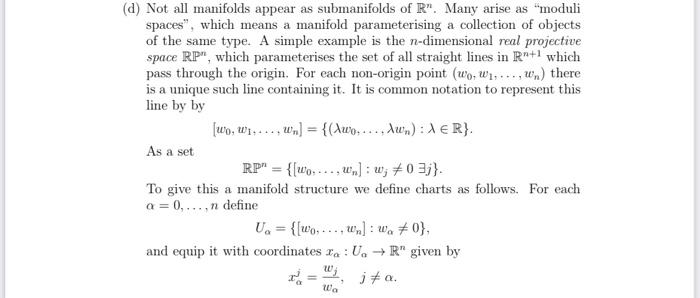
(2) (a) Following Example 1.2(d), show that the coordinate charts given there for RPn provide an atlas for RPn. (b) Show also that the map f:S2RP2;(x,y,z)[x,y,z] is smooth at the point 3=(0,0,1)S2. [Hint: to do this you need to choose a chart about e3 and about f(e3). The easiest one to use about e3 is one of those given in the lecture notes Example 1.2(b). You can try using stereogruphic projection from Q1 instead, but it's harder work.] (c) Show that dfp is invertible at p=e3 but that f is not injective (oneto-one) anywhere on S2. [In fact dfp is invertible at every p, so f is a local diffeomorphism but not a diffeomorphism.] (d) Not all manifolds appear as submanifolds of Rn. Many arise as "moduli spaces", which means a manifold parameterising a collection of objects of the same type. A simple example is the n-dimensional real projective space RPn, which parameterises the set of all straight lines in Rn+1 which pass through the origin. For each non-origin point (w0,w1,,wn) there is a unique such line containing it. It is common notation to represent this line by by [w0,w1,,wn]={(w0,,wn):R}. As a set RPn={[w0,,wn]:wj=0j}. To give this a manifold structure we define charts as follows. For each =0,,n define U={[w0,,wn]:w=0}, and equip it with coordinates x:URn given by xj=wwj,j=
Step by Step Solution
There are 3 Steps involved in it

Get step-by-step solutions from verified subject matter experts
 Study Help