Question: Here is the problem context, I already figure out the equation, I just couldn't solve for these two. Tutorial 9 Math 0130 Comparing Investments Two

Here is the problem context, I already figure out the equation, I just couldn't solve for these two.
Here is the problem context, I already figure outHere is the problem context, I already figure outHere is the problem context, I already figure out
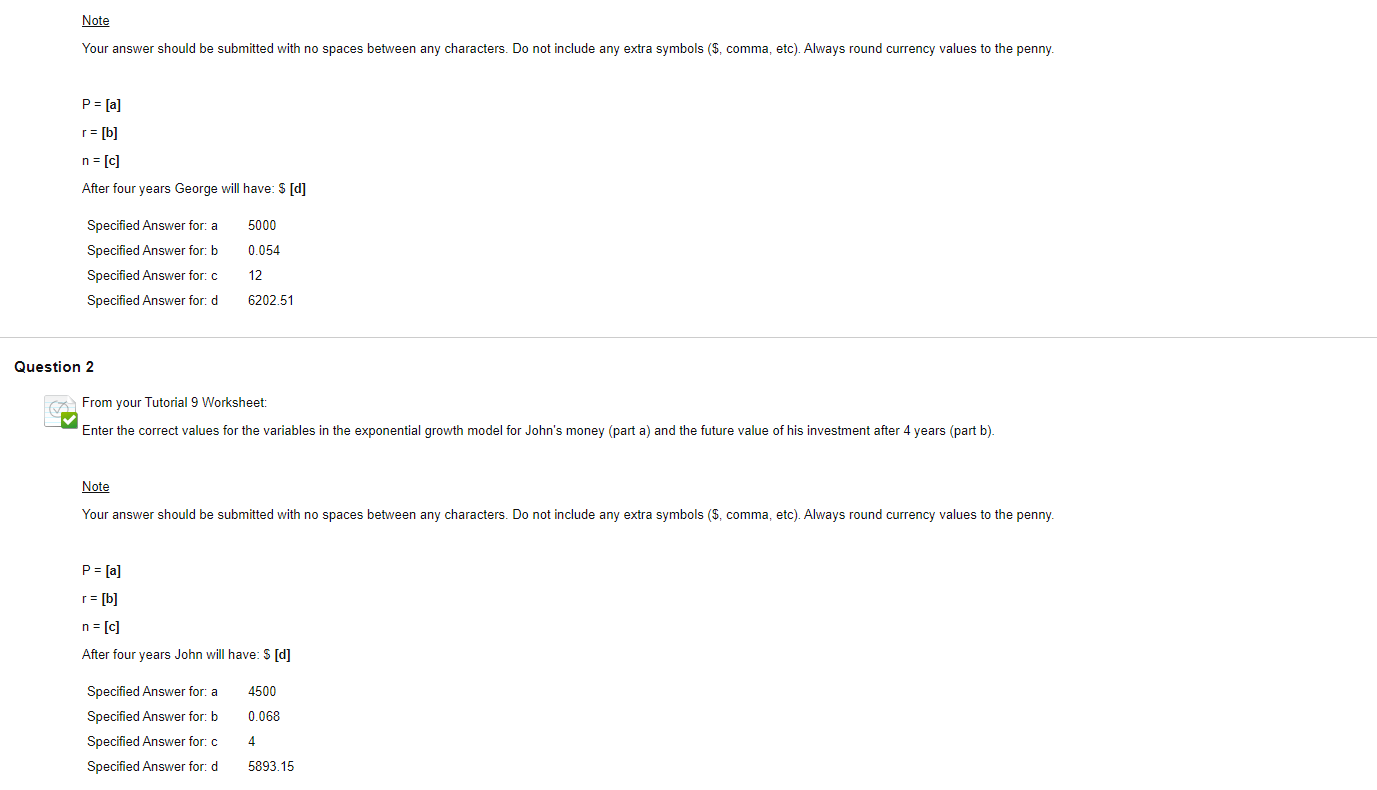
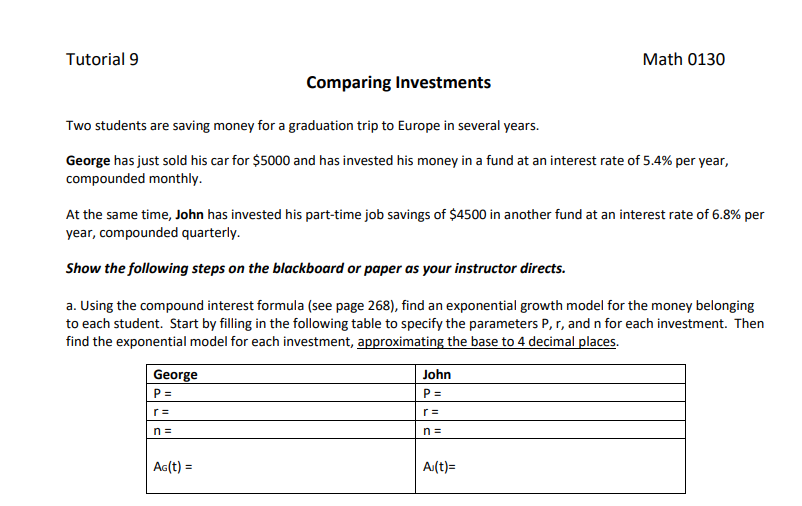
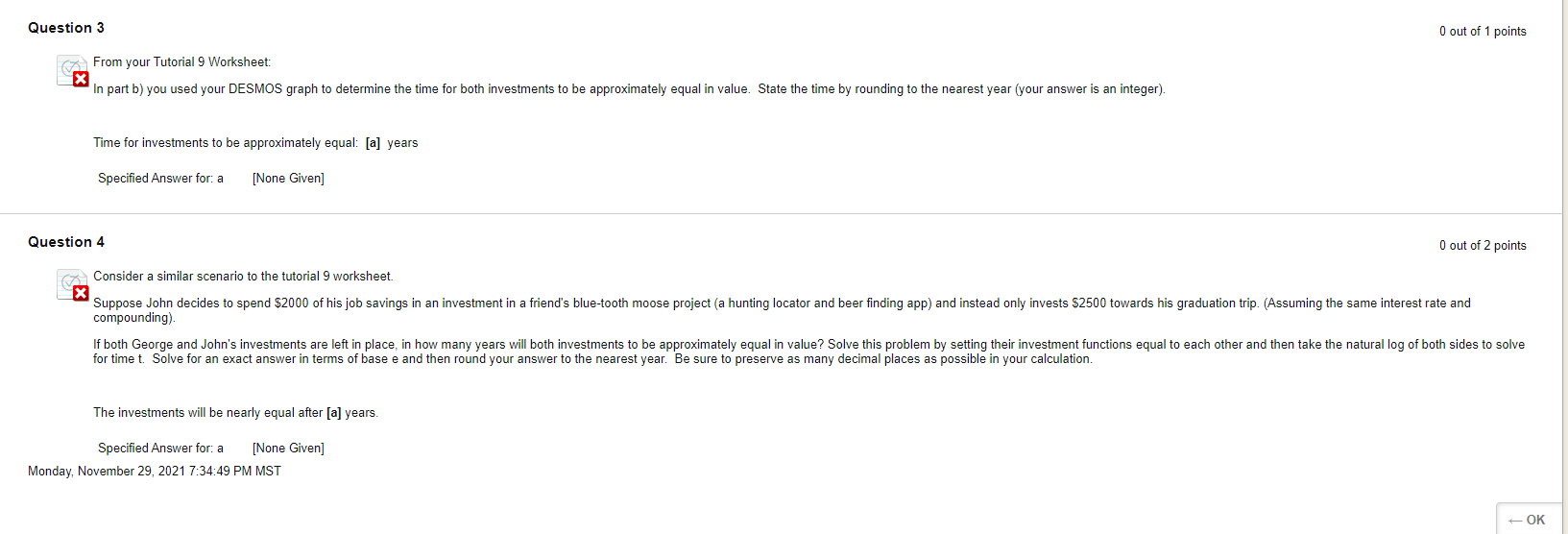
Tutorial 9 Math 0130 Comparing Investments Two students are saving money for a graduation trip to Europe in several years. George has just sold his car for $5000 and has invested his money in a fund at an interest rate of 5.4% per year, compounded monthly. At the same time. John has invested his part-time job savings of $4500 in another fund at an interest rate of 5.3% per year. compounded quarterly. Show the following steps on the blackboard or paper as your instructor directs. a. Using the compound interest formula {see page 2531* nd an exponential growth model for the money belonging to each student. Start by filling in the following table to specify the parameters P, r, and n for each investment. Then nd the exponential model for each invest me nt, approximating the base to 4 decimal places. Question 3 0 out of 1 points From your Tutorial 9 Worksheet: X In part b) you used your DESMOS graph to determine the time for both investments to be approximately equal in value. State the time by rounding to the nearest year (your answer is an integer). Time for investments to be approximately equal: [a] years Specified Answer for: a [None Given] Question 4 0 out of 2 points Consider a similar scenario to the tutorial 9 worksheet. X Suppose John decides to spend $2000 of his job savings in an investment in a friend's blue-tooth moose project (a hunting locator and beer finding app) and instead only invests $2500 towards his graduation trip. (Assuming the same interest rate and compounding). If both George and John's investments are left in place, in how many years will both investments to be approximately equal in value? Solve this problem by setting their investment functions equal to each other and then take the natural log of both sides to solve for time t. Solve for an exact answer in terms of base e and then round your answer to the nearest year. Be sure to preserve as many decimal places as possible in your calculation. The investments will be nearly equal after [a] years. Specified Answer for: a [None Given] Monday, November 29, 2021 7:34:49 PM MST - OKNote Your answer should be submitted with no spaces between any characters. Do not include any extra symbols ($, comma, etc). Always round currency values to the penny. P = [a] r = [b] n = [c] After four years George will have: $ [d] Specified Answer for: a 5000 Specified Answer for: b 0.054 Specified Answer for: c 12 Specified Answer for: d 6202.51 Question 2 A From your Tutorial 9 Worksheet: Enter the correct values for the variables in the exponential growth model for John's money (part a) and the future value of his investment after 4 years (part b). Note Your answer should be submitted with no spaces between any characters. Do not include any extra symbols ($, comma, etc). Always round currency values to the penny. P = [a] r = [b] n = [c] After four years John will have: $ [d] Specified Answer for: a 4500 Specified Answer for: b 0.068 Specified Answer for: c 4 Specified Answer for: d 5893.15

Step by Step Solution

There are 3 Steps involved in it

1 Expert Approved Answer
Step: 1 Unlock blur-text-image

Question Has Been Solved by an Expert!

Get step-by-step solutions from verified subject matter experts

Step: 2 Unlock
Step: 3 Unlock

Students Have Also Explored These Related Mathematics Questions!