







Question: Here is the program to be modified for this speific output: #include semun.h /* Definition of semun union */ #include svshm_xfr.h int main(int argc, char
Here is the program to be modified for this speific output:
#include "semun.h" /* Definition of semun union */
#include "svshm_xfr.h"
int
main(int argc, char *argv[])
{
int semid, shmid, bytes, xfrs;
struct shmseg *shmp;
union semun dummy;
/* Create set containing two semaphores; initialize so that
writer has first access to shared memory. */
semid = semget(SEM_KEY, 2, IPC_CREAT | OBJ_PERMS);
if (semid == -1)
errExit("semget");
if (initSemAvailable(semid, WRITE_SEM) == -1)
errExit("initSemAvailable");
if (initSemInUse(semid, READ_SEM) == -1)
errExit("initSemInUse");
if(semop(semid, BUF_SIZE, 1))
errExit("semop");
/* Create shared memory; attach at address chosen by system */
shmid = shmget(SHM_KEY, sizeof(struct shmseg), IPC_CREAT | OBJ_PERMS);
if (shmid == -1)
errExit("shmget");
shmp = shmat(shmid, NULL, 0);
if (shmp == (void *) -1)
errExit("shmat");
/* Transfer blocks of data from stdin to shared memory */
for (xfrs = 0, bytes = 0; ; xfrs++, bytes += shmp->cnt) {
if (reserveSem(semid, WRITE_SEM) == -1) /* Wait for our turn */
errExit("reserveSem");
shmp->cnt = read(STDIN_FILENO, shmp->buf, BUF_SIZE);
if (shmp->cnt == -1)
errExit("read");
if (releaseSem(semid, READ_SEM) == -1) /* Give reader a turn */
errExit("releaseSem");
/* Have we reached EOF? We test this after giving the reader
a turn so that it can see the 0 value in shmp->cnt. */
if (shmp->cnt == 0)
break;
}
/* Wait until reader has let us have one more turn. We then know
reader has finished, and so we can delete the IPC objects. */
if (reserveSem(semid, WRITE_SEM) == -1)
errExit("reserveSem");
if (semctl(semid, 0, IPC_RMID, dummy) == -1)
errExit("semctl");
if (shmdt(shmp) == -1)
errExit("shmdt");
if (shmctl(shmid, IPC_RMID, 0) == -1)
errExit("shmctl");
fprintf(stderr, "Sent %d bytes (%d xfrs) ", bytes, xfrs);
exit(EXIT_SUCCESS);
}
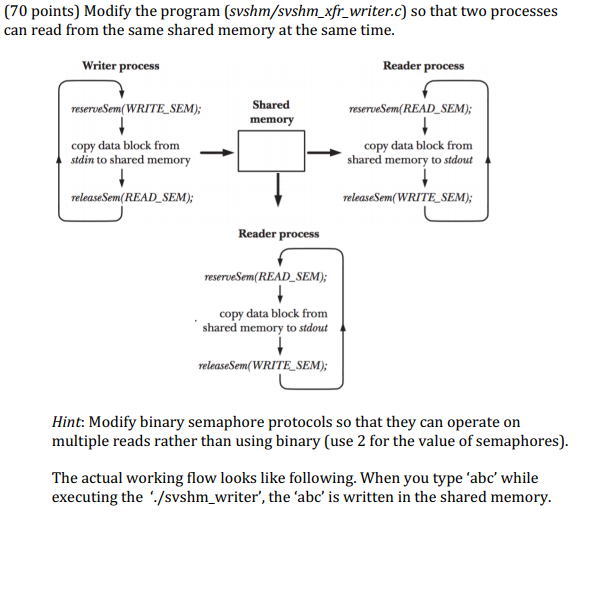
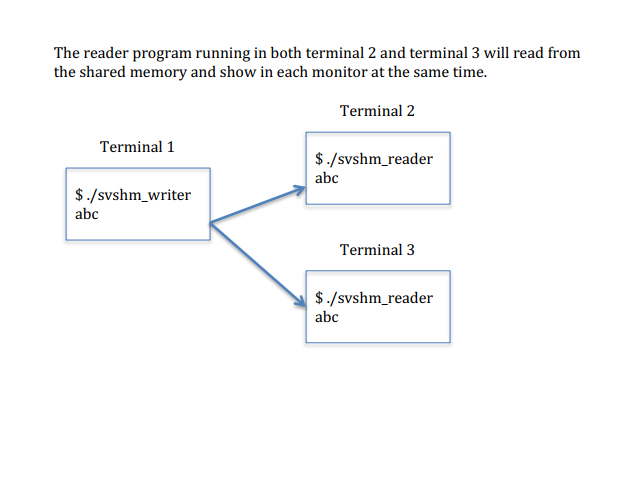
(70 points) Modify the program (svshm/svshm_xfr_ writer.c) so that two processes can read from the same shared memory at the same time. Writer process Reader process Shared memory reserueSem(WRITE SEM) reserveSem(READ SEM) copy data block from stdin to shared memory copy data block from shared memory to stdout releaseSem(READ SEM) releaseSem(WRITE SEM) Reader process reserueSem(READ SEM); copy data block from shared memory to stdout releaseSem(WRITE SEM) Hint: Modify binary semaphore protocols so that they can operate on multiple reads rather than using binary (use 2 for the value of semaphores). The actual working flow looks like following. When you type 'abe while executing the ../svshm-writer', the abc' is written in the shared memory. (70 points) Modify the program (svshm/svshm_xfr_ writer.c) so that two processes can read from the same shared memory at the same time. Writer process Reader process Shared memory reserueSem(WRITE SEM) reserveSem(READ SEM) copy data block from stdin to shared memory copy data block from shared memory to stdout releaseSem(READ SEM) releaseSem(WRITE SEM) Reader process reserueSem(READ SEM); copy data block from shared memory to stdout releaseSem(WRITE SEM) Hint: Modify binary semaphore protocols so that they can operate on multiple reads rather than using binary (use 2 for the value of semaphores). The actual working flow looks like following. When you type 'abe while executing the ../svshm-writer', the abc' is written in the shared memory
Step by Step Solution
There are 3 Steps involved in it

Get step-by-step solutions from verified subject matter experts
 Study Help