







Question: Here is the starter code: /** * Given a 2D array of ints return the value of the * most valuable contiguous sub rectangle in
Here is the starter code:
/**
* Given a 2D array of ints return the value of the
* most valuable contiguous sub rectangle in the 2D array.
* The sub rectangle must be at least 1 by 1.
*
pre: mat != null, mat.length > 0, mat[0].length > 0,
* mat is a rectangular matrix.
*
post: return the value of the most valuable contiguous sub rectangle
* in city.
* @param city The 2D array of ints representing the value of
* each block in a portion of a city.
* @return return the value of the most valuable contiguous sub rectangle
* in city.
*/
public static int getValueOfMostValuablePlot(int[][] city) {
// check preconditions
if (city == null || city.length == 0 || city[0].length == 0
|| !isRectangular(city) ) {
throw new IllegalArgumentException("Violation of precondition: " +
"getValueOfMostValuablePlot. The parameter may not be null," +
" must value at least one row and at least" +
" one column, and must be rectangular.");
}
}
Here is testers:
board = new char[][] { { '.', '.', '.', 'q' },
{ '.', '.', '.', '.' },
{ '.', '.', '.', '.' },
{ 'q', '.', '.', '.' } };
expectedBool = false;
board = new char[][] { { 'q', '.', '.', '.', '.', '.', '.' },
{ '.', '.', '.', '.', 'q', '.', '.' },
{ '.', 'q', '.', '.', '.', '.', '.' },
{ '.', '.', '.', '.', '.', 'q', '.' },
{ '.', '.', 'q', '.', '.', '.', '.' },
{ '.', '.', '.', '.', '.', '.', 'q' },
{ '.', '.', '.', 'q', '.', '.', '.' } };
expectedBool = true;
board = new char[][] {
{ 'q', '.', '.', '.', '.', '.', '.', '.', '.', '.' },
{ '.', '.', '.', '.', 'q', '.', '.', '.', '.', '.' },
{ '.', 'q', '.', '.', '.', '.', '.', '.', '.', '.' },
{ '.', '.', '.', '.', '.', 'q', '.', '.', '.', '.' },
{ '.', '.', 'q', '.', '.', '.', '.', '.', '.', '.' },
{ '.', '.', '.', '.', '.', '.', 'q', '.', '.', '.' },
{ '.', '.', '.', 'q', '.', '.', '.', '.', '.', '.' },
{ '.', '.', '.', '.', '.', '.', '.', '.', '.', '.' },
{ '.', '.', '.', '.', '.', '.', '.', '.', '.', '.' },
{ '.', '.', '.', '.', '.', '.', '.', '.', 'q', '.' }, };
expectedBool = false;
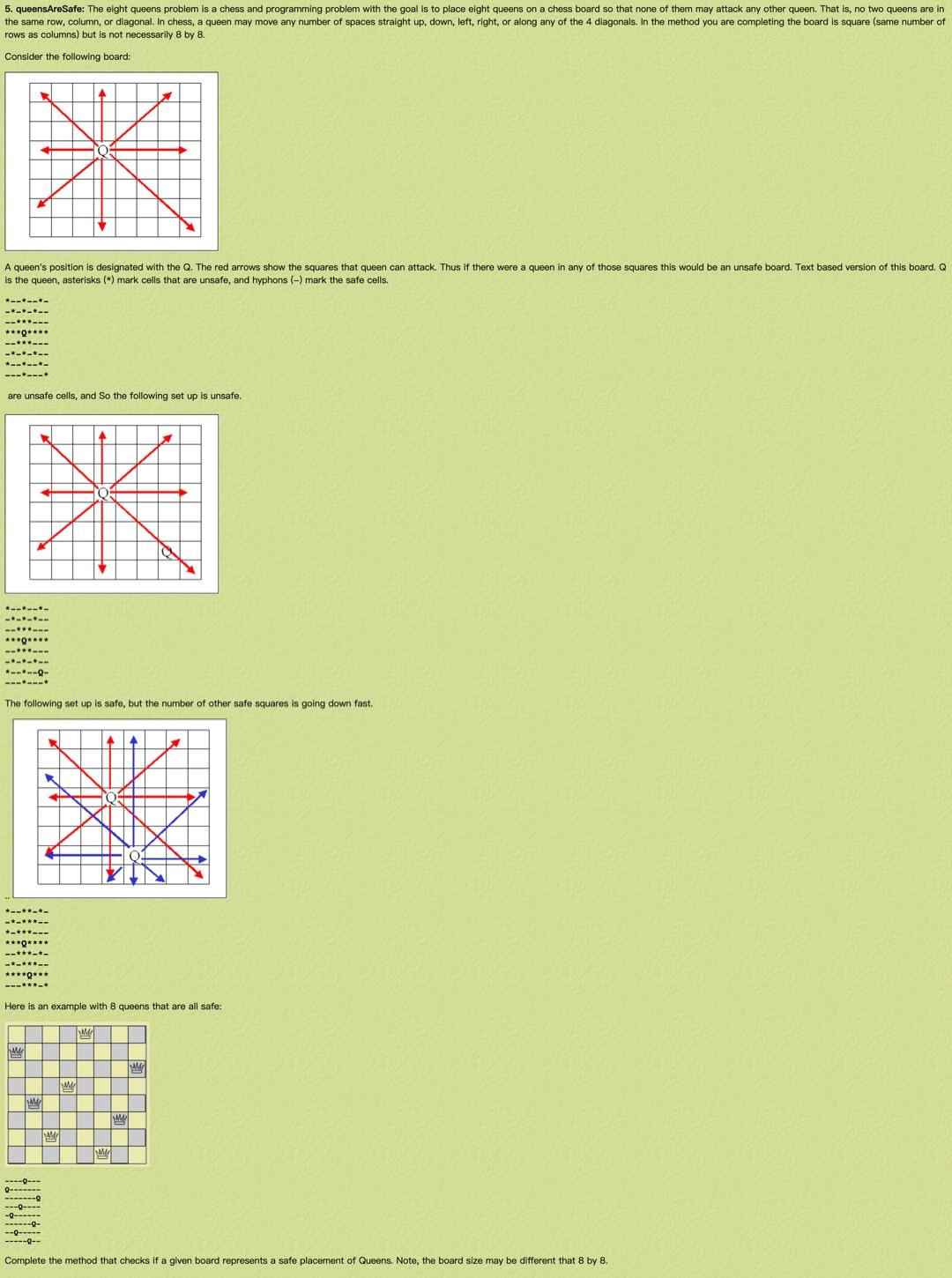
5. queensAreSafe: The eight queens problem is a chess and programming problem with the goal is to place eight queens on a chess board so that none of them may attack any other queen. That is, no two queens are in the same row, column, or diagonal. In chess, a queen may move any number of spaces straight up, down, left, right, or along any of the 4 diagonals. In the method you are completing the board is square (same number of rows as columns) but is not necessarily 8 by 8. Consider the following board: A queen's position is designated with the Q. The red arrows show the squares that queen can attack. Thus if there were a queen in any of those squares this would be an unsafe board. Text based version of this board. Q is the queen, asterisks (*) mark cells that are unsafe, and hyphons (-) mark the safe cells. are unsafe cells, and So the following set up is unsafe. *-*-*- ******* --***--- 1111110 The following set up is safe, but the number of other safe squares is going down fast. ******* Here is an example with queens that are all safe: M Q------ ------ 1181111 --- ------0- --8--- -----8- M X M W Complete the method that checks if a given board represents a safe placement of Queens. Note, the board size may be different that 8 by 8.
Step by Step Solution
3.40 Rating (156 Votes )
There are 3 Steps involved in it
To change this license header choose License Headers in Project Properties To change this template file choose Tools Templates and open the template i... View full answer

Get step-by-step solutions from verified subject matter experts
 Study Help