







Question: Here we will use a u subtitution to find the antiderivative sin'(x) cos' (x)dx Note: You will not be able to progress through the problem
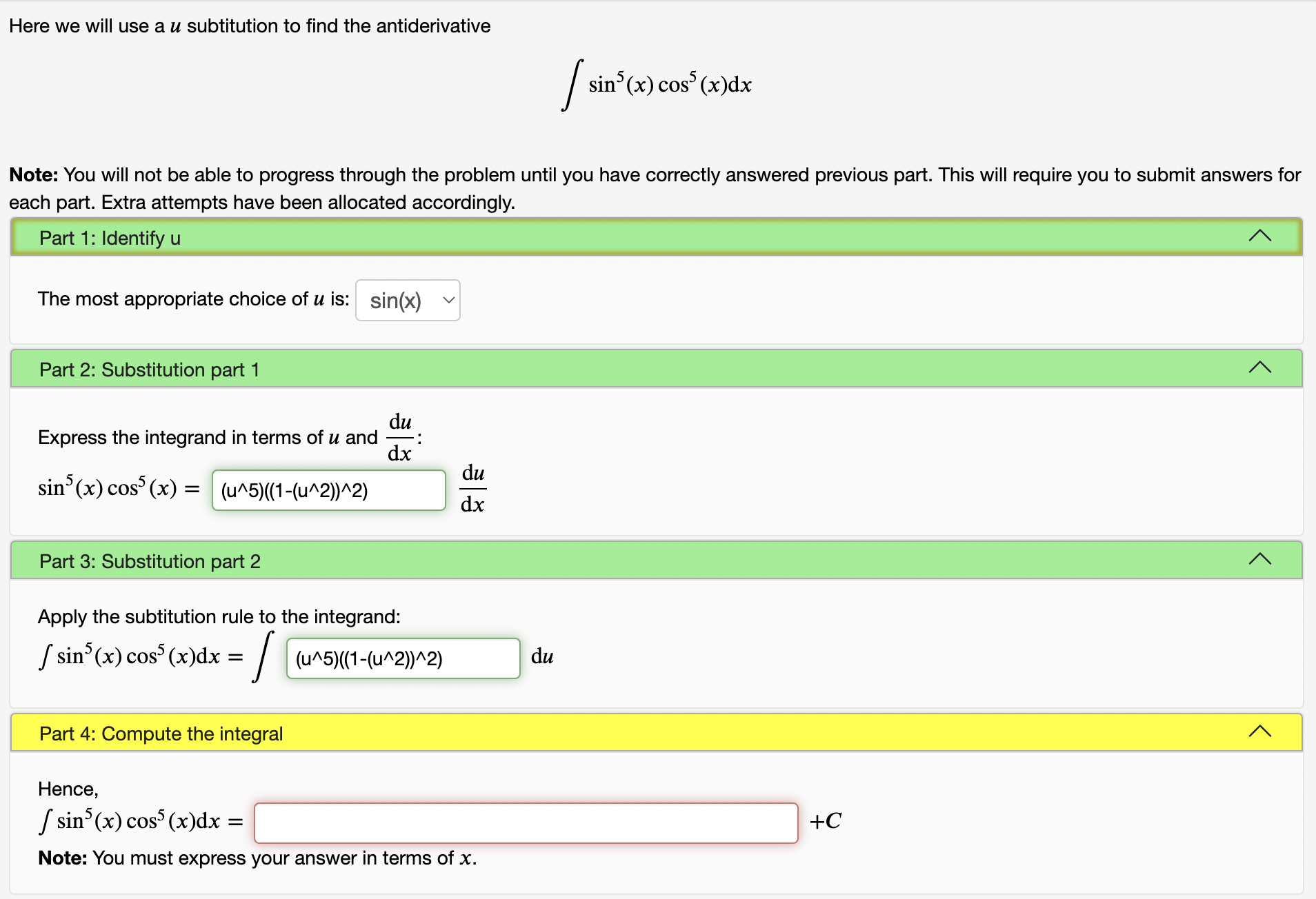
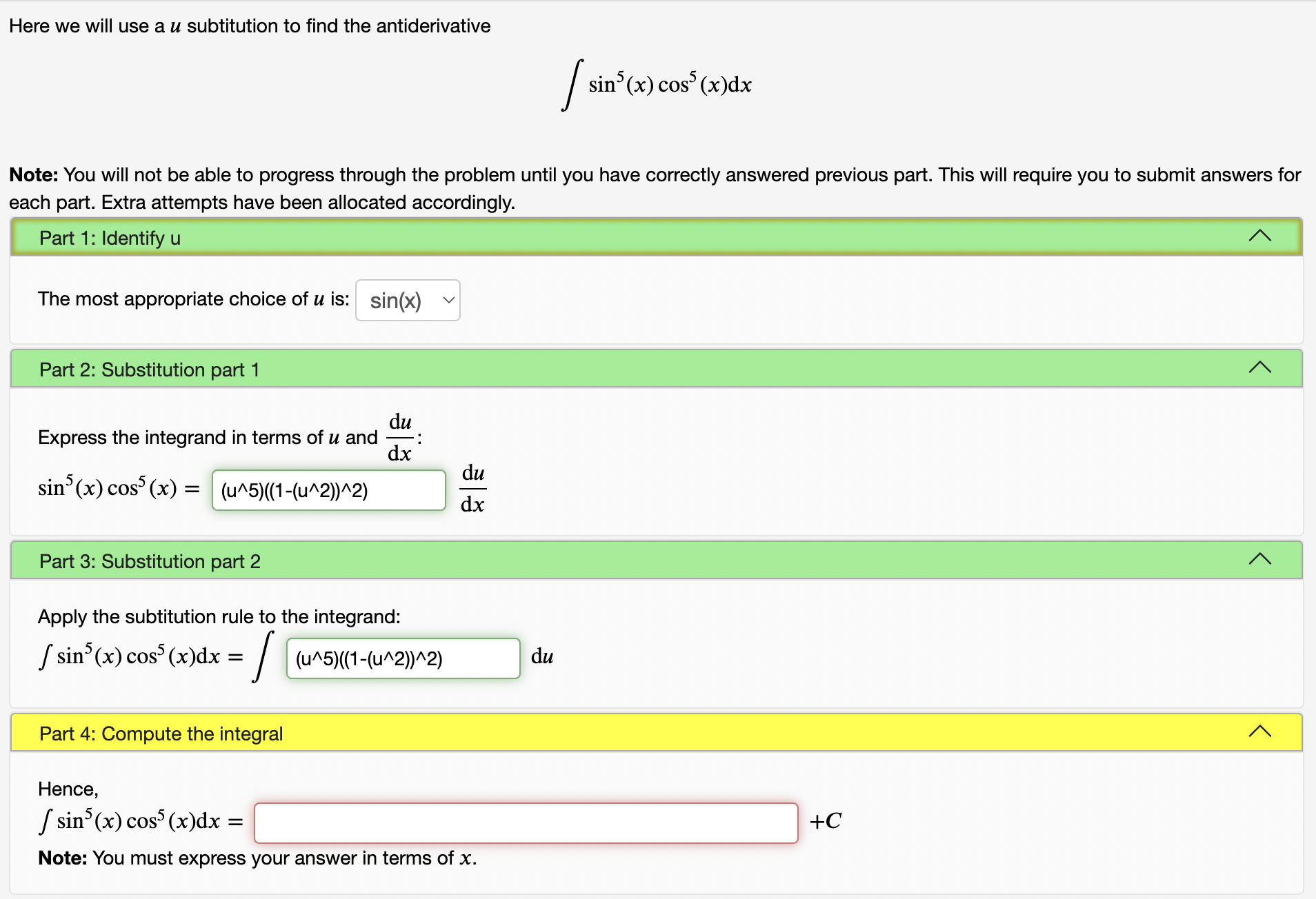
Here we will use a u subtitution to find the antiderivative sin'(x) cos' (x)dx Note: You will not be able to progress through the problem until you have correctly answered previous part. This will require you to submit answers for each part. Extra attempts have been allocated accordingly. Part 1: Identify u The most appropriate choice of u is: sin(x) Part 2: Substitution part 1 Express the integrand in terms of u and -: dx sin (x) cos' (x) = (415)((1-(4^2)) ^2) du dx Part 3: Substitution part 2 Apply the subtitution rule to the integrand: I sin'(x) cos' (x)dx = / (415)((1-(412))12) du Part 4: Compute the integral Hence, f sin'(x) cos' (x)dx = +C Note: You must express your answer in terms of x
Step by Step Solution
There are 3 Steps involved in it

Get step-by-step solutions from verified subject matter experts
 Study Help