Question: Hey, can someone please help me with this two-paragraph assignment I'm struggling.. I've written my paragraphs but i need help to finish the second paragraph
Hey, can someone please help me with this two-paragraph assignment I'm struggling.. I've written my paragraphs but i need help to finish the second paragraph and I would appreciate it if anyone who is skilled in English philosophy could authentically edit BOTH of the paragraphs like rewriting and making adjustments to improve the professionalism of the academic writing removing unnecessary words while also ensuring it follows the rubric. Also, the "closing sentences" should follow the format of a controlling idea + topic sentence. The "Summary/Context" sections should be a maximum of two sentences.
RUBRIC: Topic Sentence/Controlling Idea: A precise and unique controlling idea/topic sentence based on the topic and/or source(s) is present . The response maintains a strong focus on developing the controlling idea/topic sentence, thoroughly addressing the demands of the task, but also shows a depth of knowledge and superior understanding of the text. Supporting Detail/Textual Evidence: The response includes appropriate evidence to support the claim/topic sentence that reflects a close reading of the text. Reasoning and a deep understanding of the topic and/or source(s) are demonstrated by thorough explanations of the relationship between controlling idea and support. Organization/Unity: An effective organizational structure enhances the reader's understanding of the information. The relationships between ideas are made clear with effective transitional phrases. Language/Grammar: The response has an established, formal style that is maintained throughout. Varied sentence structure, precise language, and domain-specific vocabulary are used to communicate ideas effectively. The response rarely strays from an objective tone, and has no errors that do not interfere with meaning.
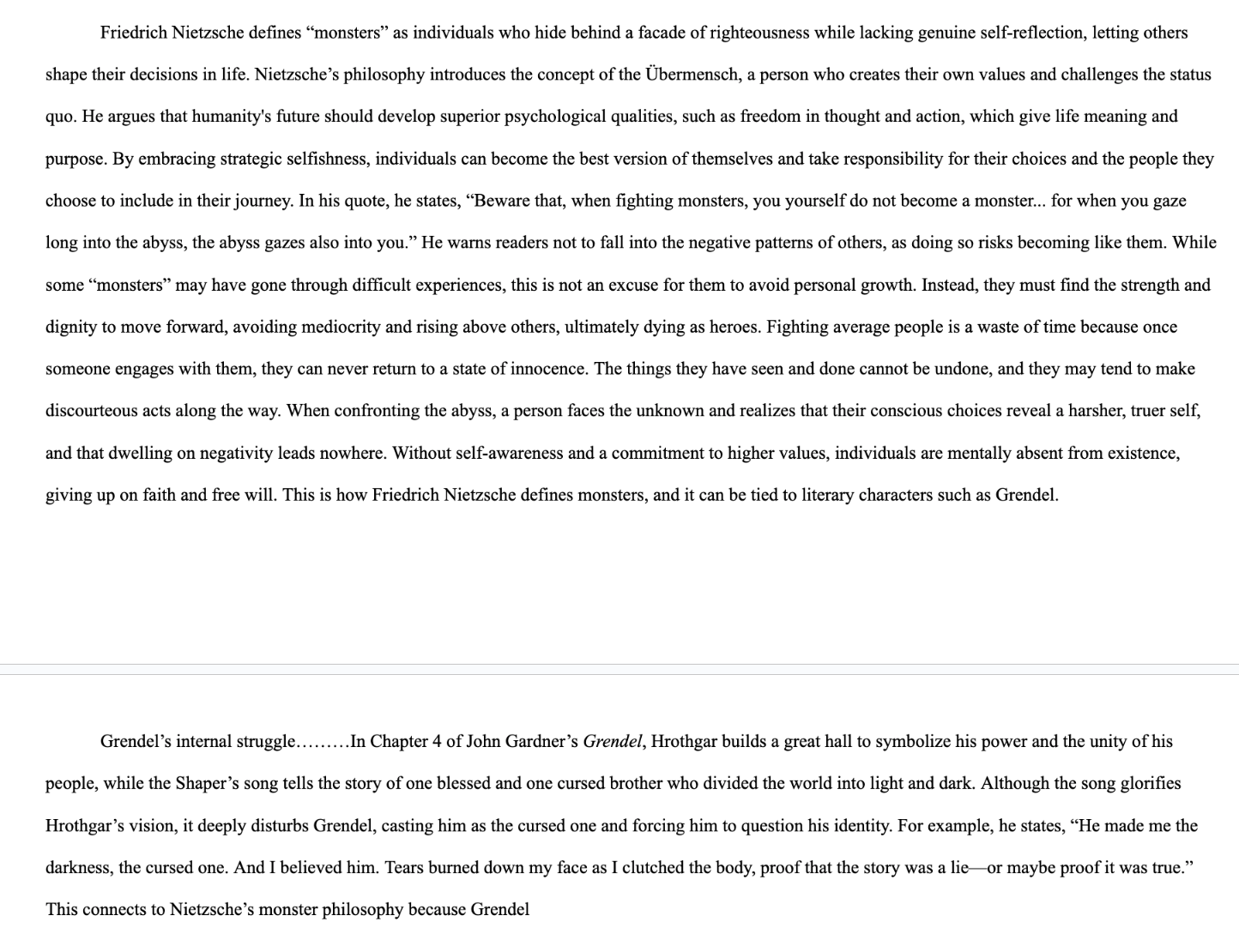
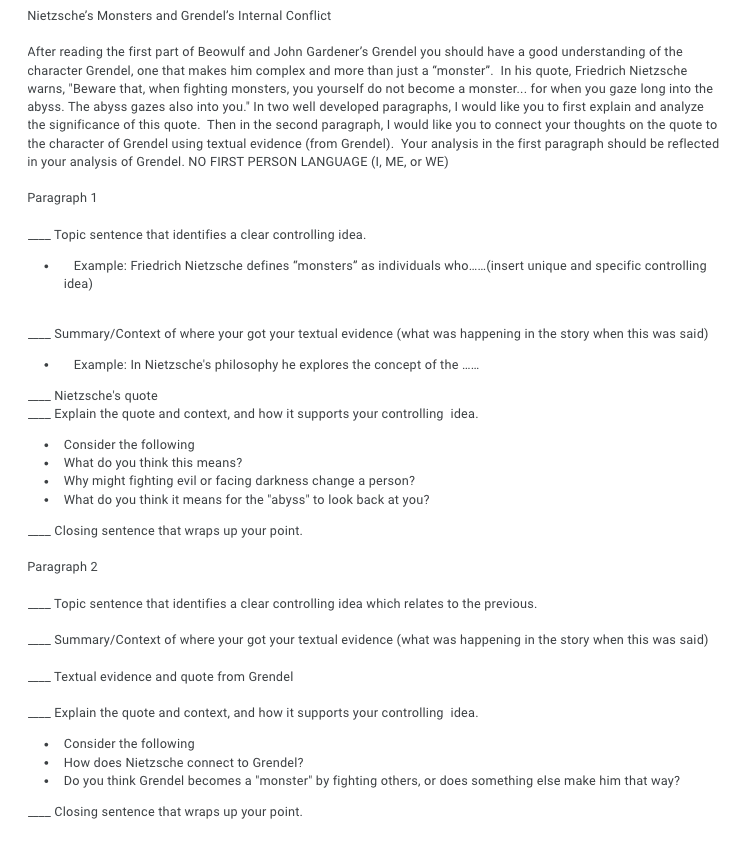
Friedrich Nietzsche defines \"monsters\" as individuals who hide behind a facade of righteousness while lacking genuine self-reflection, letting others shape their decisions in life. Nietzsche's philosophy introduces the concept of the Ubermensch, a person who creates their own values and challenges the status quo. He argues that humanity's future should develop superior psychological qualities, such as freedom in thought and action, which give life meaning and purpose. By embracing strategic selfishness, individuals can become the best version of themselves and take responsibility for their choices and the people they choose to include in their journey. In his quote, he states, \"Beware that, when fighting monsters, you yourself do not become a monster... for when you gaze long into the abyss, the abyss gazes also into you.\" He warns readers not to fall into the negative patterns of others, as doing so risks becoming like them. While some \"monsters\" may have gone through difficult experiences, this is not an excuse for them to avoid personal growth. Instead, they must find the strength and dignity to move forward, avoiding mediocrity and rising above others, ultimately dying as heroes. Fighting average people is a waste of time because once someone engages with them, they can never return to a state of innocence. The things they have seen and done cannot be undone, and they may tend to make discourteous acts along the way. When confronting the abyss, a person faces the unknown and realizes that their conscious choices reveal a harsher, truer self, and that dwelling on negativity leads nowhere. Without self-awareness and a commitment to higher values, individuals are mentally absent from existence, giving up on faith and free will. This is how Friedrich Nietzsche defines monsters, and it can be tied to literary characters such as Grendel. Grendel's internal struggle......... In Chapter 4 of John Gardner's Grendel, Hrothgar builds a great hall to symbolize his power and the unity of his people, while the Shaper's song tells the story of one blessed and one cursed brother who divided the world into light and dark. Although the song glorifies Hrothgar's vision, it deeply disturbs Grendel, casting him as the cursed one and forcing him to question his identity. For example, he states, \"He made me the darkness, the cursed one. And I believed him. Tears burned down my face as I clutched the body, proof that the story was a lieor maybe proof it was true.\" This connects to Nietzsche's monster philosophy because Grendel Nietzsche's Monsters and Grendel's Internal Conflict After reading the first part of Beowulf and John Gardener's Grendel you should have a good understanding of the character Grendel, one that makes him complex and more than just a "menster\". In his quote, Friedrich Nietzsche warns, "Beware that, when fighting monsters, you yourself do not become a monster... for when you gaze long into the abyss. The abyss gazes also into you." In two well developed paragraphs, | would like you to first explain and analyze the significance of this quote. Then in the second paragraph, | would like you to connect your thoughts on the quote to the character of Grendel using textual evidence (from Grendel). Your analysis in the first paragraph should be reflected in your analysis of Grendel. NO FIRST PERSON LANGUAGE (1, ME, or WE) Paragraph 1 Topic sentence that identifies a clear controlling idea. . Example: Friedrich Nietzsche defines \"monsters\" as individuals who.....(insert unique and specific controlling idea) ____ Summary/Context of where your got your textual evidence (what was happening in the story when this was said) Example: In Nietzsche's philosophy he explores the concept of the ... ___ Nietzsche's quote ___ Explain the quote and context, and how it supports your controlling idea. Consider the following What do you think this means? Why might fighting evil or facing darkness change a person? What do you think it means for the \""abyss" to look back at you? Closing sentence that wraps up your point. Paragraph 2 Topic sentence that identifies a clear controlling idea which relates to the previous. Summary/Context of where your got your textual evidence (what was happening in the story when this was said) Textual evidence and quote from Grendel Explain the quote and context, and how it supports your controlling idea. - Consider the following How does Nietzsche connect to Grendel? Do you think Grendel becomes a "monster\" by fighting others, or does something else make him that way? Closing sentence that wraps up your point
Step by Step Solution
There are 3 Steps involved in it
1 Expert Approved Answer
Step: 1 Unlock
Question Has Been Solved by an Expert!
Get step-by-step solutions from verified subject matter experts
Step: 2 Unlock
Step: 3 Unlock
Students Have Also Explored These Related Business Writing Questions!









 Study Help