







Question: Hey I dont really know how to approach this problem, as I got both parts wrong. Any tips? Incorrect Question 8 0/10 pts Given the
Hey I dont really know how to approach this problem, as I got both parts wrong. Any tips?
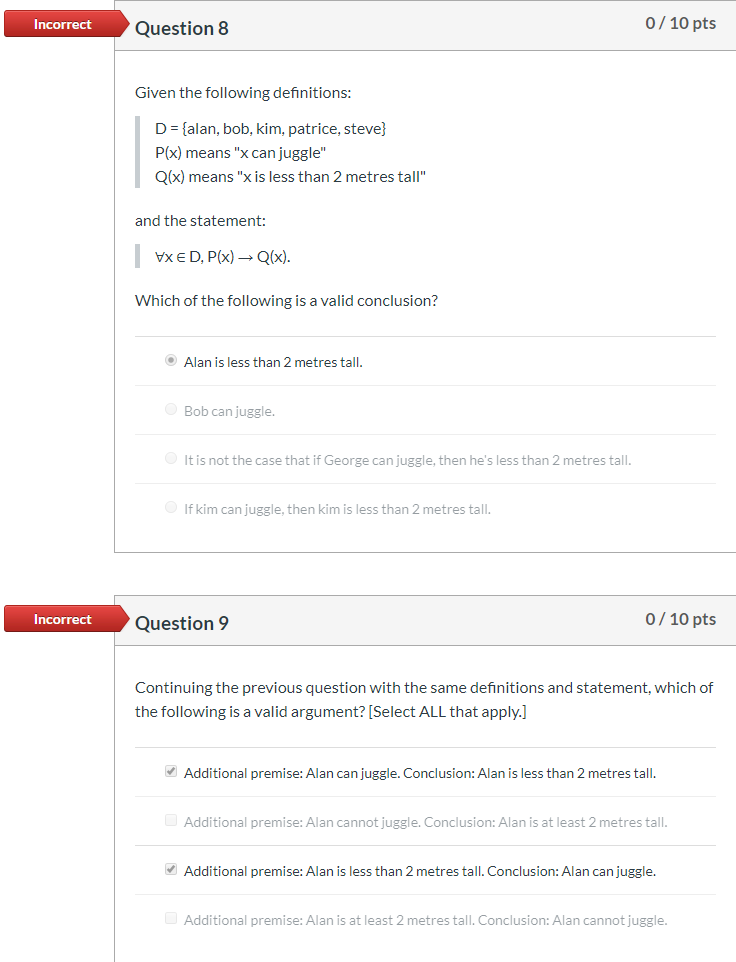
Incorrect Question 8 0/10 pts Given the following definitions: D = {alan, bob, kim, patrice, steve} P(x) means "x can juggle" Q(x) means "x is less than 2 metres tall" and the statement: XED, P(x) Q(x). Which of the following is a valid conclusion? Alan is less than 2 metres tall. Bob can juggle. It is not the case that if George can juggle, then he's less than 2 metres tall. If kim can juggle, then kim is less than 2 metres tall. Incorrect Question 9 0/10 pts Continuing the previous question with the same definitions and statement, which of the following is a valid argument? [Select ALL that apply.] Additional premise: Alan can juggle. Conclusion: Alan is less than 2 metres tall. Additional premise: Alan cannot juggle. Conclusion: Alan is at least 2 metres tall. Additional premise: Alan is less than 2 metres tall. Conclusion: Alan can juggle. Additional premise: Alan is at least 2 metres tall. Conclusion: Alan cannot juggle
Step by Step Solution
There are 3 Steps involved in it

Get step-by-step solutions from verified subject matter experts
 Study Help