







Question: Hey tutors, kindly help me with this exam prep exercise . Explanation need not be too detailed 26. [-/2 Points] DETAILS SERCP11 3.2.OP.009. MY NOTES
Hey tutors, kindly help me with this exam prep exercise . Explanation need not be too detailed
![need not be too detailed 26. [-/2 Points] DETAILS SERCP11 3.2.OP.009. MY](https://s3.amazonaws.com/si.experts.images/answers/2024/07/6683bbaa5e0a3_2906683bbaa34930.jpg)
![ground? m/s Need Help? Read It 27. [-/2 Points] DETAILS SERCP11 3.2.OP.015.](https://s3.amazonaws.com/si.experts.images/answers/2024/07/6683bbabd80e6_2916683bbabbc45c.jpg)
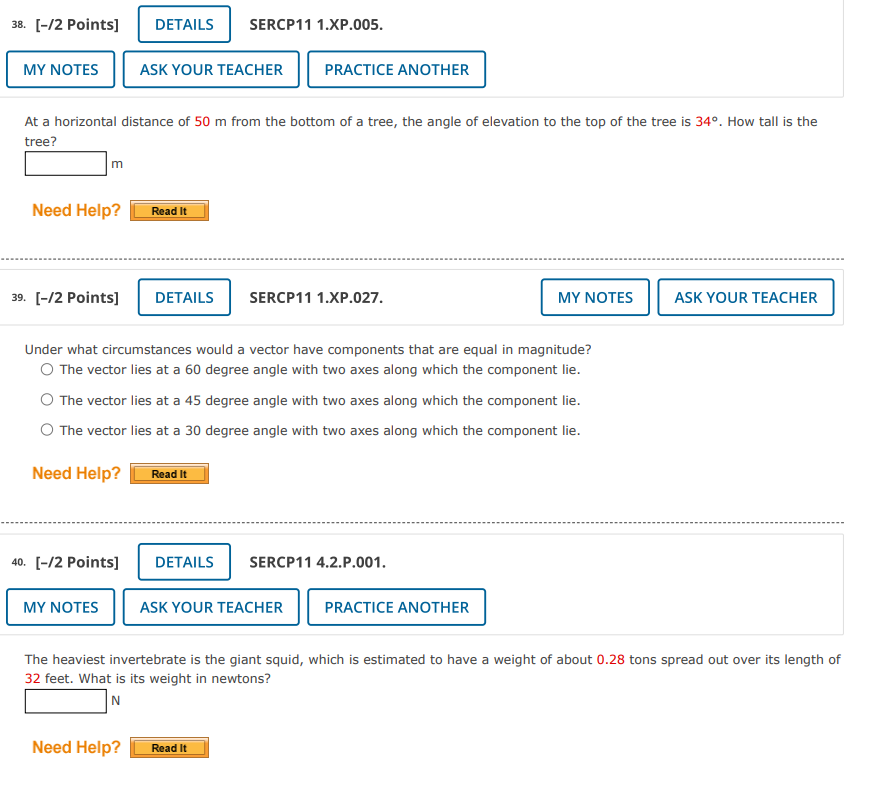
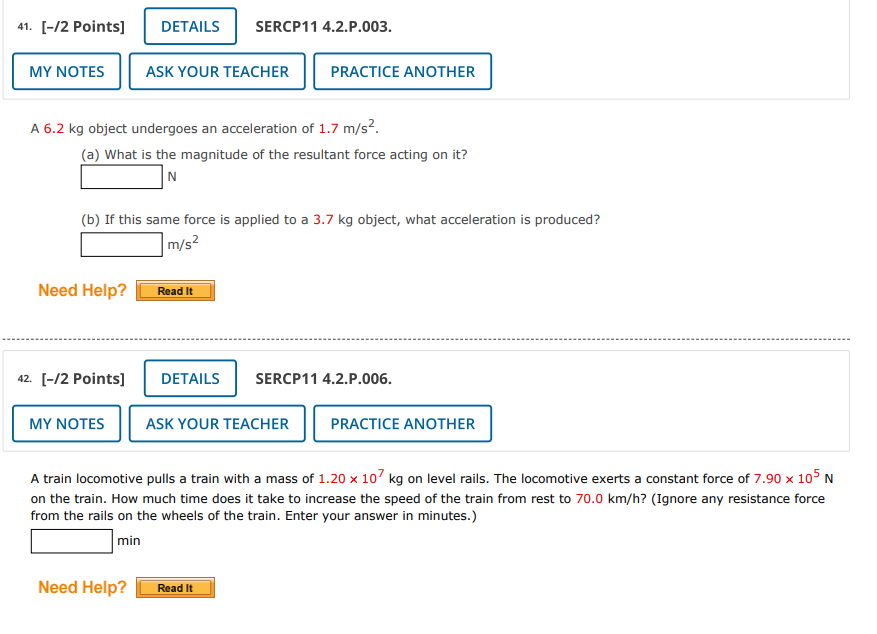
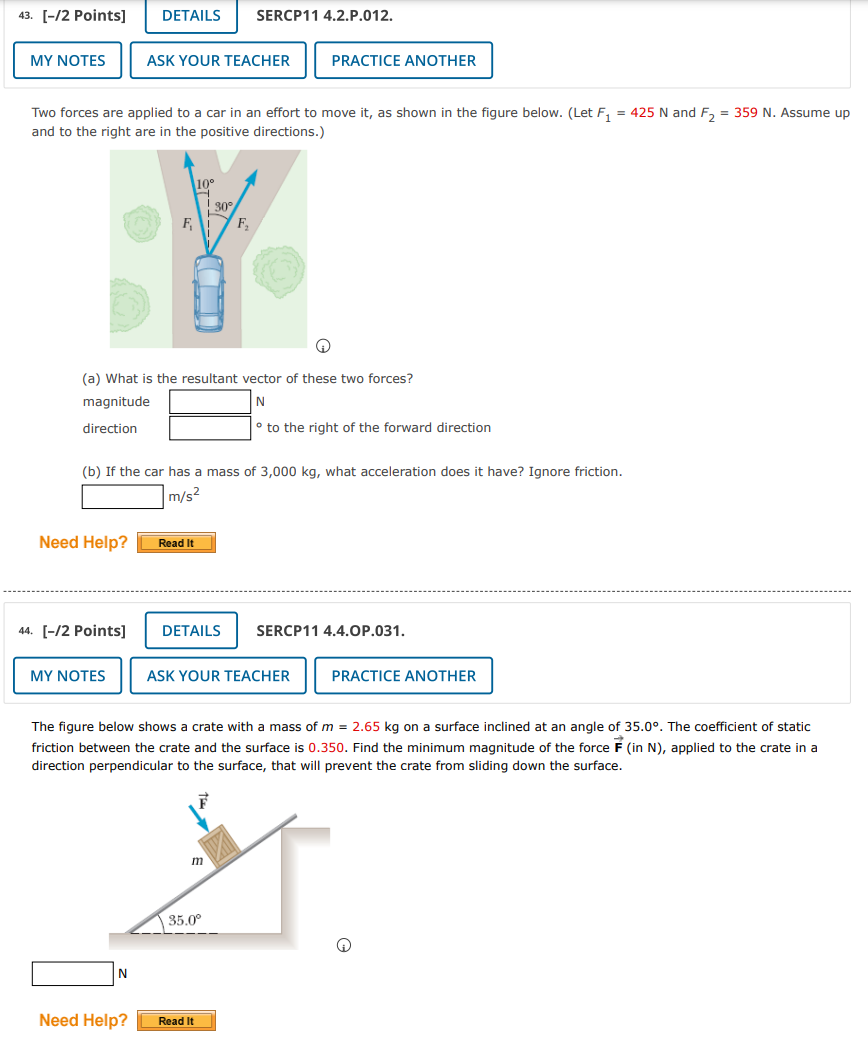
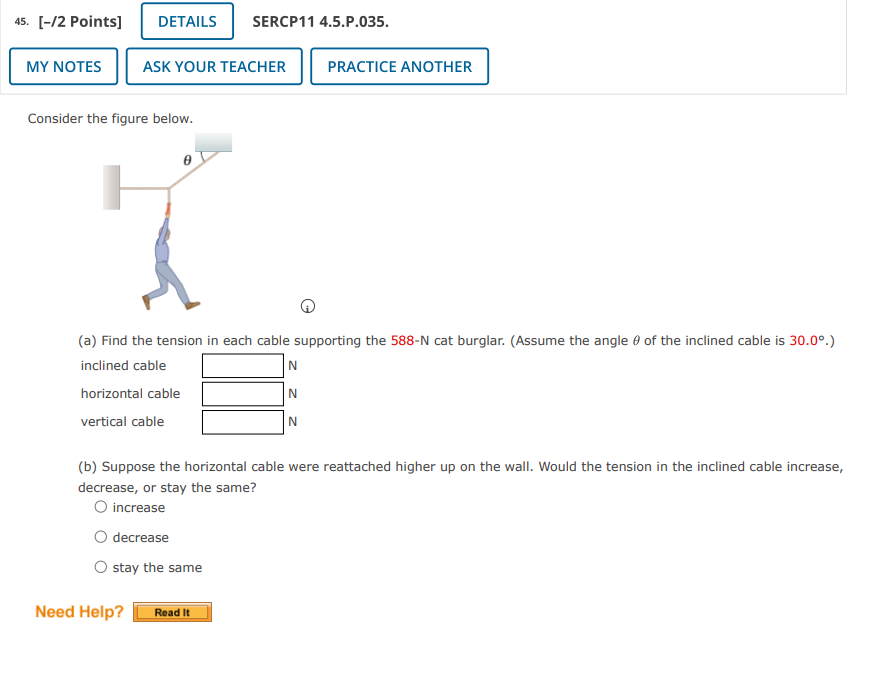
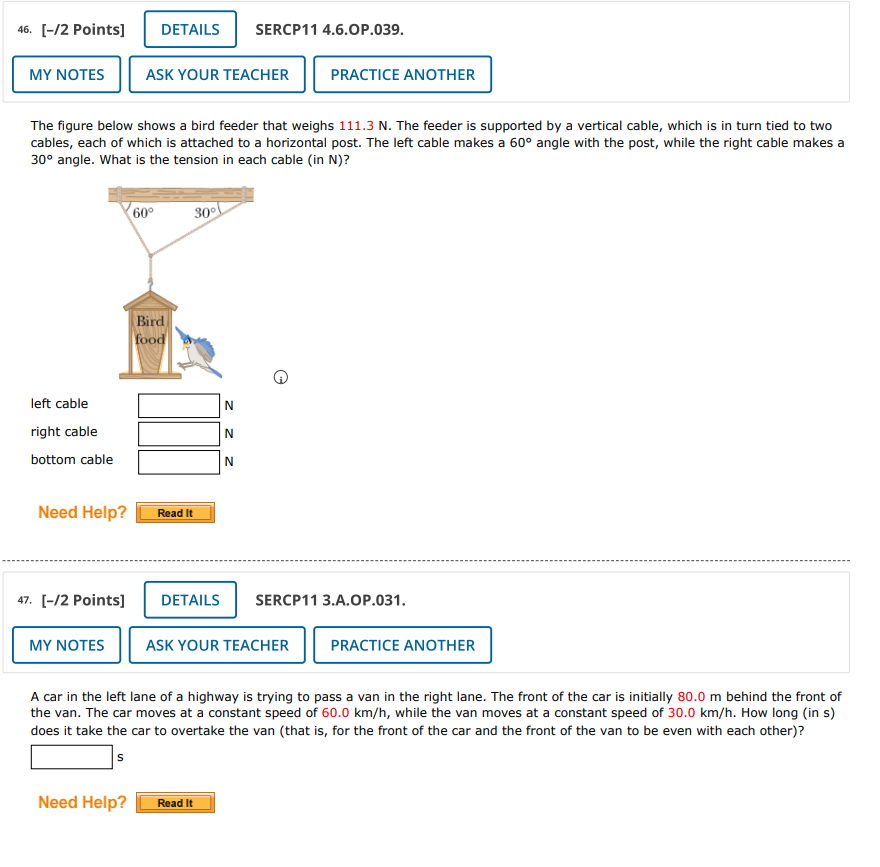
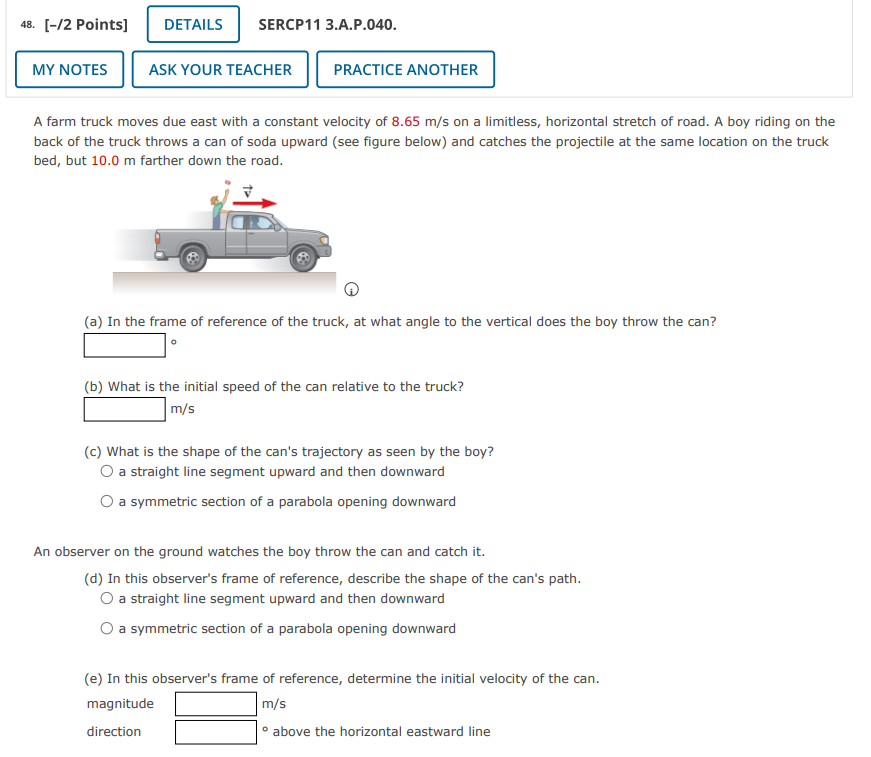
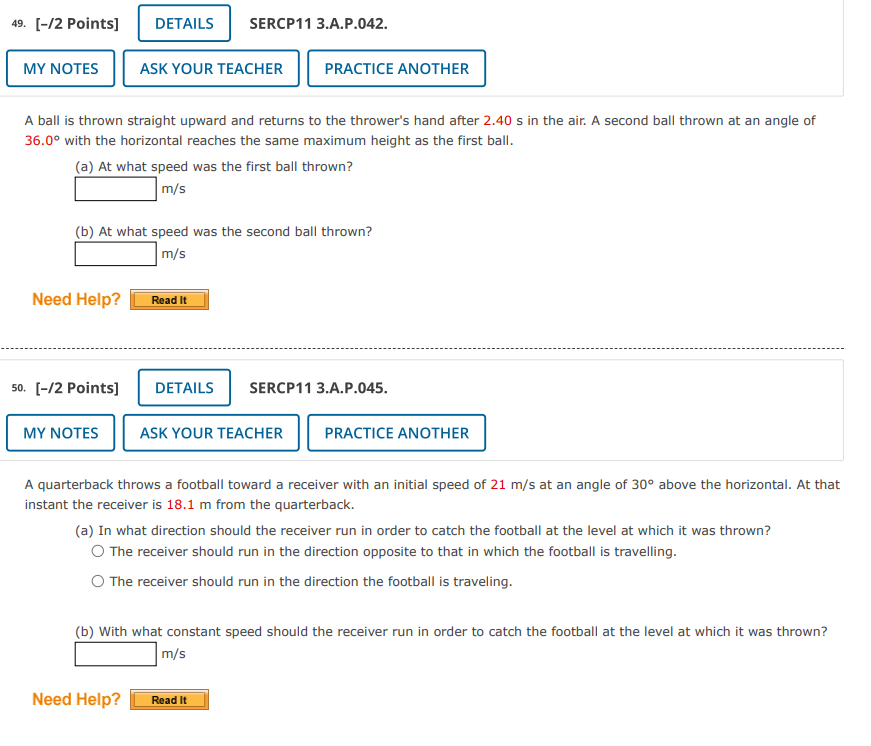
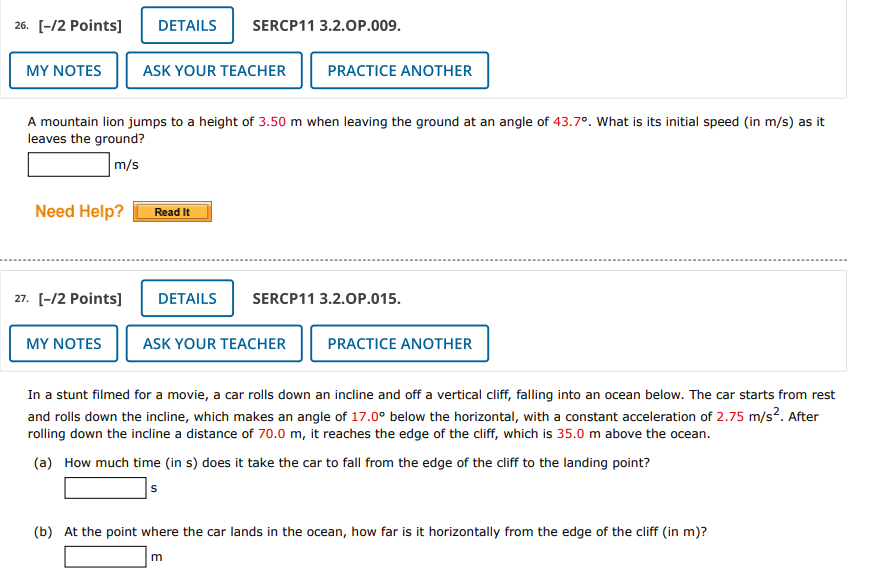
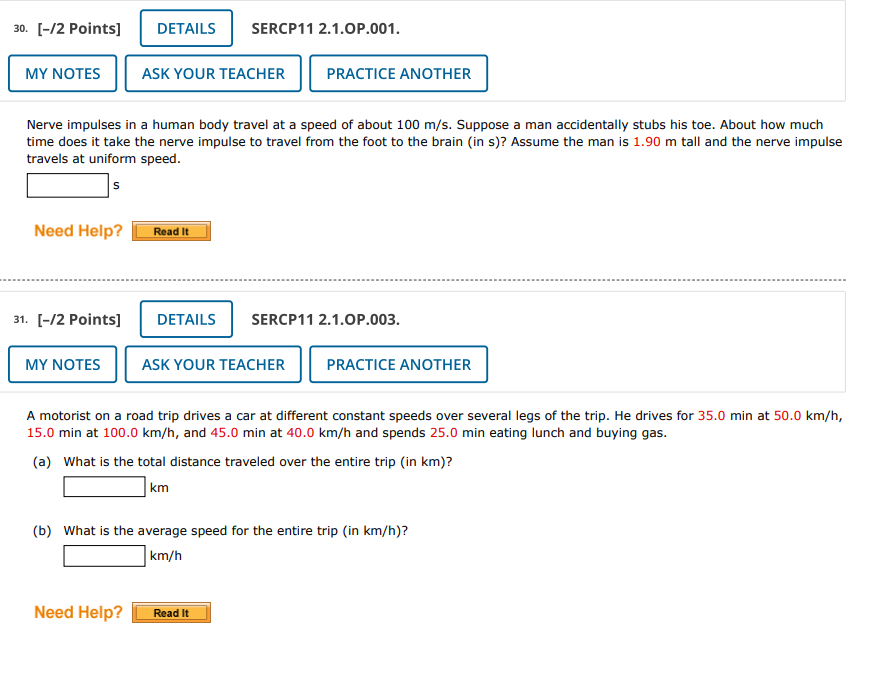
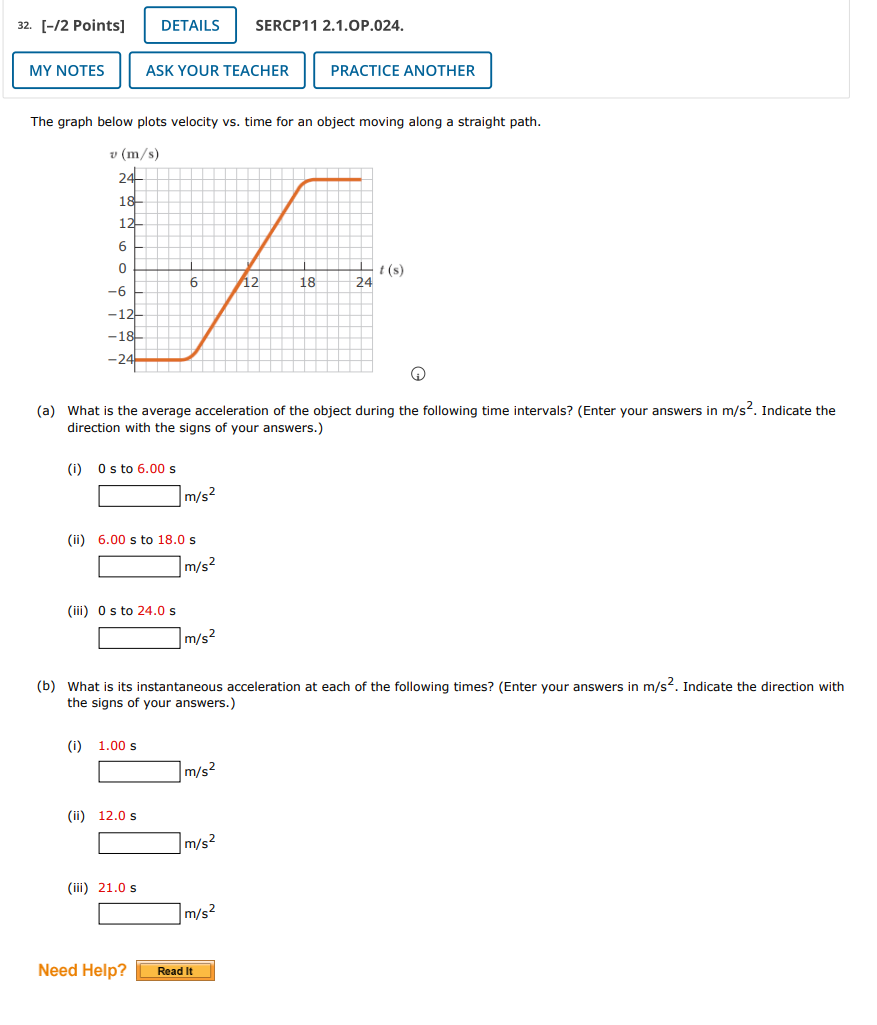
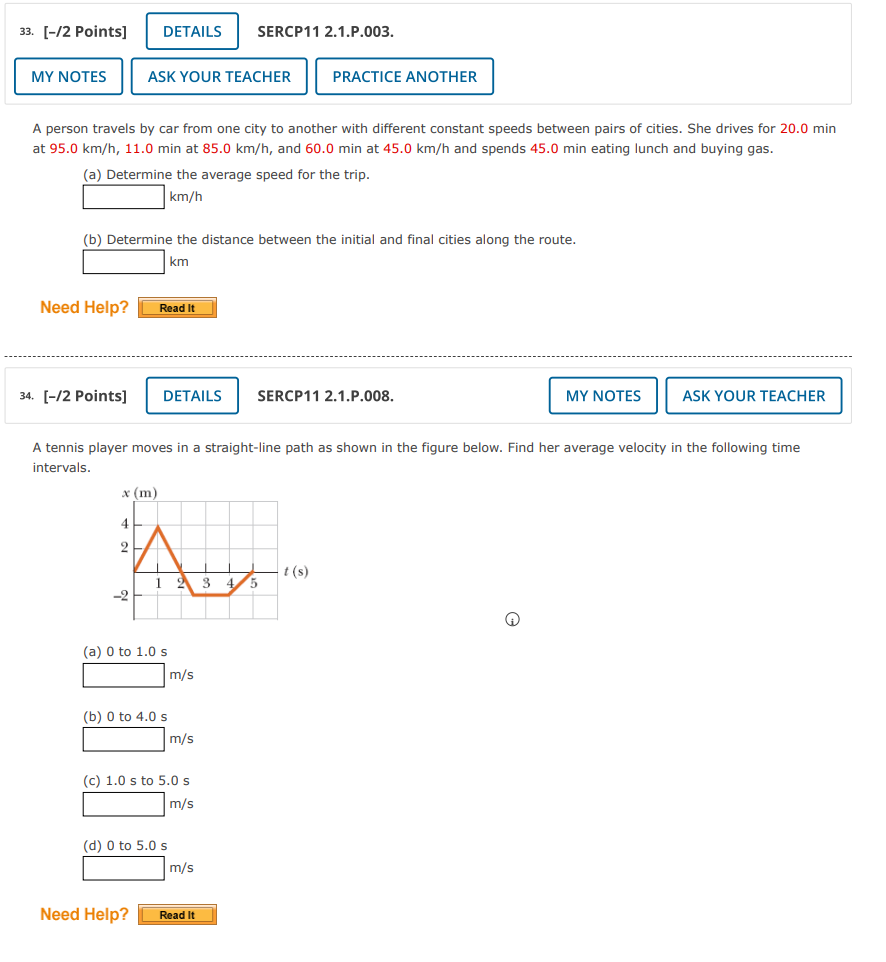
26. [-/2 Points] DETAILS SERCP11 3.2.OP.009. MY NOTES ASK YOUR TEACHER PRACTICE ANOTHER A mountain lion jumps to a height of 3.50 m when leaving the ground at an angle of 43.70. What is its initial speed (in m/s) as it leaves the ground? m/s Need Help? Read It 27. [-/2 Points] DETAILS SERCP11 3.2.OP.015. MY NOTES ASK YOUR TEACHER PRACTICE ANOTHER In a stunt filmed for a movie, a car rolls down an incline and off a vertical cliff, falling into an ocean below. The car starts from rest and rolls down the incline, which makes an angle of 17.0 below the horizontal, with a constant acceleration of 2.75 m/s . After rolling down the incline a distance of 70.0 m, it reaches the edge of the cliff, which is 35.0 m above the ocean. (a) How much time (in s) does it take the car to fall from the edge of the cliff to the landing point? (b) At the point where the car lands in the ocean, how far is it horizontally from the edge of the cliff (in m)? m28. [-/2 Points] DETAILS SERCP11 3.2.OP.018. MY NOTES ASK YOUR TEACHER PRACTICE ANOTHER Water from a fire hose is directed toward a building as shown in the figure below. The water leaves the hose at a speed of v; = 40.0 m/s and at an angle of 0, = 43.0 above the horizontal. The base of the hose (at ground level) is a horizontal distance d = 55.0 m away from the building. Find the height h (in m) where the water strikes the building. m Need Help? Read It 29. [-/2 Points] DETAILS SERCP11 3.1.OP.002. MY NOTES ASK YOUR TEACHER PRACTICE ANOTHER A woman walks 2.80 km south and then 2.00 km east, all in 3.00 hours. (a) What is the magnitude (in km) and direction (in degrees south of east) of her displacement during the given time? magnitude km direction south of east (b) What is the magnitude (in km/h) and direction (in degrees south of east) of her average velocity during the given time? magnitude km/h direction . south of east (c) What was her average speed (in km/h) during the same time interval? km/h Need Help? Read It30. [-/2 Points] DETAILS SERCP11 2.1.OP.001. MY NOTES ASK YOUR TEACHER PRACTICE ANOTHER Nerve impulses in a human body travel at a speed of about 100 m/s. Suppose a man accidentally stubs his toe. About how much time does it take the nerve impulse to travel from the foot to the brain (in s)? Assume the man is 1.90 m tall and the nerve impulse travels at uniform speed. Need Help? Read It 31. [-/2 Points] DETAILS SERCP11 2.1.OP.003. MY NOTES ASK YOUR TEACHER PRACTICE ANOTHER A motorist on a road trip drives a car at different constant speeds over several legs of the trip. He drives for 35.0 min at 50.0 km/h, 15.0 min at 100.0 km/h, and 45.0 min at 40.0 km/h and spends 25.0 min eating lunch and buying gas. (a) What is the total distance traveled over the entire trip (in km)? km (b) What is the average speed for the entire trip (in km/h)? km/h Need Help? Read It32. [-/2 Points] DETAILS SERCP11 2.1.OP.024. MY NOTES ASK YOUR TEACHER PRACTICE ANOTHER The graph below plots velocity vs. time for an object moving along a straight path. u (m/s) 24 18 12 6 0 t(s) -6 6 12 18 24 -12 18 (a) What is the average acceleration of the object during the following time intervals? (Enter your answers in m/s . Indicate the direction with the signs of your answers.) (i) 0 s to 6.00 s m/s 2 (ii) 6.00 s to 18.0 s 1 m/s 2 (iii) 0 s to 24.0 s m/s 2 (b) What is its instantaneous acceleration at each of the following times? (Enter your answers in m/s . Indicate the direction with the signs of your answers.) i) 1.00 s m /s 2 (ii) 12.0 s m/s2 (iii) 21.0 s m /s 2 Need Help? Read It33. [-/2 Points] DETAILS SERCP11 2.1.P.003. MY NOTES ASK YOUR TEACHER PRACTICE ANOTHER A person travels by car from one city to another with different constant speeds between pairs of cities. She drives for 20.0 min at 95.0 km/h, 11.0 min at 85.0 km/h, and 60.0 min at 45.0 km/h and spends 45.0 min eating lunch and buying gas. (a) Determine the average speed for the trip. km/h (b) Determine the distance between the initial and final cities along the route. km Need Help? Read It 34. [-/2 Points] DETAILS SERCP11 2.1.P.008. MY NOTES ASK YOUR TEACHER A tennis player moves in a straight-line path as shown in the figure below. Find her average velocity in the following time intervals. x (m) 9 t (s) 2 3 4 5 -2 (a) 0 to 1.0 s m/s (b) 0 to 4.0 s m/s (c) 1.0 s to 5.0 s m/s (d) 0 to 5.0 s m/s Need Help? Read It35. [-/2 Points] DETAILS SERCP11 2.1.P.011. MY NOTES ASK YOUR TEACHER PRACTICE ANOTHER The cheetah can reach a top speed of 114 km/h (71 mi/h). While chasing its prey in a short sprint, a cheetah starts from rest and runs 49 m in a straight line, reaching a final speed of 90 km/h. (a) Determine the cheetah's average acceleration during the short sprint. m / s 2 (b) Find its displacement at t = 3.0 s. (Assume the cheetah maintains a constant acceleration throughout the sprint.) m Need Help? Read It 36. [-/2 Points] DETAILS SERCP11 1.XP.001. MY NOTES ASK YOUR TEACHER PRACTICE ANOTHER Convert the following numbers to scientific notation. (a) 568,163 7 x 10 (b) 0.000389 x 10 Need Help? Read It 37. [-/2 Points] DETAILS SERCP11 1.XP.004. MY NOTES ASK YOUR TEACHER PRACTICE ANOTHER Find the polar coordinates corresponding to a point located at (-6.06, 11.84) in Cartesian coordinates. Need Help? Read It38. [-/2 Points] DETAILS SERCP11 1.XP.005. MY NOTES ASK YOUR TEACHER PRACTICE ANOTHER At a horizontal distance of 50 m from the bottom of a tree, the angle of elevation to the top of the tree is 340. How tall is the tree? m Need Help? Read It 39. [-/2 Points] DETAILS SERCP11 1.XP.027. MY NOTES ASK YOUR TEACHER Under what circumstances would a vector have components that are equal in magnitude? O The vector lies at a 60 degree angle with two axes along which the component lie. O The vector lies at a 45 degree angle with two axes along which the component lie. O The vector lies at a 30 degree angle with two axes along which the component lie. Need Help? Read It 40. [-/2 Points] DETAILS SERCP11 4.2.P.001. MY NOTES ASK YOUR TEACHER PRACTICE ANOTHER The heaviest invertebrate is the giant squid, which is estimated to have a weight of about 0.28 tons spread out over its length of 32 feet. What is its weight in newtons? Need Help? Read It41. [-/2 Points] DETAILS SERCP11 4.2.P.003. MY NOTES ASK YOUR TEACHER PRACTICE ANOTHER A 6.2 kg object undergoes an acceleration of 1.7 m/s. (a) What is the magnitude of the resultant force acting on it? (b) If this same force is applied to a 3.7 kg object, what acceleration is produced? m/s2 Need Help? Read It 42. [-/2 Points] DETAILS SERCP11 4.2.P.006. MY NOTES ASK YOUR TEACHER PRACTICE ANOTHER A train locomotive pulls a train with a mass of 1.20 x 10' kg on level rails. The locomotive exerts a constant force of 7.90 x 10³ N on the train. How much time does it take to increase the speed of the train from rest to 70.0 km/h? (Ignore any resistance force from the rails on the wheels of the train. Enter your answer in minutes.) min Need Help? Read It43. [-/2 Points] DETAILS SERCP11 4.2.P.012. MY NOTES ASK YOUR TEACHER PRACTICE ANOTHER Two forces are applied to a car in an effort to move it, as shown in the figure below. (Let F1 = 425 N and F2 = 359 N. Assume up and to the right are in the positive directions.) 30 (a) What is the resultant vector of these two forces? magnitude N direction to the right of the forward direction (b) If the car has a mass of 3,000 kg, what acceleration does it have? Ignore friction. m/s Need Help? Read It 44. [-/2 Points] DETAILS SERCP11 4.4.OP.031. MY NOTES ASK YOUR TEACHER PRACTICE ANOTHER The figure below shows a crate with a mass of m = 2.65 kg on a surface inclined at an angle of 35.0. The coefficient of static friction between the crate and the surface is 0.350. Find the minimum magnitude of the force F (in N), applied to the crate in a direction perpendicular to the surface, that will prevent the crate from sliding down the surface. 35.00 IN Need Help? Read It45. [-/2 Points] DETAILS SERCP11 4.5.P.035. MY NOTES ASK YOUR TEACHER PRACTICE ANOTHER Consider the figure below. A (a) Find the tension in each cable supporting the 588-N cat burglar. (Assume the angle ( of the inclined cable is 30.09.) inclined cable horizontal cable vertical cable (b) Suppose the horizontal cable were reattached higher up on the wall. Would the tension in the inclined cable increase, decrease, or stay the same? O increase O decrease O stay the same Need Help? Read It46. [-/2 Points] DETAILS SERCP11 4.6.OP.039. MY NOTES ASK YOUR TEACHER PRACTICE ANOTHER The figure below shows a bird feeder that weighs 111.3 N. The feeder is supported by a vertical cable, which is in turn tied to two cables, each of which is attached to a horizontal post. The left cable makes a 60 angle with the post, while the right cable makes a 309 angle. What is the tension in each cable (in N)? 60 30 Bird food A left cable N right cable N bottom cable N Need Help? Read It 47. [-/2 Points] DETAILS SERCP11 3.A.OP.031. MY NOTES ASK YOUR TEACHER PRACTICE ANOTHER A car in the left lane of a highway is trying to pass a van in the right lane. The front of the car is initially 80.0 m behind the front of the van. The car moves at a constant speed of 60.0 km/h, while the van moves at a constant speed of 30.0 km/h. How long (in s) does it take the car to overtake the van (that is, for the front of the car and the front of the van to be even with each other)? Need Help? Read ItdB [42 Points] _ETAILS SERCP11 SAP. 040 _Y NOTES _K YOURTEACHER _RACTICE ANOTHER A farm truck moves due east with a constant velocity of 3.65 mils on a limitless, horizontal stretch of road. A boy riding on the back of the truck throws a can of soda upward {see figure below} and catches the projectile at the same location on the truck bedr but 10.0 m farther down the road. h i... {I} {a} In the frame of reference of the truck, at what angle to the vertical does the boy throw the can?I |:| {b} What is the initial speed of the can relative to the truck? (c) What is the shape of the can's trajectory as seen by the boy? O a straight line segment upward and then downward O a symmetric section of a parabola opening downward An observer on the ground watches the boy throw the can and catch it. {d} In this observer's frame of reference, describe the shape of the can's path. O a straight line segment upward and then downward O a symmetric section of a parabola opening downward (e) [n this observer*s frame of reference, determine the initial velocity of the can. magnitude :l mils E direction 9 above the horizontal eastward line '9 [-32 Points] _ETAILS SERCP11 3.A.P. 042 _'r' NOTES _5K YOUR TEACHER _RACTICE ANOTHER A ball is thrown straight upward and returns to the thrower's hand after 2.40 s in the air. A second ball thrown at an angle of 36.0\" with the horizontal reaches the same maximum height as the first ball. (a) At what speed was the first ball thrown? {b} At what speed was the second ball thrown? . Need Help? so [42 Points] DETAILS SERCP11 BAP. 045. A quarterback throws a football toward a receiver with an initial speed of 21 mfs at an angle of 3D\" above the horizontal. At that instant the receiver is 13.1 m from the quarterback. (a) In what direction should the receiver run in order to catch the football at the level at which it was thrown? O The receiver should run in the direction opposite to that in which the football is travelling. CI The receiver should run in the direction the football is traveling. {b} With what constant speed should the receiver run in order to catch the football at the level at which it was thrown? Need Help
Step by Step Solution
There are 3 Steps involved in it

Get step-by-step solutions from verified subject matter experts
 Study Help