







Question: Hi can I please get some help with this question? A monopoly faces the demand function Q = 30 p. Its inverse demand function is
Hi can I please get some help with this question?
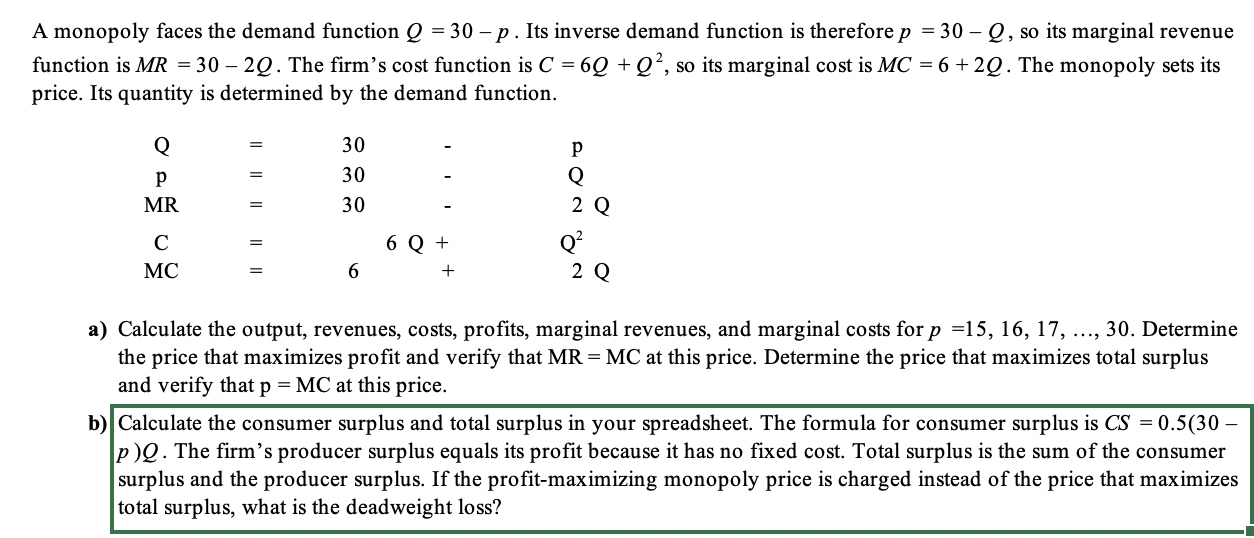
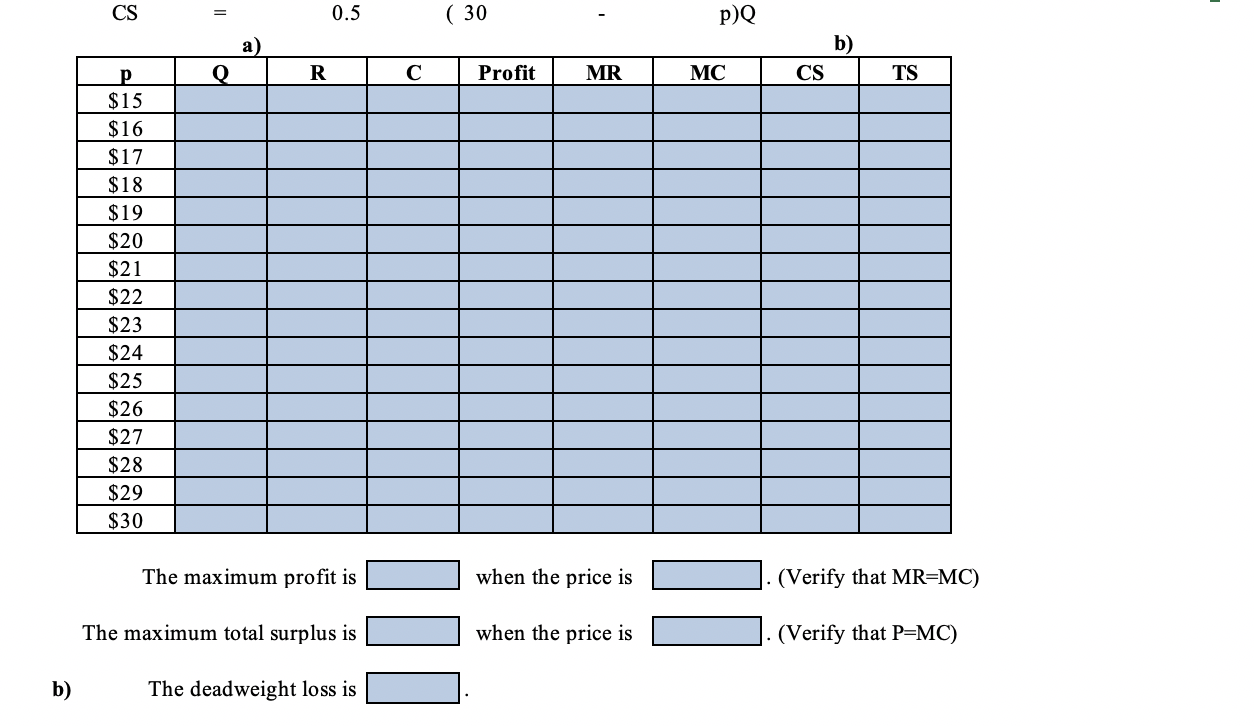
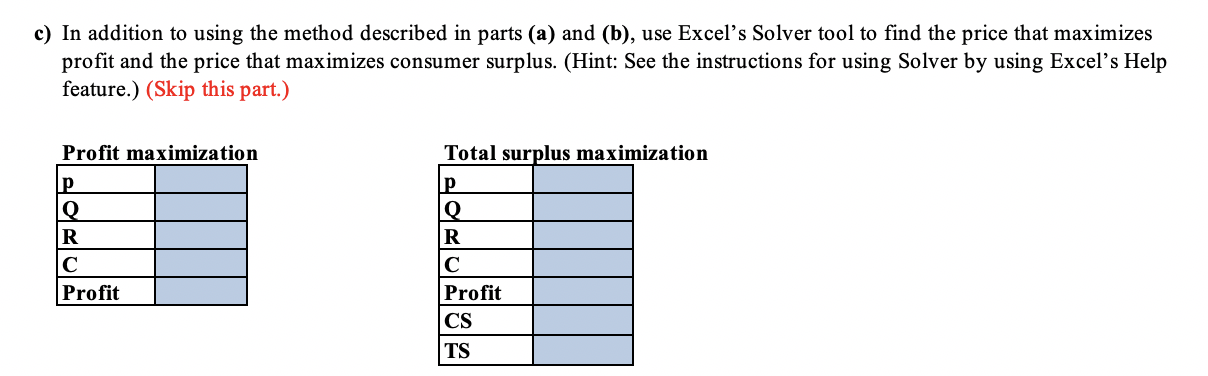
A monopoly faces the demand function Q = 30 p. Its inverse demand function is therefore p = 30 Q , so its marginal revenue function is MR = 30 2Q. The firm's cost function is C = 6Q + Q2, so its marginal cost is MC = 6 + 2Q. The monopoly sets its price. Its quantity is determined by the demand function. 0 = 30 - p P = 30 - Q MR = 30 2 Q C = 6 Q + Q2 MC = 6 + 2 Q :1) Calculate the output, revenues, costs, prots, marginal revenues, and marginal costs for ,0 =15, 16, 17, ..., 30. Determine the price that maximizes prot and verify that MR = MC at this price. Determine the price that maximizes total surplus and verify that p = MC at this price. b) Calculate the consumer surplus and total surplus in your spreadsheet. The formula for consumer surplus is CS = 0.5(30 , p )Q. The rm's producer surplus equals its prot because it has no xed cost. Total surplus is the sum of the consumer surplus and the producer surplus. If the profitmaximizing monopoly price is charged instead of the price that maximizes total surplus, what is the deadweight loss? CS = 0.5 ( 30 P)Q a) b) P O R CI Profit MR MC CS TS $15 $16 $17 $18 $19 $20 $21 $22 $23 $24 $25 $26 $27 $28 $29 $30 The maximum profit is when the price is ( Verify that MR=MC) The maximum total surplus is when the price is (Verify that P=MC) b) The deadweight loss ise) In addition to using the method described in parts (a) and (b), use Excel's Solver too] to nd the price that maximizes prot and the price that maximizes consumer surplus. (Hint: See the instructions for using Solver by using Excel's Help feature.) (Skip this part.) Prot maximization Ills maximization
Step by Step Solution
There are 3 Steps involved in it

Get step-by-step solutions from verified subject matter experts
 Study Help