







Question: Hi can you please help me answer this? Differential Equation The electrostatic potential in a rectangular area with no charge is gov- erned by the
Hi can you please help me answer this?
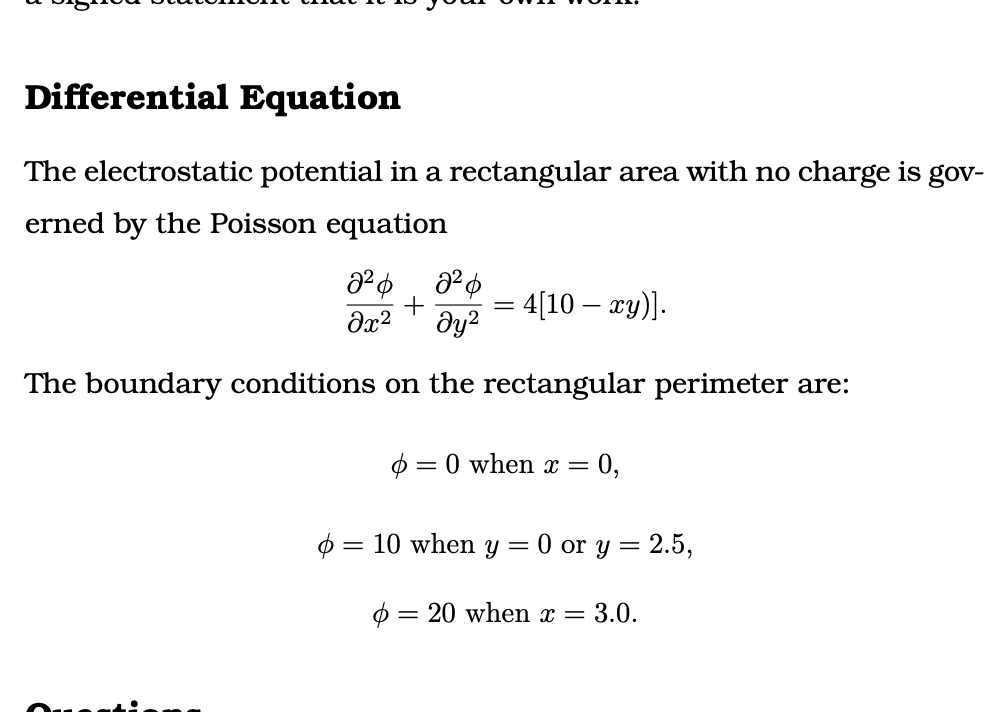
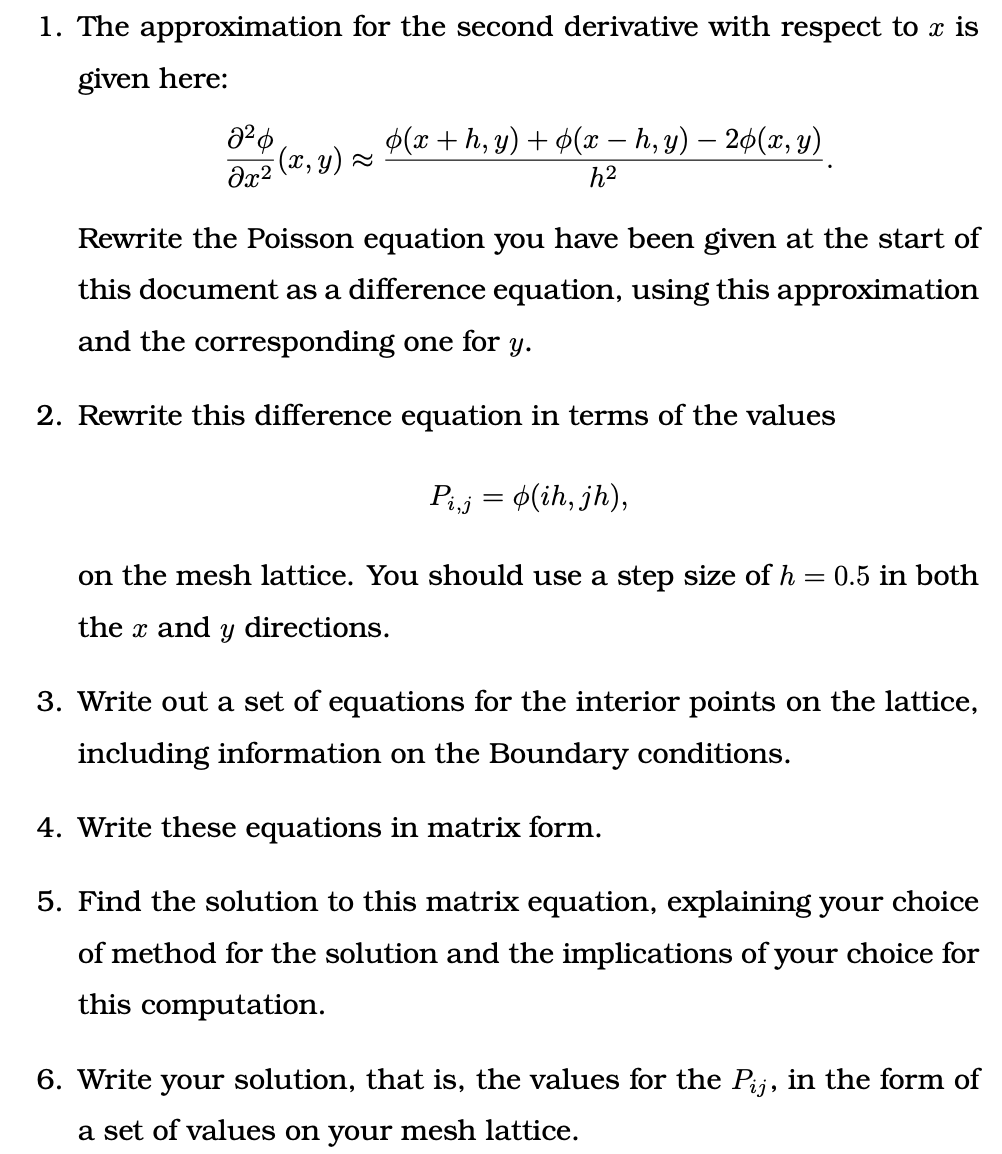
Differential Equation The electrostatic potential in a rectangular area with no charge is gov- erned by the Poisson equation + ay 2 =4[10 - xy)]. The boundary conditions on the rectangular perimeter are: p = 0 when x = 0, = 10 when y = 0 or y = 2.5, ( = 20 when x = 3.0.1. The approximation for the second derivative with respect to a: is given here: 32 (M56 + ha y) + (25(1): h, :9) 2m, y) w(ma y) m hz Rewrite the Poisson equation you have been given at the start of this document as a difference equation, using this approximation and the corresponding one for y. 2. Rewrite this difference equation in terms of the values a, = Wham, on the mesh lattice. You should use a step size of h = 0.5 in both the :3 and y directions. 3. Write out a set of equations for the interior points on the lattice, including information on the Boundary conditions. 4. Write these equations in matrix form. 5. Find the solution to this matrix equation, explaining your choice of method for the solution and the implications of your choice for this computation. 6. Write your solution, that is, the values for the Bj, in the form of a set of values on your mesh lattice
Step by Step Solution
There are 3 Steps involved in it

Get step-by-step solutions from verified subject matter experts
 Study Help